Facts
The applicant’s father, an employee of BSNL, died in harness on 12.10.2005.
Source reference: p. 2The applicant claimed to have applied for compassionate appointment in 2009.
Source reference: p. 2, 5His case was considered by the Circle Relaxation Committee (CRC) under the 2014 Policy/Circular, where he was awarded 61 points.
Source reference: p. 3His name was placed on the waiting list in three successive reviews (2016, 2017, and 2018) but was ultimately rejected via order dated 06.10.2018.
Source reference: p. 3The applicant challenged this rejection, contending his case should have been governed by the O.M. dated 09.10.1998, which was prevalent at the time of his application.
Source reference: p. 2-3Issues
1. Whether the applicant's claim for compassionate appointment should be governed by the policy prevalent at the time of the employee's death/application (1998 O.M.) or the policy at the time of consideration (2014 Circular).
Source reference: p. 2-32. Whether the lapse of 14 years since the death of the breadwinner renders the claim for compassionate appointment unsustainable.
Source reference: p. 8-9Law Applied
The principles of compassionate appointment as a non-vested right intended for immediate financial relief, rather than a standard mode of recruitment.
Source reference: no citationThe State of Madhya Pradesh v. Ashish Awasthi regarding the applicability of policies.
Source reference: p. 2State of Himachal Pradesh v. Parkash Chand regarding the governance of such claims by specific government policies.
Source reference: p. 3-4Umesh Kumar Nagpal v. State of Haryana, which established that compassionate appointment is only for families in "indigent circumstances" to "tide over sudden crisis".
Source reference: p. 7-8State of J&K v. Sajad Ahmed Mir, which held that survival of the family over a long period negates the need for such appointment.
Source reference: p. 8-9Reasoning
The Tribunal found that while the applicant sought consideration under the 1998 O.M., Clause 8 of that specific O.M. emphasizes that compassionate appointment is for "immediate assistance" and that survival over several years is "adequate proof" of dependable means of subsistence.
Source reference: p. 5The court noted that the applicant failed to provide documentary evidence of his 2009 application.
Source reference: p. 5The Tribunal observed that the respondents had followed due process by reviewing the case thrice between 2016 and 2018 under the points-based system.
Source reference: p. 3, 6Applying the Umesh Kumar Nagpal "litmus test," the court reasoned that because the family survived from 2005 to 2019, the "emergency" or "financial destitution" required to justify bypassing Article 14 (equality of opportunity in public employment) no longer existed.
Source reference: p. 7-9The scope of judicial review was deemed limited as there was no procedural infirmity in the CRC's evaluation.
Source reference: p. 6Holding
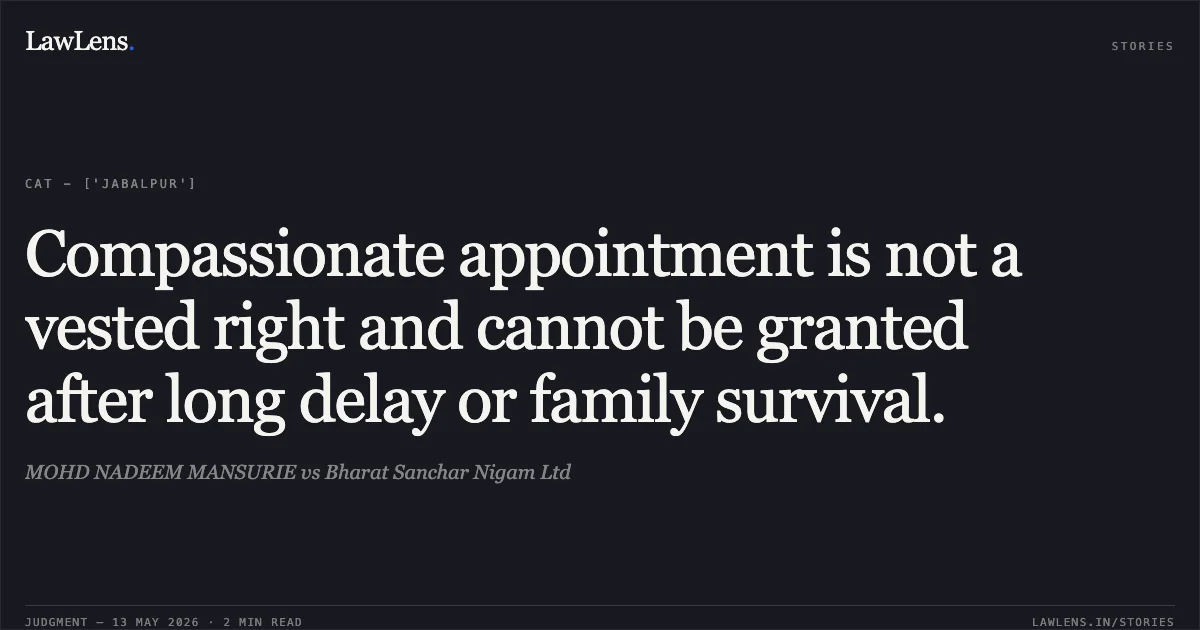
The Tribunal answered that the applicant had no vested right to appointment after a lapse of significant time and that the respondents committed no illegality in their evaluation.
The Tribunal held that compassionate appointment cannot be granted after a lapse of 14 years when the family has managed to survive.
Source reference: p. 9The Original Application (O.A. No. 762/2019) was dismissed as devoid of merit. No costs were ordered.
Source reference: p. 9Acts & Sections Cited
1 provisions across 1 statute referred to in this judgment. Linked provisions open on LawLens.
Customs (Fees for Rendering Services by Customs Officers) Regulations, 19981
Original Court PDF
MOHD NADEEM MANSURIEvsBharat Sanchar Nigam Ltd
Click to open original judgment
Original judgment, available to read, download and summarize on LawLens.in