Facts
The applicant’s father, a Telephone Mechanic at BSNL, died in a train accident on March 13, 2013
Source reference: p. 2The applicant sought compassionate appointment via multiple applications between 2013 and 2017
Source reference: p. 2His claim was initially rejected on February 9, 2016, on the grounds that he secured only 20 marks out of 100 in the 2014 committee meeting
Source reference: p. 2After a previous round of litigation (OA No. 202/223/2017), the Tribunal directed the respondents to decide on his appeal
Source reference: p. 3Upon reconsideration by a High Power Committee on October 17, 2017, the applicant's marks were increased to 43 based on weightage for dependents and pension
Source reference: p. 4, 6However, this remained below the qualifying benchmark of 55 points; consequently, his claim was rejected via order dated December 20, 2017
Source reference: p. 6The applicant challenged this rejection, alleging irregularities in the marking system and vacancy calculations
Source reference: p. 2Issues
1. Whether the rejection of the applicant’s claim for compassionate appointment was legally sustainable given that his score (43) was below the prescribed benchmark (55)
Source reference: p. 62. Whether the present application is barred by the principles of res judicata and the law of limitation
Source reference: p. 7Law Applied
The court applied the BSNL Policy dated June 27, 2007, which utilizes a "Weightage Point System" to assess indigence, requiring a minimum of 55 points for consideration
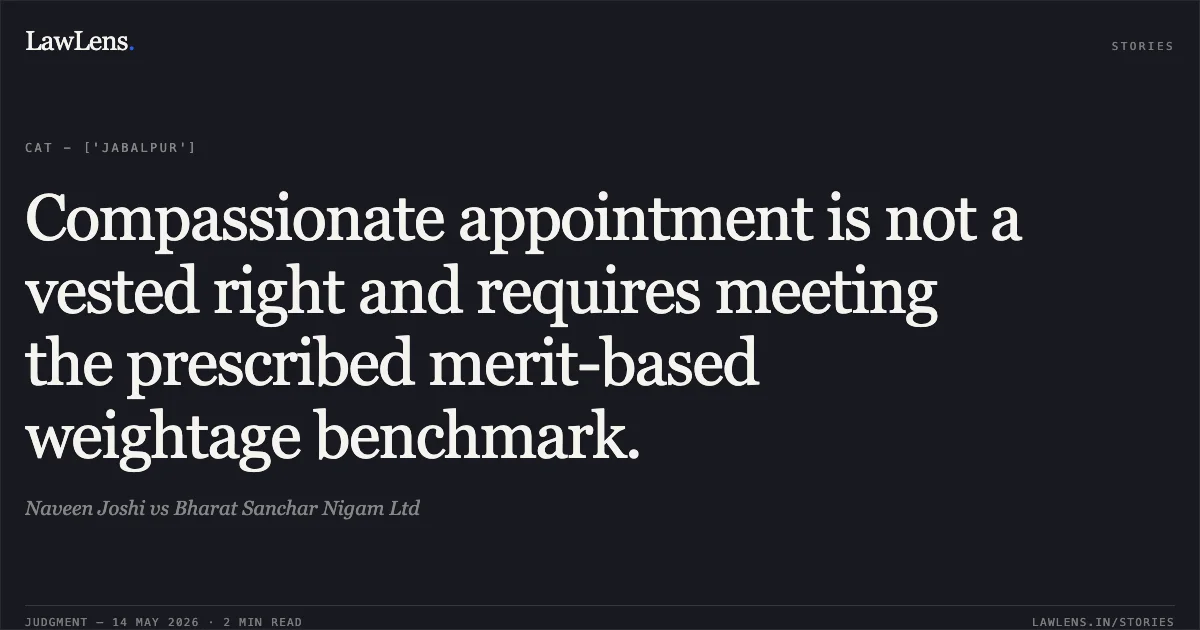
Source reference: p. 6It relied on the precedent from Maneet Singh v. State of Madhya Pradesh (2018), establishing that compassionate appointment is a mode to salvage a family from "instant financial penury" rather than a vested right or privilege
Source reference: p. 6Further, it cited Steel Authority of India Ltd. v. Madhusudan Das (2008) and State of Gujarat v. Arvind Kumar T. Tiwari (2012), affirming that such appointments must strictly adhere to administrative rules and financial assessments
Source reference: p. 7-8Finally, it applied the doctrine of res judicata to prevent re-litigation of the same cause of action
Source reference: p. 7Reasoning
The Tribunal found that the High Power Committee had properly re-evaluated the applicant's case, even increasing his marks from 20 to 43 after considering dependent data and terminal benefits
Source reference: p. 4, 6However, as the score remained below the mandatory benchmark of 55, the applicant was correctly classified as "non-indigent" under the BSNL policy
Source reference: p. 6The court noted that the family had received terminal benefits exceeding Rs. 11 lakhs and a monthly pension of Rs. 15,091, mitigating the immediate financial crisis
Source reference: p. 4Regarding procedure, the Tribunal observed that the applicant was attempting to re-agitate issues already settled in a previous OA, thereby violating res judicata
Source reference: p. 7Additionally, the application was filed with a five-month delay without a formal condonation request, making it barred by limitation
Source reference: p. 7Holding
The Tribunal held that the applicant had no legal right to compassionate appointment as he failed to meet the objective criteria (55-point benchmark) set by the department
The court answered in the negative regarding the applicant's entitlement, holding that compassionate appointment cannot be granted after a long lapse of time or in the absence of immediate penury
Source reference: p. 8The Original Application was dismissed on both merits and procedural grounds (limitation and res judicata)
Source reference: p. 7-8No costs were awarded
Source reference: p. 8Acts & Sections Cited
2 provisions across 2 statutes referred to in this judgment. Each provision opens on LawLens.
Administrative Tribunals Act, 19851
Code of Civil Procedure, 19081
Original Court PDF
Naveen JoshivsBharat Sanchar Nigam Ltd
Click to open original judgment
Original judgment, available to read, download and summarize on LawLens.in