Facts
The appellant’s father, a Personal Assistant in the State Insurance and Provident Fund Department, suffered a brain stroke on April 1, 2023, resulting in "Hemiplegia" (paralysis) and 75% permanent disability.
Source reference: para. 1The appellant sought compassionate appointment under the Rajasthan Compassionate Appointment of Dependents of Permanent Total Disabled Government Servants Rules, 2023 ("Rules of 2023").
Source reference: no citationThe Single Bench ruled in favor of the appellant regarding age eligibility but did not grant the appointment based on the nature of the disability.
Source reference: para. 3The appellant challenged this before the Division Bench, arguing that a medical condition arising from work-related stress should be interpreted as an "accident" under welfare legislation.
Source reference: para. 4Issues
1. Whether an employee suffering from paralysis (Hemiplegia) resulting in 75% disability qualifies as having suffered a "Permanent Total Disability" due to an "accident while on duty" as defined under Rules 2(b) and 2(f) of the Rules of 2023.
Source reference: para. 6, 11Law Applied
Rule 2(b) defines a "Permanent Total Disabled Government Servant" as one who suffers permanent total disability due to an accident while on duty.
Source reference: para. 6Rule 2(f) provides an exhaustive—not inclusive—definition of "Permanent Total Disability," listing eight specific categories of injuries, including loss of limbs, total blindness, absolute deafness, mental infirmity, and specific occupational accidents in hazardous sectors like sewerage or mining.
Source reference: para. 6, 8The court also addressed the "Golden Rule of Interpretation," holding that while beneficial legislation should be interpreted liberally, it cannot override the plain, exhaustive language of a statute.
Source reference: para. 8.2Reasoning
The court reasoned that the Legislature consciously restricted the benefit of compassionate appointment to disabilities arising "solely and directly" from accidents while on duty.
Source reference: para. 7, 8It observed that Rule 2(f) does not use expansive language like "includes" or "residuary clauses," meaning the eight listed categories are exhaustive.
Source reference: para. 8The court noted that these categories cover catastrophic physical injuries or hazards inherent to specific jobs, and Hemiplegia (paralysis) caused by a stroke is not listed.
Source reference: para. 8.1, 11The court rejected the appellant's reliance on Pitambar Das Manikpuri v. NTPC, stating that a general definition of "accident" from other contexts cannot override the specific statutory constraints of the Rules of 2023.
Source reference: para. 9Even if a stroke were considered an "accident," the resulting condition must still fit one of the eight categories in Rule 2(f) to qualify, which it does not.
Source reference: para. 11Holding
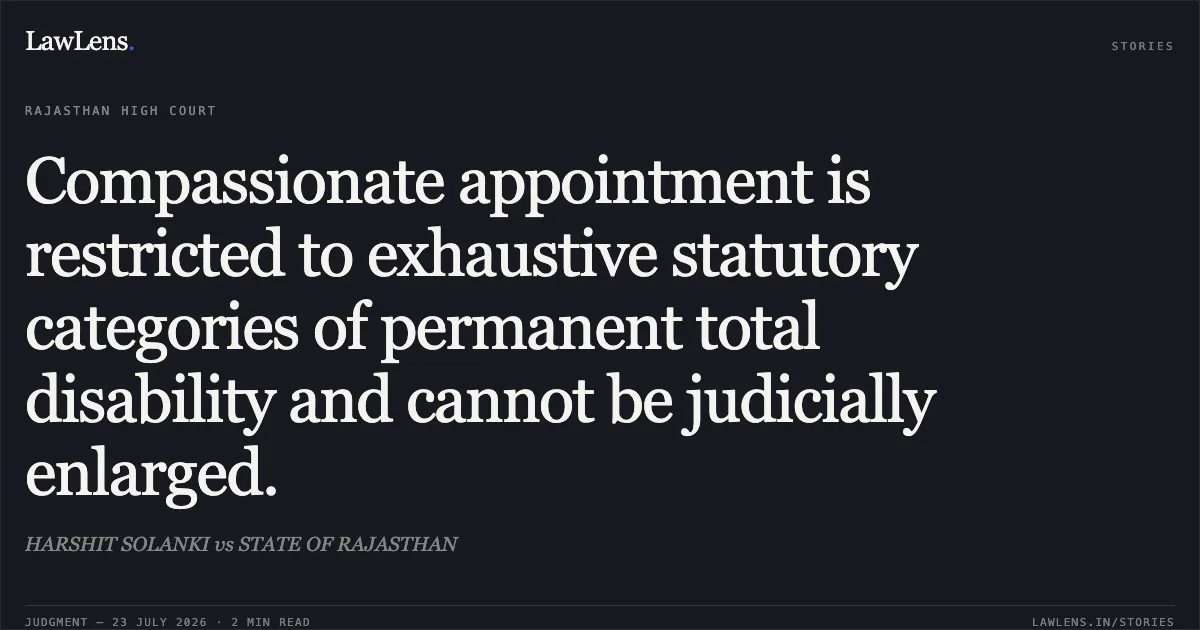
The court answered the issue in the negative, holding that compassionate appointment is a statutory concession, not a right, and must strictly adhere to the prescribed Rules.
Since the appellant's father's condition (paralysis) does not fall within the exhaustive list under Rule 2(f), the appellant is ineligible for compassionate appointment. The Division Bench upheld the Single Bench's order and dismissed the appeal.
Source reference: para. 11, 12, 13Original Court PDF
HARSHIT SOLANKIvsSTATE OF RAJASTHAN
Click to open original judgment
Original judgment, available to read, download and summarize on LawLens.in


