Facts
The respondent’s father purchased land in Survey Nos. 14 and 16 of Bommuru Agrahara Village; the land was later converted to non-agricultural use.
Source reference: p. 3–5In connection with widening and formation of the Bengaluru–Mysuru Highway, land was acquired under the Land Acquisition Act, 1894. Although an award was made and compensation was deposited in the Assistant Commissioner’s bank account, it was neither paid to the respondent nor deposited in court.
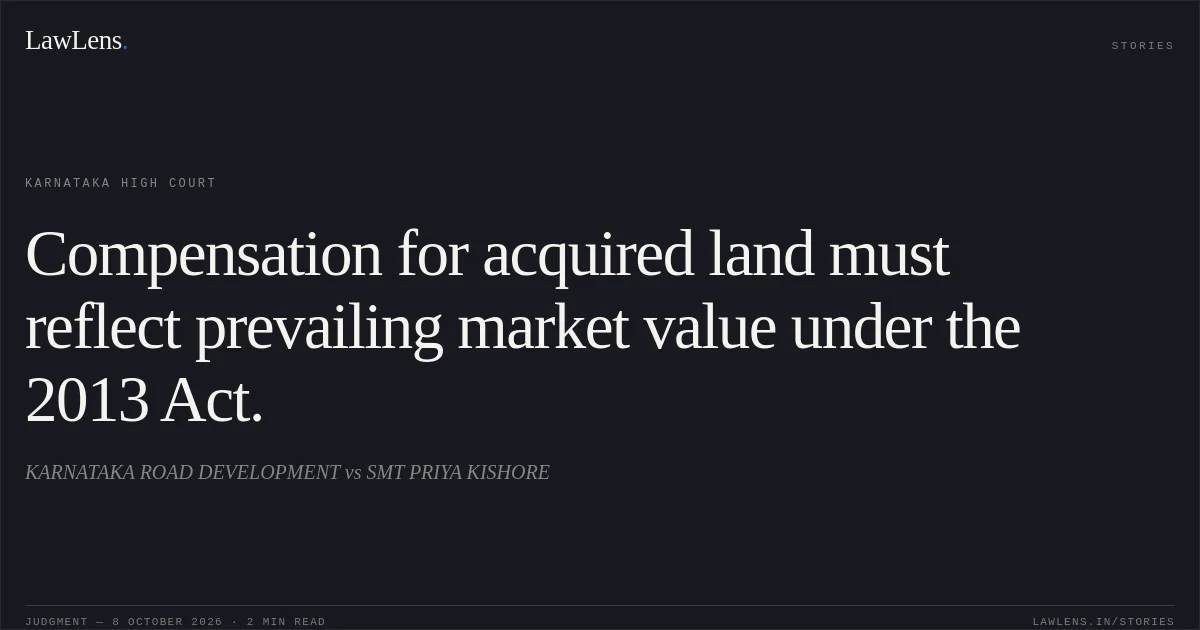
Source reference: p. 3–5The respondent sought acquisition and compensation for 27 guntas in Survey No. 16 under the Right to Fair Compensation and Transparency in Land Acquisition, Rehabilitation and Resettlement Act, 2013 (“2013 Act”).
Source reference: p. 5–6The writ court rejected her claim that the acquisition had lapsed under Section 24(2), but directed determination and payment of compensation under Sections 26–30 of the 2013 Act. The Corporation appealed.
Source reference: p. 5–6Issues
1. Whether the acquisition had lapsed under Section 24(2) of the 2013 Act
Source reference: p. 5–62. Whether depositing compensation with the Assistant Commissioner/Special Land Acquisition Officer, without payment to the landowner or deposit in court, amounted to payment
Source reference: p. 5–63. Whether the writ court was correct to direct compensation to be determined and paid under Sections 26–30 of the 2013 Act for the land utilized for the highway project
Source reference: p. 6–7Law Applied
Section 24(2) of the 2013 Act governs when pre-existing acquisition proceedings may be deemed to have lapsed; the writ court rejected lapse on the facts of this case.
Source reference: p. 5–6Section 31 of the Land Acquisition Act, 1894 addresses payment or deposit of compensation.
Source reference: p. 6–7Article 300A of the Constitution protects against deprivation of property except by authority of law, and the Court held that acquisition without payment of compensation is invalid and violates Articles 14 and 300A.
Source reference: p. 6–7Sections 26–30 of the 2013 Act provide the basis for determining compensation, including statutory components; the Court relied on Bernard Francies Joseph Vaz v. Government of Karnataka, 2025 SCC OnLine SC 20.
Source reference: p. 6Reasoning
The Court found that compensation for the respondent’s land had neither been paid nor deposited in court, notwithstanding its deposit in the Assistant Commissioner’s bank account.
Source reference: p. 6In light of the constitutional requirement that compensation accompany the State’s exercise of eminent domain, the Court upheld the direction to determine and pay compensation by applying Sections 26–30 of the 2013 Act and the cited Supreme Court decision.
Source reference: p. 6–7It found no error in the writ court’s order.
Source reference: p. 7Holding
The acquisition was not declared lapsed under Section 24(2).
The appeal was dismissed and the writ court’s order affirmed.
Source reference: p. 5–7The Corporation was required to determine and pay compensation for the land utilized for the highway project in accordance with Sections 26–30 of the 2013 Act, including the applicable statutory components.
Source reference: p. 5–7Acts & Sections Cited
7 provisions across 2 statutes referred to in this judgment. Each provision opens on LawLens.
KARNATAKA HIGH COURT ACT, 19611
Right to Fair Compensation and Transparency in Land Acquisition, Rehabilitation and Resettlement Act, 20136
Original Court PDF
KARNATAKA ROAD DEVELOPMENTvsSMT PRIYA KISHORE
Click to open original judgment
Original judgment, available to read, download and summarize on LawLens.in