Facts
The seven petitioners (including legal heirs of deceased employees) were originally daily wage employees of the Water Resource Department whose services were subsequently regularized.
Source reference: p. 5They approached the High Court seeking the removal of service anomalies and the grant of pay scales as prescribed in a Gazette Notification dated 14.10.1982.
Source reference: p. 3-4The petitioners relied on a previous decision of a Coordinate Bench in Dwarikadas Vaishnav & another v. State of Madhya Pradesh (now Chhattisgarh) (WPS No. 2904 of 2005).
Source reference: p. 5The State maintained that it had previously considered such issues based on precedents from the State Administrative Tribunal, Gwalior Bench, but expressed willingness to review fresh representations.
Source reference: p. 5-6Issues
1. Whether the petitioners are entitled to a revision of their pay scale in accordance with the Gazette Notification dated 14.10.1982 issued by the State of Madhya Pradesh.
Source reference: p. 4 / para. 1(ii)2. Whether the court should direct the respondent authorities to consider the petitioners’ grievances in light of the liberty granted in similar matters like Bhojram Nayak v. State of Chhattisgarh.
Source reference: p. 4 / para. 1(iii)Law Applied
The Court's directions were predicated on the administrative application of the Gazette Notification dated 14.10.1982 (as modified) issued by the State of Madhya Pradesh regarding pay scales for regularized employees.
Source reference: p. 5The court also relied on the principle of parity and judicial consistency, citing the precedent set in Dwarikadas Vaishnav & another v. State of Madhya Pradesh (now Chhattisgarh).
Source reference: p. 5The guidelines established in Laxmi Narayan Upadhyay v. State of M.P. by the State Administrative Tribunal.
Source reference: p. 5Reasoning
The Court did not adjudicate on the merits of the pay scale entitlement but focused on the procedural right of the petitioners to have their claims evaluated by the competent authority.
Source reference: p. 6By observing that the petitioners' situation was "similarly situated" in fact and law to the batch of petitions led by Dwarikadas Vaishnav, the Court applied the same logic of granting liberty to file a representation rather than issuing a writ of mandamus for immediate payment.
Source reference: p. 5The Court took note of the State’s submission that if a fresh representation were filed, they would consider it specifically in light of the 1982 Notification, thereby bridging the gap between the petitioners' demand and the administrative review process.
Source reference: p. 6Holding
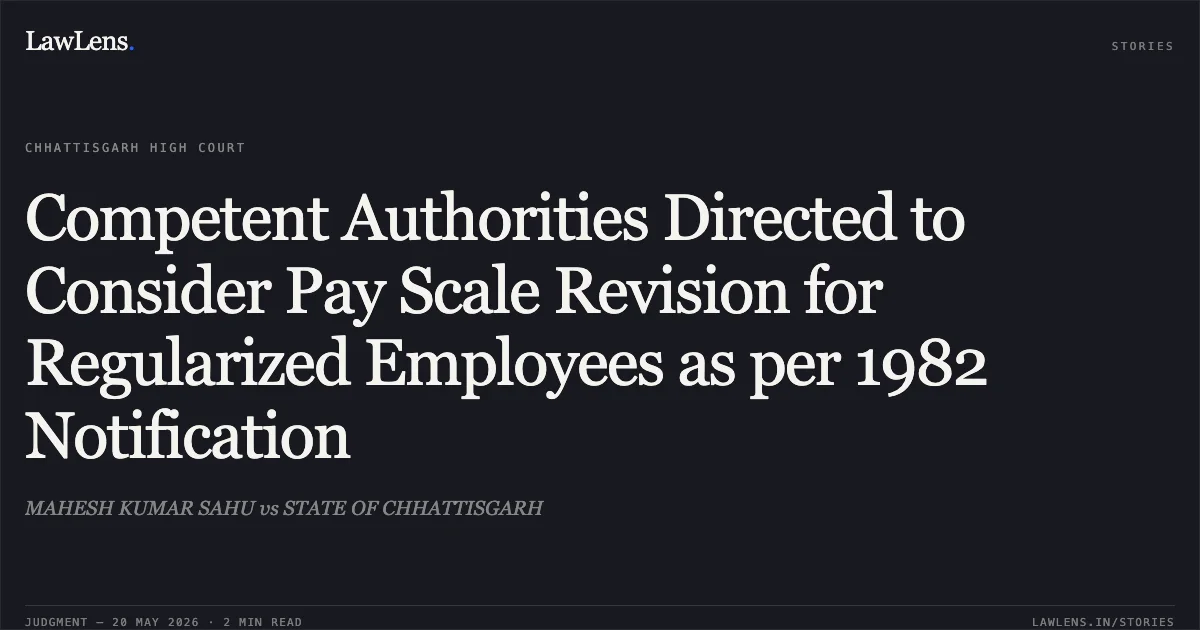
The High Court disposed of the writ petition without a final adjudication on the merits of the pay scale. It held that the petitioners are entitled to a formal consideration of their grievances by the State.
The Court directed that if the petitioners file a fresh representation before the competent authority, said authority must consider and decide the matter in light of the Notification dated 14.10.1982. The order mandates the disposal of such representation expeditiously, preferably within six months from the date of receipt of the certified copy of the order.
Source reference: p. 6Original Court PDF
MAHESH KUMAR SAHUvsSTATE OF CHHATTISGARH
Click to open original judgment
Original judgment, available to read, download and summarize on LawLens.in