Facts
The petitioners were contractual Office Messengers appointed under the Poshan Abhiyan and were receiving a monthly honorarium of ₹8,000.
Source reference: p. 2They sought enhancement to ₹32,500, relying on General Administration Department Letter No. 15582 dated 22 August 2025, Directorate of Consolidation Memo No. 348 dated 13 April 2026—under which similarly situated contractual office attendants were allegedly granted ₹32,500 with effect from 1 July 2025—and Labour Resources Department Letter No. 47 dated 1 April 2026 concerning minimum wages.
Source reference: p. 2The petitioners alleged discrimination and violation of Articles 14, 16, 21 and 23 of the Constitution, invoking the principle of equal pay for equal work.
Source reference: p. 2They had submitted representations to the concerned authorities, including the Additional Chief Secretary, Social Welfare Department, but no decision had been taken.
Source reference: p. 2The writ petition was thereafter filed seeking enhancement of honorarium.
Source reference: pp. 2–3With the consent of the parties, the High Court proceeded to dispose of the petition at the admission stage.
Source reference: p. 1Issues
Whether the petitioners’ claim for enhancement of their monthly honorarium from ₹8,000 to ₹32,500, on the basis of parity with similarly situated contractual employees and the applicable government communications, warranted consideration by the competent authority.
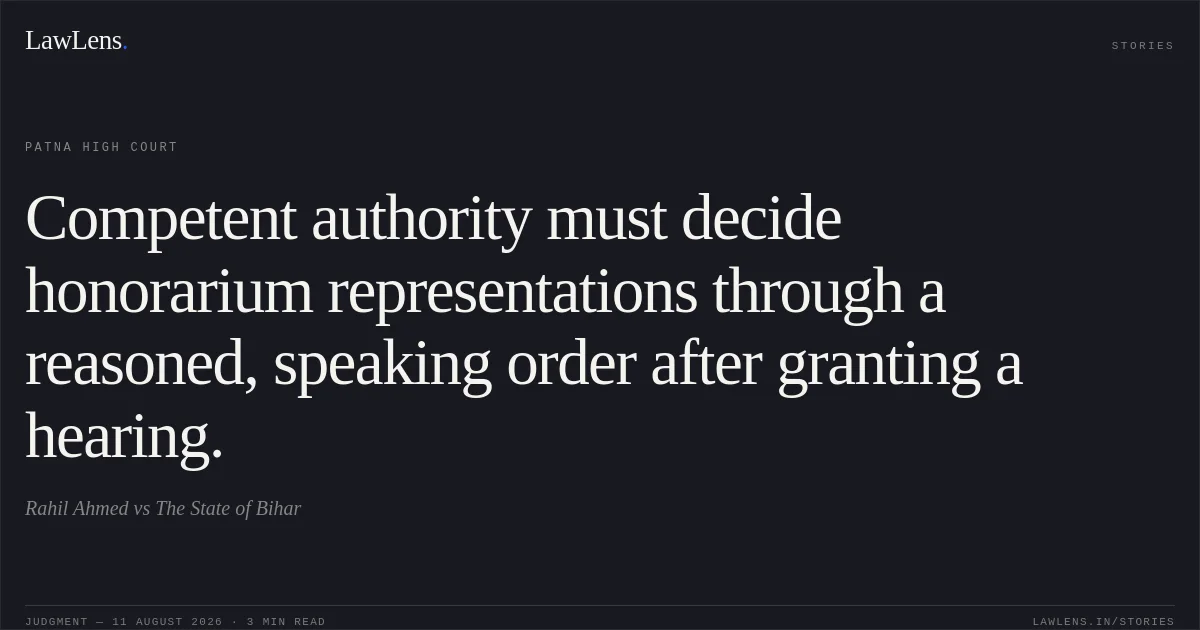
Source reference: pp. 2–3Whether the respondents were required to decide the petitioners’ representations through a reasoned and speaking order after granting them an opportunity of hearing.
Source reference: p. 3Law Applied
The Court considered the constitutional guarantees under Articles 14, 16, 21 and 23, including the principle of “equal pay for equal work” relied upon by the petitioners.
Source reference: p. 2The petitioners relied on People’s Union for Democratic Rights v. Union of India, (1982) 3 SCC 235, concerning the constitutional significance of payment of minimum wages, and State of Punjab v. Jagjit Singh, (2017) 1 SCC 148, concerning equal pay for equal work for employees performing duties comparable to those of regular employees.
Source reference: p. 2The Court also directed consideration of the General Administration Department’s Letter No. 15582 dated 22 August 2025, the Directorate of Consolidation Memo No. 348 dated 13 April 2026, and the Labour Resources Department’s minimum-wage communication dated 1 April 2026.
Source reference: p. 2Reasoning
The Court did not adjudicate the petitioners’ substantive entitlement to ₹32,500 or conclusively determine whether the principle of equal pay for equal work applied.
Source reference: pp. 2–3Instead, it noted that the petitioners had already raised their claim before the departmental authorities and that the claim was based on specific government communications, alleged parity with similarly situated contractual employees, and constitutional and precedential grounds.
Source reference: pp. 2–3To ensure an authoritative determination by the competent authority, the Court required each petitioner to submit an individual representation with supporting documents and the judgments relied upon.
Source reference: p. 3It further mandated that the Director, ICDS Directorate, consider the representations within a prescribed period, after granting an opportunity of hearing, and issue a reasoned and speaking order.
Source reference: p. 3Holding
The writ petition was disposed of without a decision on the merits.
The petitioners were directed to file individual representations before the Director, ICDS Directorate, Department of Social Welfare, Bihar, within four weeks, accompanied by all supporting documents and relied-upon judgments.
Source reference: p. 3If filed within time, the Director was directed to decide them within eight weeks of receipt, after granting an opportunity of hearing and by passing a reasoned and speaking order.
Source reference: p. 3If the Director found the petitioners entitled to the claimed relief, the benefit was to be extended within a further four weeks from the date of the final order.
Source reference: p. 3Original Court PDF
Rahil AhmedvsThe State of Bihar
Click to open original judgment
Original judgment, available to read, download and summarize on LawLens.in