Facts
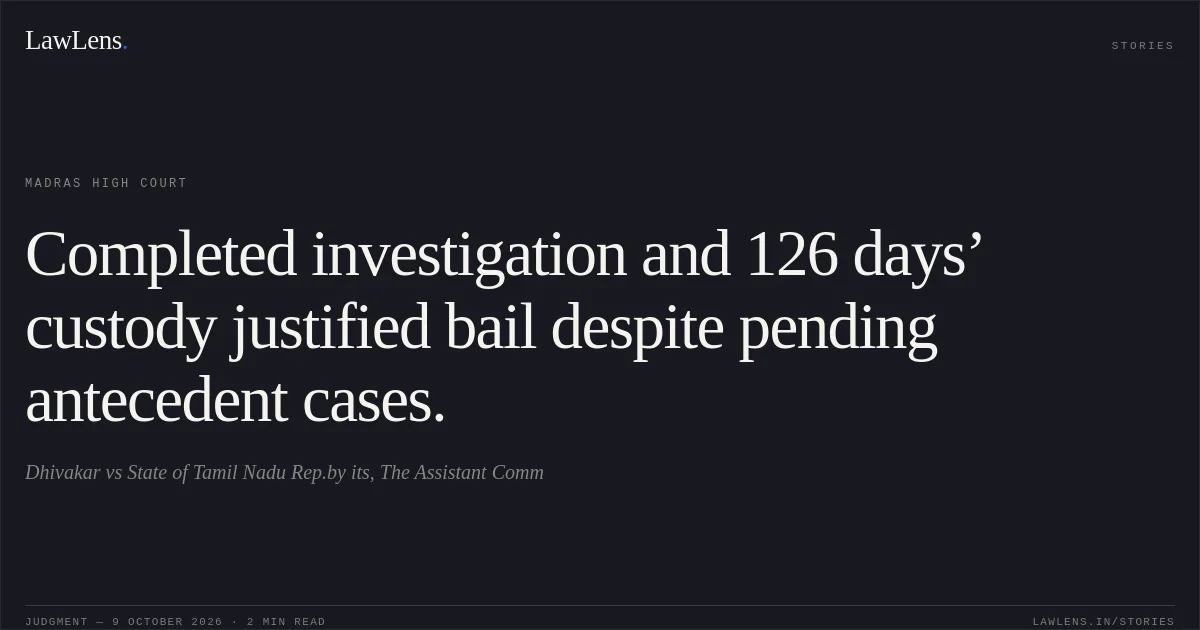
The appellant, arrayed as A2, challenged the Sessions Court’s dismissal of his bail application in a case alleging that he attacked the victim with a knife and humiliated the de facto complainant on account of caste
Source reference: p. 2; para. 2He submitted that he had been in custody for more than 126 days, the investigation was complete, and the final report had been filed
Source reference: p. 3; para. 3The respondents opposed bail, citing the alleged overt act and three previous cases; one of those cases had resulted in acquittal, while two remained pending trial
Source reference: pp. 3–4; paras. 4, 6The High Court heard the appeal under Section 14A(2) of the SC/ST Act against the order dated 08.09.2026
Source reference: p. 2Issues
Whether the dismissal of the appellant’s bail application should be set aside and bail granted, given his period in custody, completion of the investigation, and the pending trial
Source reference: pp. 3–6; paras. 3–7Law Applied
The appeal was brought under Section 14A(2) of the Scheduled Castes and Scheduled Tribes (Prevention of Atrocities) Act
Source reference: p. 2In considering bail, the Court relied on the circumstances that the appellant had been in custody for 126 days, the investigation was complete, and the case was pending trial
Source reference: p. 4; para. 6It also referred to P.K. Shaji v. State of Kerala, [(2005) AIR SCW 5560], for the proposition that, upon breach of bail conditions, the trial court may take appropriate action as if it had itself imposed those conditions and granted bail
Source reference: p. 5; condition (viii)The order further stated that absconding could result in a fresh FIR under Section 229A IPC
Source reference: p. 5; condition (ix)Reasoning
The Court considered the seriousness of the allegations and the respondents’ objection based on the appellant’s alleged prior cases, but noted that one prior case had ended in acquittal and only two were pending trial
Source reference: p. 4; para. 6Since the investigation was complete, the final report had been filed, and the trial remained pending, the Court concluded that continued custody was not required for the purposes of the trial
Source reference: p. 4; para. 6It granted bail subject to conditions addressing attendance, non-interference with witnesses or evidence, non-commission of similar offences, and the safety of the de facto complainant
Source reference: pp. 4–5; para. 6Holding
The Court allowed the appeal and set aside the Sessions Court’s order dismissing bail
It directed the appellant’s release on a bond of ₹25,000 with two sureties for the like sum, subject to the stated conditions, including appearance before the trial court every Monday at 10:30 a.m. and on all hearing dates
Source reference: pp. 4–5; para. 6The police were directed to ensure the de facto complainant’s safety, and the order specified consequences for breach of conditions or absconding
Source reference: p. 5; para. 6Acts & Sections Cited
2 provisions across 2 statutes referred to in this judgment. Linked provisions open on LawLens.
Scheduled Castes and the Scheduled Tribes (Prevention of Atrocities) Act, 19891
Indian Penal Code, 18601
Original Court PDF
DhivakarvsState of Tamil Nadu Rep.by its, The Assistant Comm
Click to open original judgment
Original judgment, available to read, download and summarize on LawLens.in