Facts
The prosecution alleged that on 6 July 2026, the appellant obstructed the minor victim while she was returning from agricultural work, attempted to touch and pull her, threatened her against reporting the incident, and abused her by referring to her caste.
Source reference: pp. 3–4The victim later informed her father, who lodged a complaint the next day, leading to registration of Crime No. 121/2026.
Source reference: pp. 3–4The appellant was arrested on 7 July 2026 and charged under Sections 78(2), 352, 351(2) and 3(5) of the Bharatiya Nyaya Sanhita, 2023; Sections 8 and 12 of the POCSO Act, 2012; and Sections 3(1)(r), 3(1)(s) and 3(2)(v-a) of the SC/ST (Prevention of Atrocities) Act, 1989.
Source reference: pp. 2–3After the Sessions Court rejected his bail application on 25 July 2026, he appealed under Section 14A(2) of the SC/ST Act, read with Section 483 of the BNSS.
Source reference: pp. 4–6By the time of the appeal, the charge-sheet had been filed, the appellant had been in custody for nearly two months, and the other accused had been granted bail.
Source reference: pp. 4–6, 8Issues
Whether the appellant had made out sufficient grounds to set aside the Sessions Court’s order refusing bail and to be released on bail.
Source reference: p. 6, para. 16Law Applied
The appeal was brought under Section 14A(2) of the SC/ST (Prevention of Atrocities) Act, read with Section 483 of the BNSS.
Source reference: pp. 1–2In deciding bail, the Court treated the seriousness and nature of the accusations, period of custody, completion of investigation and filing of the charge-sheet, risk of interference with witnesses or evidence, and the overall circumstances—including parity with co-accused—as relevant considerations.
Source reference: pp. 8–9, paras. 21–23The Court cited no precedents and did not set out a separate statutory test for the charged offences.
Source reference: no citationReasoning
The Court acknowledged the seriousness of allegations involving a minor and the need to protect the victim, but considered those factors alongside the appellant’s custody of nearly two months, completion of the investigation, and filing of the charge-sheet, which meant further custodial interrogation was not considered necessary.
Source reference: pp. 7–9, paras. 19–22It also considered that the other accused had been released on bail, while noting that parity must be assessed with regard to each accused’s role and the circumstances of the case.
Source reference: p. 8, para. 21On the overall circumstances, the Court found continued detention unwarranted, subject to conditions protecting the prosecution case and ensuring the appellant’s attendance.
Source reference: p. 9, para. 23Holding
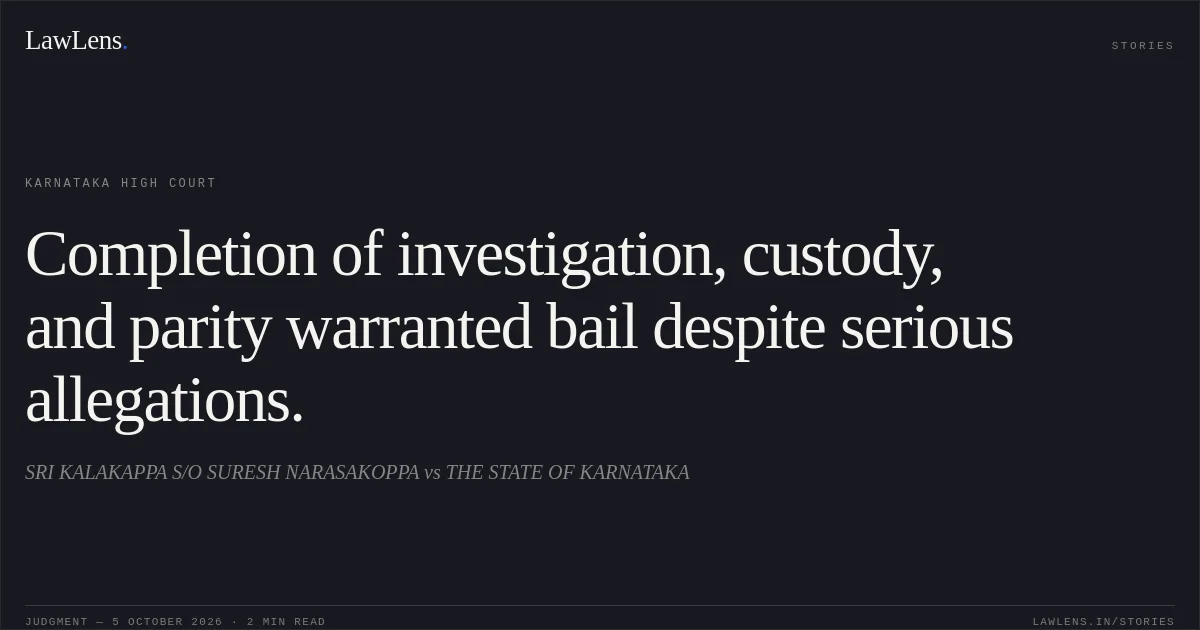
The Court answered the issue in the affirmative, allowed the appeal, and set aside the order rejecting bail.
It directed the appellant’s release on bail upon execution of a personal bond of ₹1,00,000 with two sureties for the like sum, subject to conditions including non-interference with witnesses or evidence, regular appearance before the Trial Court, and restrictions on leaving its jurisdiction without permission.
Source reference: pp. 10–12The Court clarified that its observations were confined to the bail appeal and would not affect the trial on the merits.
Source reference: pp. 9–10, para. 24; p. 12Acts & Sections Cited
8 provisions across 4 statutes referred to in this judgment. Each provision opens on LawLens.
Scheduled Castes and the Scheduled Tribes (Prevention of Atrocities) Act, 19891
Bharatiya Nagarik Suraksha Sanhita, 20231
Bharatiya Nyaya Sanhita, 20234
Protection of Children from Sexual Offences Act, 20122
Original Court PDF
SRI KALAKAPPA S/O SURESH NARASAKOPPAvsTHE STATE OF KARNATAKA
Click to open original judgment
Original judgment, available to read, download and summarize on LawLens.in