Facts
The Appellants were employed by Respondent No. 1 (Kirloskar Oil Engines Ltd) through a sequence of appointments: initially as trainees for one year, then as temporary workers for six months, and finally placed on probation for six months
Source reference: para. 2(i)-(iv), 15Upon completion of the six-month probation period, the Respondent terminated their services via letters (or oral communication) stating their employment ended by efflux of time/completion of probation
Source reference: para. 2, 22The Appellants filed complaints under Section 28 of the MRTU & PULP Act, alleging unfair labour practices
Source reference: para. 2(v)The Labour Court ruled in favor of the Appellants, holding that Model Standing Order 4A prescribes a maximum probation of three months, making the six-month contract illegal and the termination an unfair labor practice
Source reference: para. 18, 27However, the Industrial Court in revision reversed this, holding the termination fell under Section 2(oo)(bb) of the ID Act
Source reference: para. 20The Single Judge of the High Court dismissed the subsequent Writ Petition
Source reference: para. 1Issues
1. Whether the termination of the Appellants' services upon the expiry of the contractual probation period amounted to an unfair labour practice under Items 1(b) and (f) of Schedule IV of the MRTU & PULP Act
Source reference: para. 8, 162. Whether Clause 4A of Schedule-I of the Model Standing Orders (prescribing a 3-month probation) results in "deemed confirmation" of a probationer in the absence of a written order of permanency
Source reference: para. 9, 11, 133. Whether Rule 32 of the Model Standing Orders allows a contract of service with a longer probation period to prevail over Clause 4A
Source reference: para. 9, 12Law Applied
Clause 4A of Schedule-I of the Bombay Industrial Employment (Standing Orders) Rules, 1959 (Model Standing Orders), which requires a probationer to be made permanent by "an order in writing" within seven days of completing three months of service, provided the manager may terminate services if performance is unsatisfactory
Source reference: para. 9-11Rule 32 of the same Orders, which stipulates that the Standing Orders shall not operate to the prejudice of any right under a contract of service
Source reference: para. 9, 12Doctrine of "deemed confirmation," as clarified in Supreme Court precedents of Durgabai Deshmukh Memorial Senior Secondary School v. J.A.J. Vasu Sena and High Court of M.P. v. Satyanarayan Jhavar, establishing that if a rule requires a specific act (like an order in writing) for confirmation, mere continuation in service beyond the probation period does not result in automatic permanency
Source reference: para. 21, 25Reasoning
The Court reasoned that Clause 4A must be read holistically; it imposes a duty on the manager to issue an "order in writing" to make a probationer permanent, which implies a necessitated assessment of performance
Source reference: para. 10-11The second proviso of Clause 4A expressly preserved the employer's right to terminate a probationer whose services are found unsatisfactory
Source reference: para. 11The Court held that Row 32 ensures the most beneficial provision (between the contract and Standing Orders) applies to the worker, but it does not dispense with the requirement of a formal act of confirmation
Source reference: para. 12-13The appointment letters specifically stated that confirmation would only be granted via a "separate letter" if performance was satisfactory; otherwise, employment would end upon the expiry of the probation
Source reference: para. 22Since no such written confirmation was ever issued, the Appellants remained probationers
Source reference: para. 23, 26The Court distinguished Raymond Uco Denim Pvt. Ltd. v. Praful Warade, noting that in that case, the employer had actually confirmed the employees, whereas here, the Respondent consistently treated the relationship as ending upon the expiry of the probation period
Source reference: para. 27-28Holding
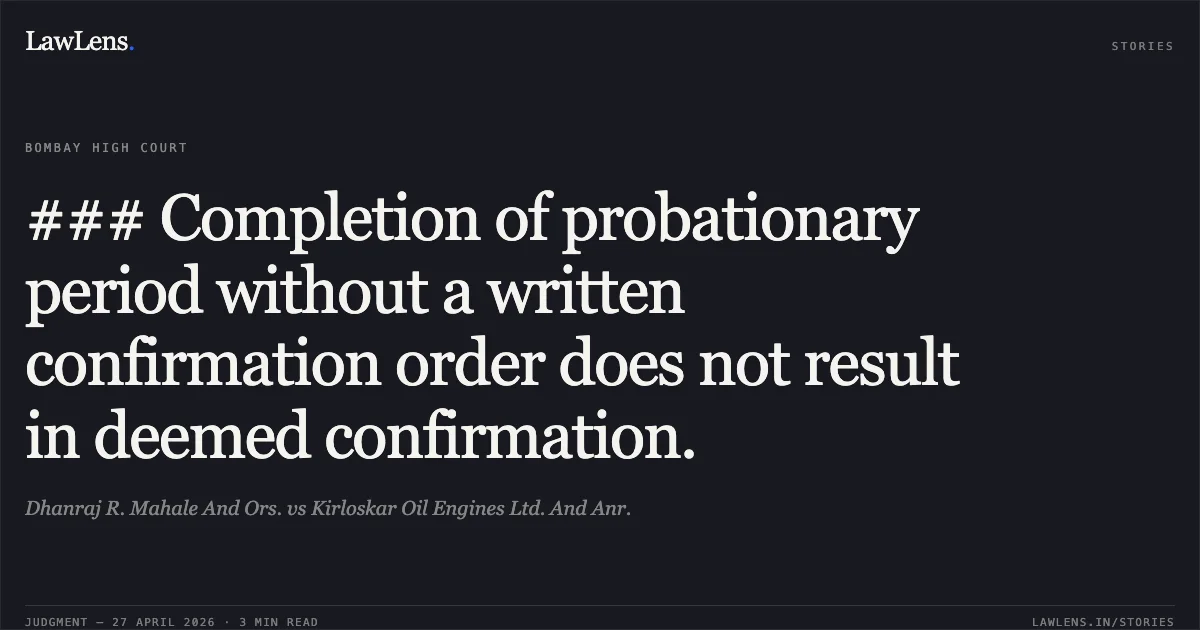
The Court dismissed the appeal, holding that completion of the three-month period under Model Standing Order 4A does not result in automatic or "deemed" confirmation in the absence of a written order by the employer
The termination of the Appellants upon the expiry of their contractual probation did not constitute an unfair labour practice, as they had no vested right to permanency without a formal confirmation letter; The Court affirmed the Industrial Court’s decision to set aside the Labour Court's order for reinstatement and back wages
Source reference: para. 32Acts & Sections Cited
4 provisions across 1 statute referred to in this judgment. Each provision opens on LawLens.
Maharashtra Recognition of Trade Unions and Prevention of Unfair Labour Practices Act, 19714
Original Court PDF
Dhanraj R. Mahale And Ors.vsKirloskar Oil Engines Ltd. And Anr.
Click to open original judgment
Original judgment, available to read, download and summarize on LawLens.in