Facts
The ten accused were public servants in the District Family Welfare and Health Department, Jagdalpur, between 1979 and 1985.
Source reference: para. 4The primary accused (A1), the then Chief Medical and Health Officer (CMHO), allegedly employed three sweepers as domestic help at his residence and, after they left service, conspired with the appellants (subordinate accountants and clerks) to prepare false salary bills totaling ₹42,040.35.
Source reference: para. 4It was alleged that forged thumb impressions were used to withdraw these funds.
Source reference: para. 4Following a trial, the Special Judge convicted the appellants under Sections 420, 467, 468, and 471 read with 120-B of the IPC, and Section 13(1)(d) of the Prevention of Corruption (PC) Act, 1988.
Source reference: p. 3The appellants challenged the conviction on the grounds that they merely followed the administrative orders of A1 and derived no personal pecuniary benefit.
Source reference: para. 8Issues
1. Whether the prosecution proved beyond reasonable doubt that the appellants, in furtherance of a criminal conspiracy, committed cheating and forgery under the IPC.
Source reference: para. 112. Whether the subordinate officials could be held liable for criminal misconduct under Section 13(1)(d) of the PC Act for acts performed under the directions of a superior officer.
Source reference: para. 11 / para. 30Law Applied
The court applied Sections 420 (cheating), 467, 468, 471 (forgery), and 120-B (criminal conspiracy) of the IPC, alongside Section 13(1)(d) of the PC Act, 1988, which requires proof of "pecuniary advantage" obtained by corrupt or illegal means or by abusing a public position.
Source reference: para. 12, 32It relied on Sharanappa v. State of Karnataka, establishing that subordinates discharging duties based on superior reports without independent roles lack criminal liability.
Source reference: para. 29The court further applied principles from C.K. Jaffer Sharief v. State, emphasizing that "dishonest intention" (mens rea) is the gist of an offence under Section 13(1)(d).
Source reference: para. 32Surendra Kumar v. State of U.P., holding that conspiracy must be inferred from solid evidence, not mere suspicion.
Source reference: para. 34Reasoning
The Court observed that the entire salary disbursement process was dominated and directed by A1 (CMHO).
Source reference: para. 13Testimonies from the cashier (PW-17) and clerk (PW-18) confirmed that salary bills were prepared and payments made strictly under A1's oral and written instructions.
Source reference: para. 13, 14, 23Crucially, the Investigating Officer (PW-29) admitted that the appellants were subordinate officials duty-bound to comply with A1’s directions.
Source reference: para. 25Regarding the forgery charges, the prosecution failed to produce expert fingerprint evidence to prove the thumb impressions were fabricated, as the specialist's report was inconclusive.
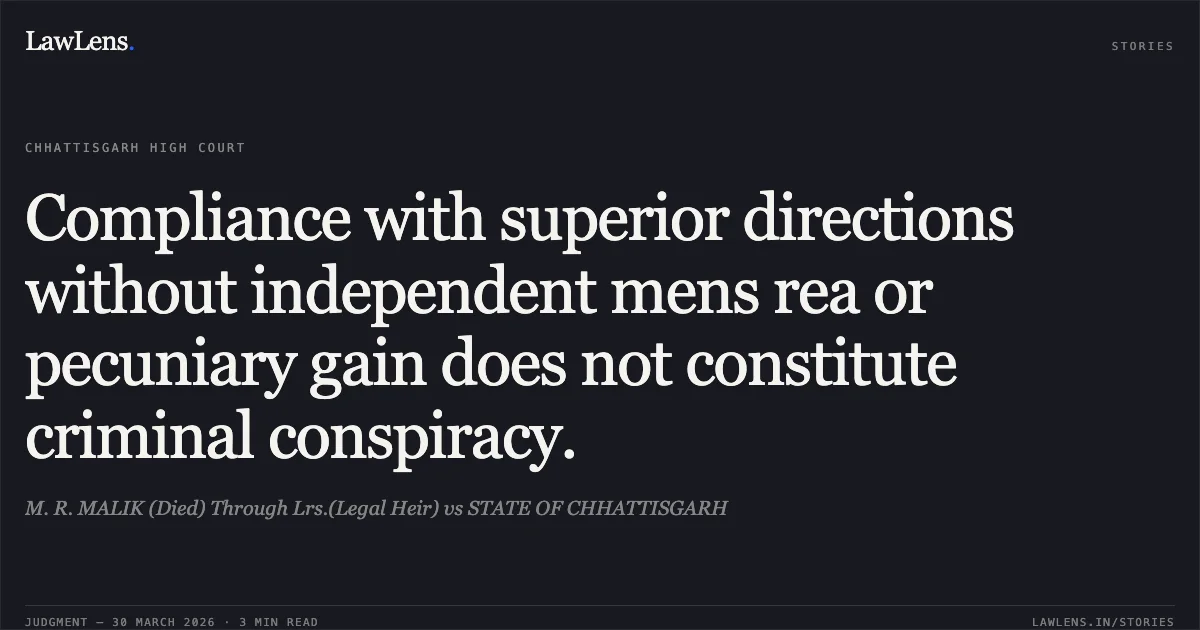
Source reference: para. 21, 28Furthermore, no evidence was led to show the appellants obtained any "pecuniary advantage" or acted with "mens rea"; they performed routine official work in a hierarchical setup.
Source reference: para. 30, 36The court noted that while procedural irregularities existed, "suspicion, howsoever strong, cannot take the place of legal proof".
Source reference: para. 37Holding
The High Court allowed the appeal and set aside the conviction and sentence of the appellants.
The Court held that the prosecution failed to establish a "meeting of minds" for conspiracy under Section 120-B IPC or the essential ingredients of forgery and cheating.
Source reference: para. 35, 38It specifically ruled that criminal misconduct under Section 13(1)(d) of the PC Act was not proved as there was no evidence of personal pecuniary gain or dishonest intention by the subordinate staff.
Source reference: para. 30, 31The appellants were acquitted of all charges, and their bail bonds were discharged.
Source reference: para. 40, 41Acts & Sections Cited
13 provisions across 4 statutes referred to in this judgment. Each provision opens on LawLens.
Indian Penal Code, 18607
Prevention of Corruption Act, 19882
Code of Criminal Procedure, 19733
Bharatiya Nagarik Suraksha Sanhita, 20231
Original Court PDF
M. R. MALIK (Died) Through Lrs.(Legal Heir)vsSTATE OF CHHATTISGARH
Click to open original judgment
Original judgment, available to read, download and summarize on LawLens.in


