Facts
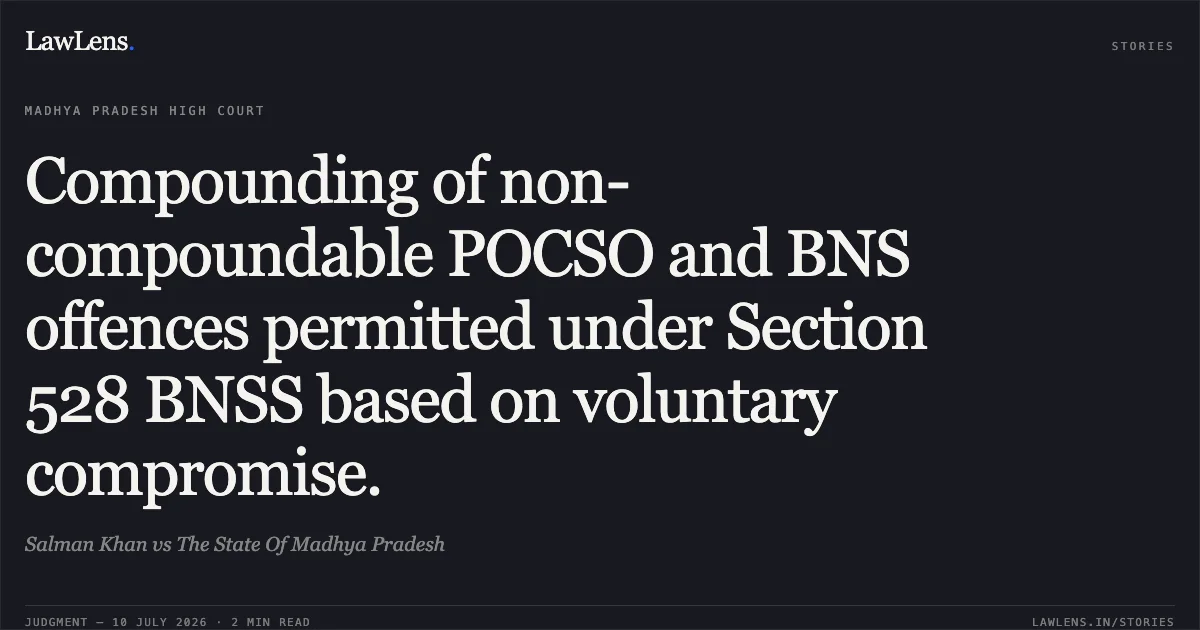
The petitioner filed a petition under Section 528 of the Bhartiya Nagarik Suraksha Sanhita (BNSS) to quash an FIR and subsequent proceedings involving allegations under Sections 137(2) and 70(2) of the BNS, as well as Sections 5(g)/6 of the POCSO Act.
Source reference: para. 1The parties reached a voluntary settlement, expressing an intent to marry once the prosecutrix reaches the age of majority.
Source reference: para. 2, 4The Principal Registrar verified the compromise, confirming it was reached without coercion.
Source reference: para. 3Issues
Whether criminal proceedings involving non-compoundable offenses under the BNS and POCSO Act can be quashed by the High Court on the basis of a compromise between the parties to prevent an abuse of the process of law.
Source reference: para. 1, 10Law Applied
The court applied Section 528 of the BNSS (equivalent to Section 482 of the Cr.P.C.) regarding the inherent powers of the High Court to quash proceedings.
Source reference: para. 1, 10Supreme Court precedents, including Gian Singh v. State of Punjab and Narinder Singh v. State of Punjab, establish that even in non-compoundable cases, proceedings may be quashed to save judicial time and preserve social harmony when a settlement is reached.
Source reference: para. 9The court also emphasized the principle that a "lean compromise" is preferable to protracted litigation.
Source reference: para. 8Reasoning
The court reasoned that since the parties had voluntarily entered into a compromise with the intent to settle their personal lives, continuing the criminal trial would be a "futile exercise".
Source reference: para. 10By perusing the verification report from the Principal Registrar, the court satisfied itself that the settlement was genuine and not the result of threat or inducement.
Source reference: para. 3It determined that the "bonhomie" created by the settlement should be preserved to save the resources of the judiciary and achieve substantial justice, concluding that no fruitful purpose would be served by a trial where a conviction is unlikely due to the victims' cooperation with the accused.
Source reference: para. 10, 11Holding
The court allowed the petition and quashed the FIR (Crime No. 542/2024) and all consequential proceedings (Case No. 203/2024) specifically against the petitioner.
The court clarified that the trial would proceed independently against any remaining co-accused without being influenced by this order. The applications for compounding were formally allowed, and the case was disposed of.
Source reference: para. 11, 13, 14Acts & Sections Cited
6 provisions across 4 statutes referred to in this judgment. Each provision opens on LawLens.
Bharatiya Nagarik Suraksha Sanhita, 20231
Bharatiya Nyaya Sanhita, 20232
Code of Criminal Procedure, 19731
Original Court PDF
Salman KhanvsThe State Of Madhya Pradesh
Click to open original judgment
Original judgment, available to read, download and summarize on LawLens.in