Facts
The appellants were convicted by the 1st ADJ, Araria, in Sessions Trial No. 338 of 2007 for an incident occurring on September 4, 2005.
Source reference: p. 1-2Following a land dispute regarding the placement of jute sticks, the appellants allegedly assaulted the informant and his nephews with lathis and a sword, causing grievous injuries.
Source reference: p. 2-3The trial court sentenced Appellant No. 1 to 7 years R.I. under Sections 307 and 326 IPC, and Appellants No. 2 and 3 to 5 years R.I. under Section 307 IPC, along with other concurrent minor sentences.
Source reference: p. 1-2During the pendency of this appeal, the parties entered into an amicable settlement to maintain harmony.
Source reference: p. 3-4Issues
1. Whether a conviction for non-compoundable offences, specifically Section 307 IPC, can be modified or set aside based on a compromise between the parties during an appeal.
Source reference: para 72. Whether the ends of justice require the reduction of the sentence to the period already undergone in light of the settlement.
Source reference: para 8, 11Law Applied
The Court primarily considered Section 307 (Attempt to murder), Section 326 (Voluntarily causing grievous hurt by dangerous weapons), and Section 320 of the CrPC regarding the compounding of offences.
Source reference: p. 1, 4It relied heavily on the precedent of Ram Gopal and Anr. vs State of Madhya Pradesh (2022) 14 SCC 531, which establishes that while High Courts cannot technically "compound" non-compoundable offences under Section 320 CrPC, they may invoke inherent powers under Section 482 CrPC (or appellate powers) to quash proceedings or modify sentences in private/family disputes where a settlement advances peace and the offense is not "heinous" or against society at large.
Source reference: para 9Reasoning
The Court observed that while Section 307 IPC is non-compoundable, the dispute originated from a private land matter rather than a threat to public order.
Source reference: para 8The Court reasoned that because a considerable amount of time (nearly 21 years) had passed since the occurrence and the parties had mutually resolved their differences without coercion, maintaining the full sentence would serve no useful purpose.
Source reference: para 10Integrating the principles from Ram Gopal, the Court found that the settlement would foster cordiality between the neighbors and that the conduct of the parties justified a "quietus" to the litigation.
Source reference: para 10-11Holding
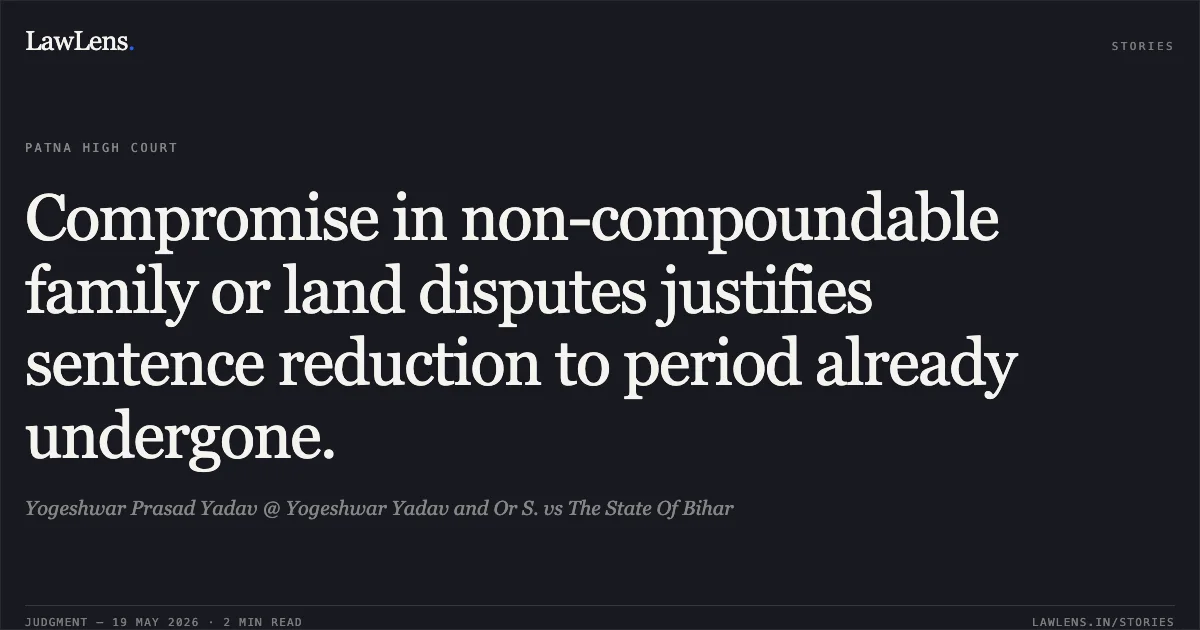
The Court affirmed the conviction but modified the order of sentence. It held that the ends of justice were met by reducing the substantive term of imprisonment to the period already undergone by the appellants.
However, the sentence of fine imposed by the trial court was affirmed; the appellants were directed to deposit the fine within four weeks if not already done. The appeal was partly allowed.
Source reference: para 11-12Acts & Sections Cited
10 provisions across 2 statutes referred to in this judgment. Each provision opens on LawLens.
Code of Criminal Procedure, 19734
Indian Penal Code, 18606
Original Court PDF
Yogeshwar Prasad Yadav @ Yogeshwar Yadav and Or S.vsThe State Of Bihar
Click to open original judgment
Original judgment, available to read, download and summarize on LawLens.in