Facts
The petitioner was appointed as a Salesman in Bhojpur Cooperative Society on 1 April 1989 and was subsequently directed to work as a Night Watchman.
Source reference: p.2–4By a resolution dated 25 June 2012, the Society’s Board of Management promoted him to the vacant post of Assistant Secretary, in which capacity he allegedly worked as In-charge without receiving the corresponding salary.
Source reference: p.2–4In 2016, disciplinary proceedings were initiated against him for alleged tampering with loan records. He was suspended, but was later reinstated with a warning after the enquiry.
Source reference: p.2–3His request for approval of the promotion was rejected by the competent authority through communication dated 12 April 2018 on the ground that the procedure prescribed under the 7 February 2011 Circular had not been followed, particularly the requirement of consideration by the Appointment Committee.
Source reference: p.3–4, 13–14During the pendency of the writ petition, the Society passed a resolution dated 11 October 2019 compulsorily retiring him after an incident in which he was alleged to have abused employees, damaged office property and caused registration of an FIR.
Source reference: p.7–8, 20The petitioner challenged both the refusal of approval to his promotion and the order of compulsory retirement.
Source reference: no citationIssues
Whether the petitioner’s promotion to the post of Assistant Secretary, made by the Managing Committee without following the Appointment Committee procedure under Clause 5 of the 2011 Circular, was entitled to administrative approval.
Source reference: p.13–17; para. 9Whether the Society’s resolution compulsorily retiring the petitioner, based principally on the alleged misconduct and FIR, was legally valid when no departmental enquiry or opportunity of hearing had been provided.
Source reference: p.17–20; paras. 14–16Whether the petitioner was entitled to restoration of service, notional fixation of salary, consequential consideration of disciplinary action, and fresh consideration of promotion.
Source reference: p.21; para. 18Law Applied
The Court applied Sections 2(ff) and 28 of the Odisha Cooperative Societies Act, 1962, under which the Managing Committee governs the affairs and administration of the Society, including its employees.
Source reference: p.16It applied Clauses 5, 6 and 12 of the Circular dated 7 February 2011: Clause 5 requires appointments, including the prescribed Appointment Committee process; Clause 6 permits Grade-I and Grade-II posts to be filled through direct recruitment, deputation or promotion subject to the applicable conditions; and Clause 12 provides that promotion is not a matter of right, must ordinarily be based on seniority-cum-merit, and must comply with the Circular, with the Managing Committee as the competent authority.
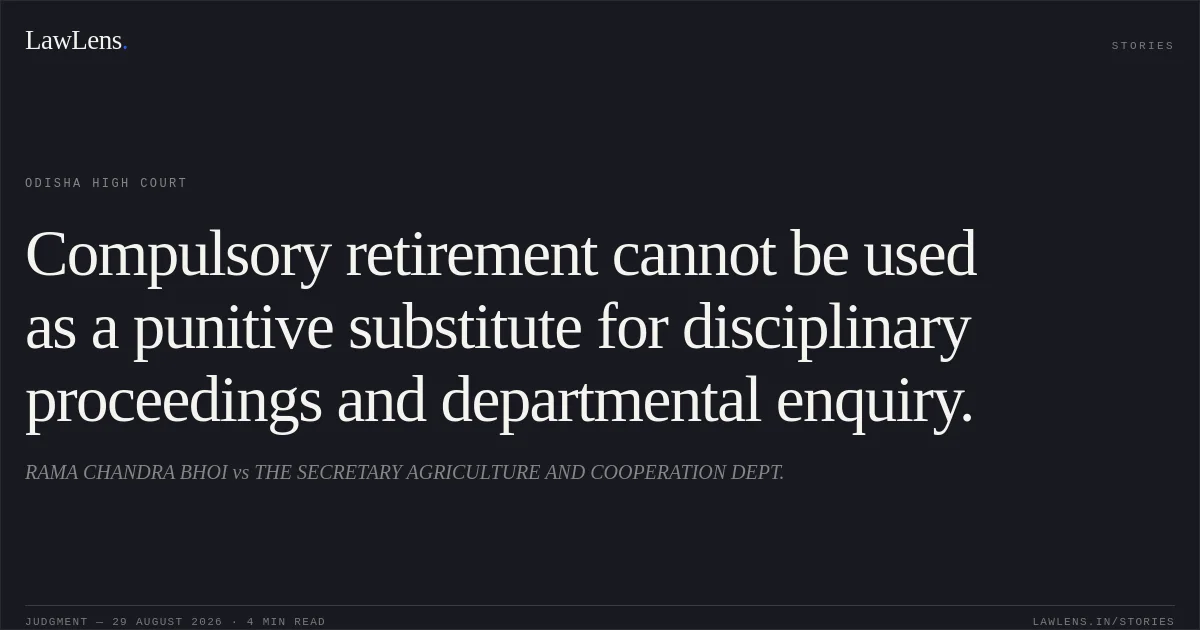
Source reference: p.10–13The Court further applied the principle that compulsory retirement, when based on an objective assessment of an employee’s utility and carrying no stigma, is administrative and ordinarily does not require a prior hearing; however, when used as a substitute for disciplinary punishment for specific misconduct, it becomes punitive and cannot be imposed without a departmental enquiry and observance of natural justice.
Source reference: p.18–20Relying on Sushil Sharma v. Union of India, 2026 SCC OnLine SC 1501, the Court held that compulsory retirement cannot be used to bypass disciplinary proceedings where the order is founded on allegations affecting the employee’s integrity or conduct.
Source reference: p.19; para. 15Reasoning
The Court rejected the petitioner’s contention that Clause 5 applied only to direct appointments and not promotions.
Source reference: no citationReading Clauses 5, 6 and 12 together, it held that promotion to a Grade-II post must also be processed through the constitutionally prescribed Appointment Committee before the Managing Committee can validly finalize it.
Source reference: p.13–17; paras. 10–13Since the petitioner’s promotion was granted solely by the Board of Management and without compliance with that procedure, the refusal of administrative approval was held justified.
Source reference: no citationThe position was different regarding compulsory retirement.
Source reference: no citationThe Society’s resolution was passed immediately after the alleged incident and FIR and was demonstrably founded on specific allegations of misconduct rather than an objective assessment of the petitioner’s overall service record or administrative utility.
Source reference: p.20; para. 16It therefore carried a punitive and stigmatic character. In the absence of a disciplinary enquiry and an opportunity of hearing, the resolution violated the principles of natural justice and was legally unsustainable.
Source reference: p.18–21; paras. 14–16Holding
The writ petition was allowed in part.
The Court upheld the refusal to approve the petitioner’s earlier promotion because the Appointment Committee procedure under the 2011 Circular had not been followed.
Source reference: p.16–17; para. 13However, the compulsory-retirement resolution dated 11 October 2019 was declared invalid and quashed.
Source reference: p.21; para. 18The opposite parties were directed to restore the petitioner to the post he held before the disputed promotion, notionally fix his salary, and, if considered expedient, initiate disciplinary proceedings in accordance with law and due procedure.
Source reference: p.21; para. 18Any future proposal for his promotion was directed to be considered only after compliance with the prescribed guidelines.
Source reference: p.21; para. 18No order was made as to costs.
Source reference: no citationActs & Sections Cited
2 provisions across 1 statute referred to in this judgment. Linked provisions open on LawLens.
Orissa Co-operative Societies Act, 19622
Original Court PDF
RAMA CHANDRA BHOIvsTHE SECRETARY AGRICULTURE AND COOPERATION DEPT.
Click to open original judgment
Original judgment, available to read, download and summarize on LawLens.in
![A police constable cannot be removed for unauthorized absence without a Rule 359-compliant inquiry.. Mohammad Sidiq Khan vs D/o Home Ut Of Jammu & Kashmir. CAT - ['Srinagar']. LawLens](/stories/thumbnails/a-police-constable-cannot-be-removed-for-unauthorized-absence-without-a-rule-359-compliant-7b43fc316bd94f22a62676153bbc9d54.webp)
![A Review DPC lacks authority to determine or alter inter se seniority.. SAURABH KUMAR vs REVENUE. CAT - ['Patna']. LawLens](/stories/thumbnails/a-review-dpc-lacks-authority-to-determine-or-alter-inter-se-seniority-4b21640f20af46fcabdfc8273d2ce959.webp)