Facts
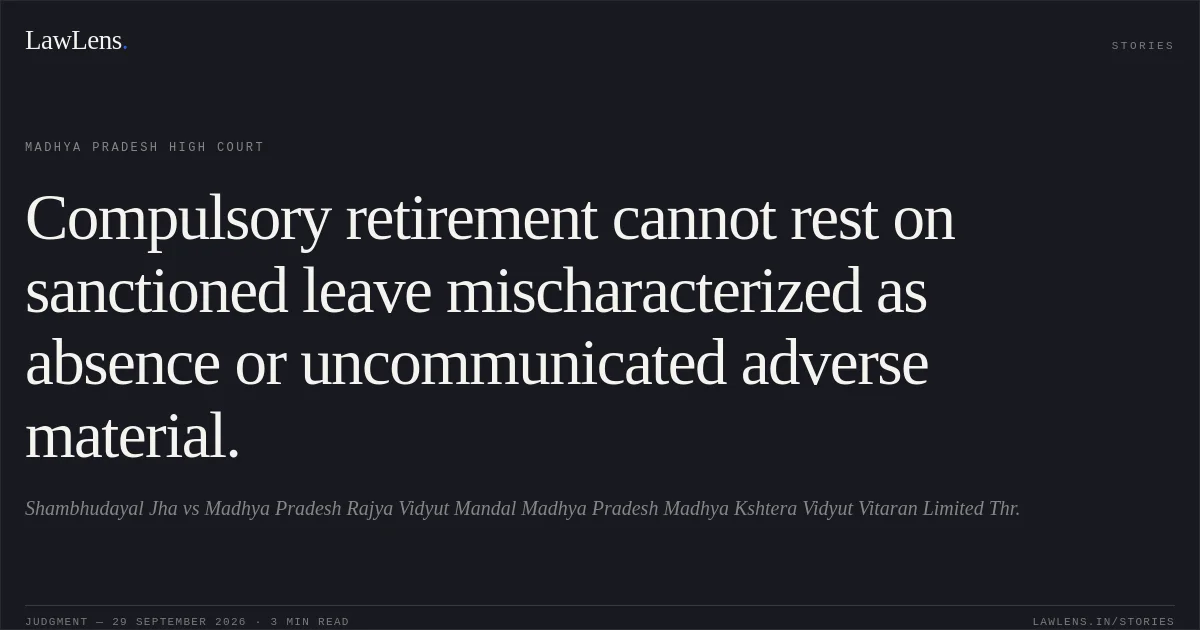
The petitioner, appointed as an Office Assistant in 1974, was compulsorily retired on 24 September 2009, before reaching the age of superannuation. He challenged the retirement before the Labour Court, contending that his service conditions fixed superannuation at 58 years, that leave relied upon as absence had been sanctioned, and that adverse service material was not communicated to him. The Labour Court dismissed his claim on 28 June 2017. He then challenged that award under Articles 226 and 227 of the Constitution and sought reinstatement and consequential benefits
Source reference: no citationIssues
1. Whether the respondents lawfully exercised their power to compulsorily retire the petitioner, including whether sanctioned leave could be treated as unauthorized absence and whether the adverse material was properly considered
Source reference: no citation2. Whether the Labour Court erred in upholding the compulsory retirement without examining the basis for the alleged unauthorized absence, communication of the adverse report, and consideration of the petitioner’s entire service record
Source reference: no citationLaw Applied
Under Articles 226 and 227 of the Constitution, the High Court may interfere where a Labour Court’s award rests on an unlawful exercise of power. Compulsory retirement is generally an assessment of an employee’s suitability in the public interest, but it must not be used as a substitute for disciplinary proceedings where the substance of the allegations is misconduct.
Source reference: no citationIn State of Gujarat v. Umedbhai M. Patel, (2001) 3 SCC 314, the Supreme Court stated that compulsory retirement cannot be used to avoid a departmental enquiry where one is otherwise warranted.
Source reference: no citationThe High Court also relied on Shantimal Bhandari v. State of M.P. & Others, W.P. No. 3649 of 2009, decided 4 December 2013, 2014 (2) MPJR 65, applying that principle to allegations of absence and indiscipline.
Source reference: no citationThe Court further held that leave sanctioned by the competent authority cannot be treated as unauthorized absence unless the sanction was cancelled or the employee remained absent beyond the sanctioned period
Source reference: no citationReasoning
The Court found no material establishing that the petitioner’s absence during the period covered by sanctioned leave was unauthorized. It also found no material showing that the adverse service report for 2007–08 had been communicated to him or that his entire service record had been objectively assessed.
Source reference: no citationBecause the respondents did not appear to justify the decision, the Court had no basis to find that the compulsory retirement rested on a properly established assessment. The Labour Court had failed to address these matters, and its award could not stand
Source reference: no citationHolding
The High Court allowed the petition, set aside the Labour Court’s award and the compulsory retirement order, and directed the respondents to determine and release the petitioner’s admissible consequential service benefits as if he had continued in service until the date he would otherwise have superannuated.
Payment was due within three months of production of a certified copy, with amounts already paid to be adjusted. The claim for 18% interest was rejected; unpaid benefits would accrue interest at 6% per annum after that three-month period. The order did not bar any action otherwise permissible under the applicable service rules and due process
Source reference: no citationActs & Sections Cited
1 provisions across 1 statute referred to in this judgment. Linked provisions open on LawLens.
the Act (alias, unresolved)1
Original Court PDF
Shambhudayal JhavsMadhya Pradesh Rajya Vidyut Mandal Madhya Pradesh Madhya Kshtera Vidyut Vitaran Limited Thr.
Click to open original judgment
Original judgment, available to read, download and summarize on LawLens.in