Facts
The Petitioner joined Central Electronics Limited (“CEL”) on 10 December 1993 and was serving as Senior Manager (Public Relations). Disciplinary proceedings initiated in 2017 alleged that he used tweets and other communications to publicise allegations of corruption against CEL, approached governmental authorities and the media, attempted to exert external pressure on the organisation, and bypassed internal grievance procedures.
Source reference: pp. 2–3, paras. 4–6The Petitioner was dismissed on 5 October 2018, and the appellate authority substituted removal from service for dismissal on 28 November 2018.
Source reference: pp. 2–3, paras. 4–6In W.P.(C) 13377/2018, the Court upheld the findings of misconduct but held that removal from service was disproportionate because the disciplinary orders did not adequately explain why lesser major penalties were insufficient, particularly in light of the Petitioner’s long service and the subsequent deletion of the tweets. The punishment was set aside and the question of penalty was remitted for fresh consideration.
Source reference: pp. 3–4, paras. 7–9On 18 March 2026, CEL imposed compulsory retirement.
Source reference: p. 4, para. 11The Petitioner challenged the fresh penalty in the writ petition and alleged, in the contempt petition, that CEL had failed to comply with the earlier judgment.
Source reference: pp. 6–7, paras. 17–23Issues
Whether CEL’s fresh order dated 18 March 2026 amounted to compliance with the earlier judgment, such that contempt proceedings were maintainable for alleged non-compliance?
Source reference: pp. 6–7, paras. 18–23Whether compulsory retirement was a permissible and proportionate penalty under CEL’s Conduct, Discipline and Appeal Rules, 2019, after the earlier penalty of removal had been set aside?
Source reference: pp. 7–9, paras. 24–30Whether the disciplinary authority properly considered lesser penalties, the proved misconduct, the Petitioner’s past record, mitigating circumstances, length of service and the consequences of compulsory retirement?
Source reference: pp. 9–12, paras. 31–40Whether the Court should remand the matter for a further reconsideration of penalty or itself substitute an appropriate punishment?
Source reference: pp. 12–14, paras. 41–44What relief should be granted regarding reinstatement, back wages, continuity of service and fixation of pay?
Source reference: pp. 14–17, paras. 45–56Law Applied
The Court applied Rules 23, 25 and 26(3) of CEL’s Conduct, Discipline and Appeal Rules, 2019: Rule 23 provides a graded range of minor and major penalties, including reduction in pay, reduction to a lower grade or post, compulsory retirement, removal and dismissal; Rule 25 prescribes the procedure where a major penalty is contemplated but does not predetermine the punishment; and Rule 26(3) permits imposition of any penalty specified in Rule 23.
Source reference: pp. 7–9, paras. 25–29The Court applied the principle that a fresh order passed pursuant to a judicial remand may be challenged in substantive judicial review, but an erroneous or legally unsustainable order does not, by itself, constitute contempt; wilful disobedience must be established, as explained in J.S. Parihar v. Ganpat Duggar, 1996 INSC 1030.
Source reference: pp. 6–7, paras. 19–23On proportionality, the Court relied on Chairman-cum-Managing Director, Coal India Ltd. v. Mukul Kumar Choudhuri, (2009) 15 SCC 620, requiring consideration of the nature, magnitude and degree of misconduct, relevant and irrelevant circumstances, and whether a reasonable employer would impose the same punishment in comparable circumstances.
Source reference: pp. 12–13, paras. 38–40It also applied B.C. Chaturvedi v. Union of India, (1995) 6 SCC 749, and Dev Singh v. Punjab Tourism Development Corporation Ltd., (2003) 8 SCC 9, recognising that, in exceptional cases where punishment shocks the conscience and further remand would prolong litigation, a writ court may substitute an appropriate lesser penalty.
Source reference: pp. 13–14, paras. 41–44Reasoning
The Court dismissed the contempt petition because the earlier judgment required only fresh reconsideration of the penalty and did not mandate reinstatement or prescribe a particular punishment. CEL had undertaken a fresh exercise, and whether that exercise was correct belonged to the writ jurisdiction rather than contempt jurisdiction.
Source reference: pp. 6–7, paras. 19–23In the writ petition, the Court held that compulsory retirement was legally available under Rule 23 and was not automatically barred merely because it ended the employment relationship.
Source reference: pp. 7–9, paras. 24–30However, the authority wrongly treated the initiation of major-penalty proceedings as excluding minor penalties, and its rejection of reduction in pay or grade merely because the Petitioner would remain in service assumed the very conclusion that required justification.
Source reference: p. 9, para. 28; p. 9, para. 32The references to information that the authority had “been given to understand”, alleged threats to CEL’s existence, and a general “pattern of indiscipline” were insufficiently connected to the misconduct actually proved; prior charge sheets and penalties set aside on appeal could not be treated uniformly as aggravating circumstances.
Source reference: pp. 10–11, paras. 34–35The authority also failed to substantively balance the deletion of the tweets, the Petitioner’s long service, his representation and family circumstances, and the absence of corruption, pecuniary gain, moral turpitude or criminal conduct.
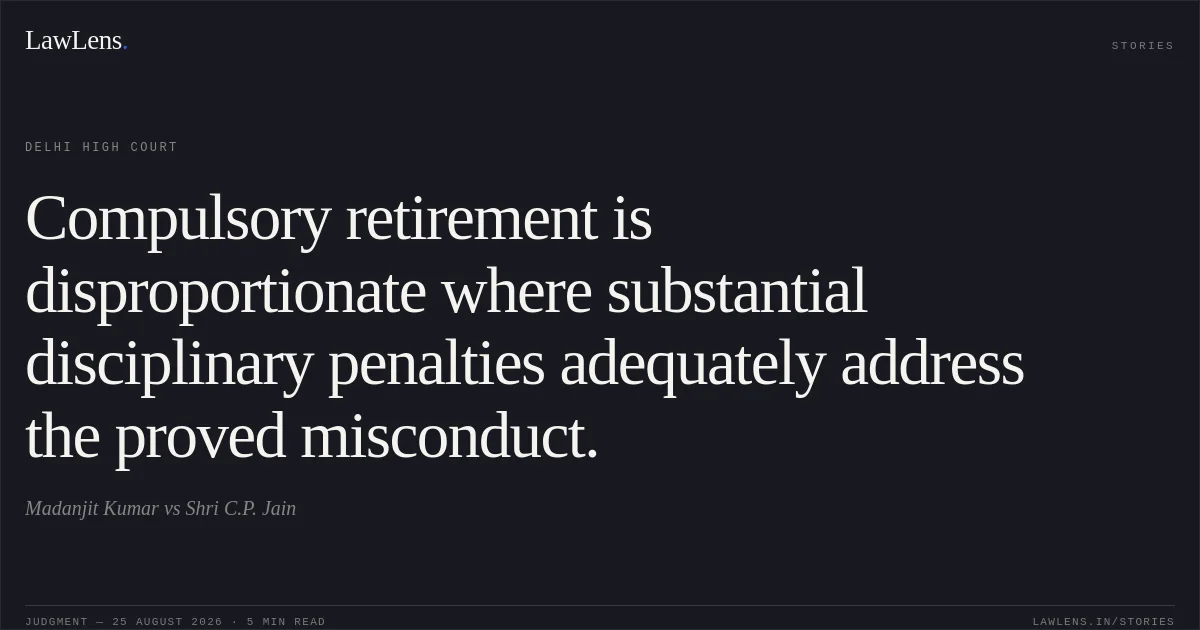
Source reference: pp. 11–12, paras. 36–38Applying proportionality, the Court found that a substantial penalty was justified but that permanent severance from employment was not shown to be necessary.
Source reference: pp. 12–14, paras. 40–44Since the proceedings had continued since 2017, the Petitioner had remained out of service since 2018, and the record was complete, a further remand was considered futile.
Source reference: pp. 12–14, paras. 40–44The Court therefore substituted a two-stage reduction in the applicable time scale of pay for two years, with no increments during that period and no postponement of future increments thereafter.
Source reference: pp. 14–15, paras. 45–48Holding
The contempt petition, CONT.CAS(C) 881/2026, was dismissed because no wilful disobedience of the earlier judgment was established; the contempt notice, if any, was discharged.
The writ petition, W.P.(C) 4359/2026, was partly allowed. The order dated 18 March 2026 imposing compulsory retirement was set aside, while the findings of misconduct remained undisturbed.
Source reference: p. 17, para. 56(i)–(iii)In substitution, the Court imposed the major penalty of reduction by two stages in the applicable time scale of pay for two years from reinstatement, without increments during that period and without postponement of future increments thereafter.
Source reference: p. 17, para. 56(i)–(iii)CEL was directed to reinstate the Petitioner within four weeks, while retaining discretion over his posting and assignment.
Source reference: p. 17, para. 56(iv)The Petitioner was denied back wages and allowances from 5 October 2018 until reinstatement, but the intervening period was not to constitute a break in service for length-of-service and eligible terminal benefits; notional increments and applicable pay revisions were to be considered for pay fixation, followed by application of the substituted penalty.
Source reference: p. 17, para. 56(v)–(vii)If reinstatement did not occur within four weeks, salary would become payable thereafter until actual reinstatement, subject to the imposed penalty.
Source reference: p. 17, para. 56(viii)Original Court PDF
Madanjit KumarvsShri C.P. Jain
Click to open original judgment
Original judgment, available to read, download and summarize on LawLens.in
![Courts will not interfere with transfers absent mala fides or violation of statutory rules.. M Ramya vs EMPLOYEES STATE INSURANCE CORPORATION (ESIC). CAT - ['Chennai']. LawLens](/stories/thumbnails/courts-will-not-interfere-with-transfers-absent-mala-fides-or-violation-of-statutory-rules-a6845e9ca6f548fca284c51c8351957f.webp)
![Courts cannot direct one-time recruitment age relaxation absent authority in the governing rules or advertisement.. UT OF PUDUCHERRY vs M ANDAL. CAT - ['Chennai']. LawLens](/stories/thumbnails/courts-cannot-direct-one-time-recruitment-age-relaxation-absent-authority-in-the-governing-895d78fde47143e2a8ed0207c4b6a44f.webp)
![A review cannot correct an allegedly erroneous decision absent an error apparent on the record.. Ajit Kumar Jha vs RAILWAY BOARD. CAT - ['Delhi']. LawLens](/stories/thumbnails/a-review-cannot-correct-an-allegedly-erroneous-decision-absent-an-error-apparent-on-the-re-8ac952fd4eba470c92f7da20af72a220.webp)