Facts
The appellant was appointed as an Additional Assistant Engineer on 19 November 1977 and was subsequently proceeded against in a disciplinary inquiry involving five charges.
Source reference: p.1, paras. 1–3The Inquiry Officer found the charges proved, which was accepted by the disciplinary authority, resulting in an order of removal from service dated 16 May 2007.
Source reference: p.1, paras. 1–3On appeal, the punishment of removal was substituted with compulsory retirement, and the appellant was stated to be entitled to compassionate pension by order dated 4 January 2008.
Source reference: p.2, para. 4The appellant challenged that order in a writ petition filed in 2008.
Source reference: p.2, para. 5During its pendency, he attained the age of superannuation in 2014; by then, he had completed more than 30 years of service.
Source reference: p.2, para. 5The learned Single Judge dismissed the writ petition.
Source reference: p.2, para. 6Although the respondent-Board proposed payment of compassionate pension, the Government did not approve the proposal, and the appellant consequently received no such pension.
Source reference: p.2, para. 6In the Letters Patent Appeal, the appellant contended that the penalty was disproportionate and undertook not to claim arrears of salary or full pension for the entire period, seeking 25% pension arrears from 30 June 2014.
Source reference: p.3, paras. 8–10Issues
Whether the punishment of compulsory retirement, imposed after the appellant had completed more than 30 years of service, was disproportionate to the charges proved against him.
Source reference: p.2, para. 7; p.3, para. 9Whether the appellant should be permitted to retire voluntarily in lieu of compulsory retirement and be granted pension and other retiral benefits on that basis.
Source reference: p.3, paras. 9–11Whether the appellant was entitled to pension arrears at 25% from the date of superannuation and full pension thereafter.
Source reference: p.3, paras. 10–11Law Applied
The Court applied the principle of proportionality in judicial review of disciplinary punishment, holding that the penalty must correspond to the seriousness of the misconduct and the surrounding circumstances, including the employee’s length of service.
Source reference: p.4, para. 12It relied on the Supreme Court’s decision in Special Leave Petition (Diary No. 11294 of 2025), decided on 11 June 2026, which held that dismissal is the severest disciplinary penalty, has serious consequences for the employee and dependants, permanently affects the service record, and should be reserved for misconduct of the most serious nature.
Source reference: p.4, para. 12The Court also applied the principle that, where the punishment is found excessive, appropriate relief may be fashioned by modifying the penalty and moulding the consequential pensionary relief in accordance with the employee’s undertaking and the circumstances of the case.
Source reference: p.3, paras. 9–11Reasoning
The Court examined the charges and found that they did not involve financial irregularity or embezzlement.
Source reference: p.2, para. 7Although the appellate authority had already considered removal too harsh and substituted compulsory retirement, the Court held that compulsory retirement was still disproportionate because the appellant had rendered more than 30 years of service and the charges were not of the gravest nature.
Source reference: p.2, para. 7; p.3, para. 9Applying the Supreme Court’s emphasis on reserving the severest penalties for the most serious misconduct, the Court granted further leniency by treating the appellant as having voluntarily retired from the date of removal, namely 16 May 2007.
Source reference: p.3, paras. 9–12The pensionary relief was limited in accordance with the appellant’s undertaking not to claim salary arrears and not to insist on full pension from the date of superannuation.
Source reference: p.3, paras. 10–11Holding
The Letters Patent Appeal was allowed to the stated extent.
The respondent-Board was directed to treat the appellant as having voluntarily retired with effect from 16 May 2007, in lieu of compulsory retirement.
Source reference: p.3, para. 10His service was to be reckoned from 19 November 1977 to 30 June 2014.
Source reference: p.4, para. 13The respondents were directed to pay pension at 25% of the admissible amount from 30 June 2014 to 31 July 2026, and full pension from 1 August 2026 onwards.
Source reference: p.3, para. 11The appellant was also held entitled to other retiral benefits payable upon voluntary retirement, if not already paid.
Source reference: p.5, para. 14Original Court PDF
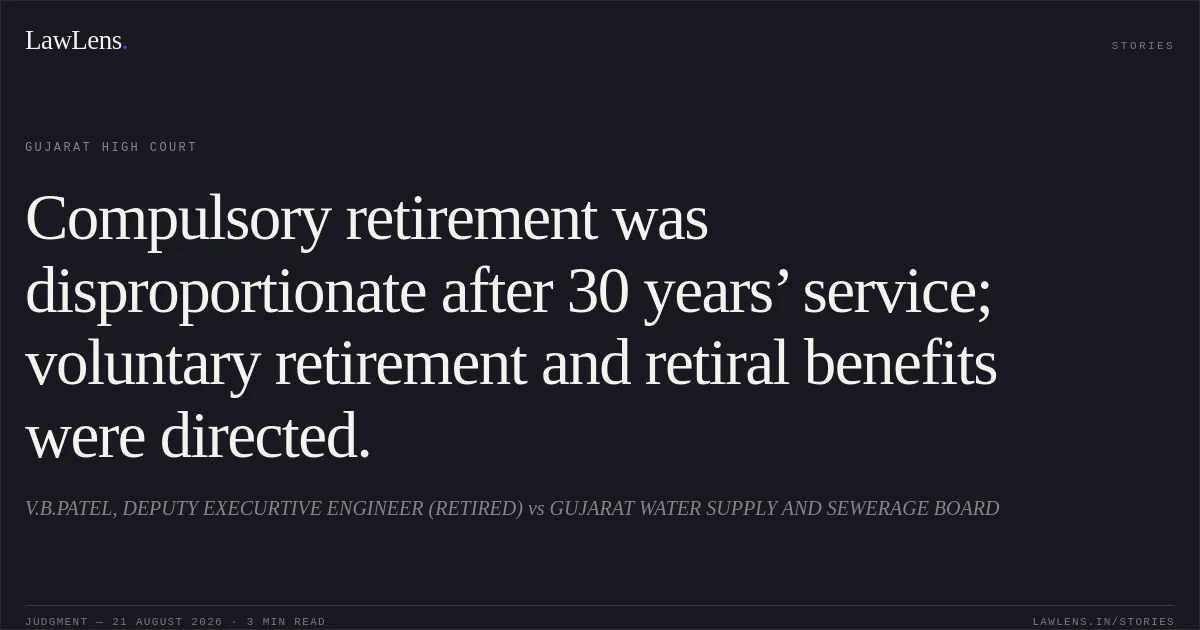
V.B.PATEL, DEPUTY EXECURTIVE ENGINEER (RETIRED)vsGUJARAT WATER SUPPLY AND SEWERAGE BOARD
Click to open original judgment
Original judgment, available to read, download and summarize on LawLens.in