Facts
The petitioner, appointed as a Store Keeper and later redesignated as a Junior Marketing Assistant, claimed seniority over private respondents and challenged their promotions to Marketing Assistant, seeking promotion, revised pay, and Assured Career Progression (ACP) benefits
Source reference: para. 1–4Respondent No. 3, a cooperative federation, opposed the claim on the grounds that the petitioner lacked the prescribed 10+2 qualification and had an adverse disciplinary record; the petitioner had faced several disciplinary proceedings, including findings of guilt and penalties, and had admitted responsibility in one matter
Source reference: para. 6–10The petitioner did not disclose those proceedings and penalties in his petition
Source reference: para. 14–15The Court also noted that he had received revised pay benefits and was promoted to Junior Marketing Assistant retrospectively from 1 July 2010
Source reference: para. 10, 22Issues
Whether the petitioner was entitled to discretionary relief under Article 226 despite failing to disclose material disciplinary proceedings and penalties
Source reference: para. 14–18Whether the petitioner was entitled to promotion as Marketing Assistant despite lacking the 10+2 qualification prescribed by the applicable amended rules
Source reference: para. 19–21Whether the petitioner was entitled to ACP benefits or application of the sealed-cover procedure
Source reference: para. 22–23Law Applied
The jurisdiction under Article 226 is extraordinary, equitable, and discretionary; a petitioner seeking relief must disclose all material facts, and suppression or misleading presentation may justify dismissal without consideration of the merits, as stated in Prestige Lights Ltd. v. State Bank of India, (2007) 8 SCC 449, K.D. Sharma v. Steel Authority of India Ltd., (2008) 12 SCC 481, and Kusha Duruka v. State of Odisha, (2024) 4 SCC 432
Source reference: para. 16–18An employee has a right to be considered for promotion under the rules in force when consideration takes place, but no universal rule requires vacancies to be filled under the rules existing when they arose; the Court applied State of Himachal Pradesh v. Raj Kumar, (2023) 3 SCC 773, and distinguished Chairman, Railway Board v. C.R. Rangadhamaiah, (1997) 6 SCC 623
Source reference: para. 20–21Promotion remained subject to the applicable recruitment qualification, including the 10+2 requirement
Source reference: para. 6–7, 21Reasoning
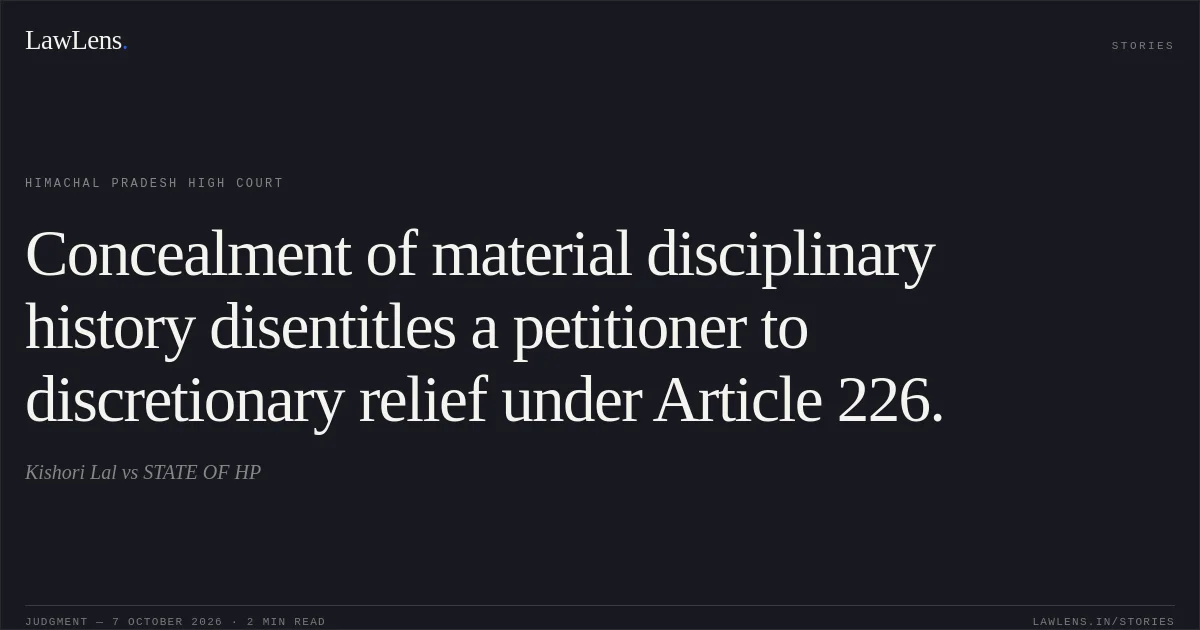
The Court held that the petitioner’s failure to disclose repeated disciplinary proceedings, penalties, and his admission in one matter amounted to suppression of material facts and independently disentitled him to discretionary relief under Article 226
Source reference: para. 14–18On the merits, he did not dispute that he lacked the 10+2 qualification required by the rules in force when the private respondents were promoted.
Source reference: para. 20–21His reliance on Rangadhamaiah failed because he had not already acquired a vested right to promotion; the Court instead applied Raj Kumar on the rules governing consideration for promotion
Source reference: para. 20–21The ACP claim also failed because he had received pay-scale benefits and had been promoted to Junior Marketing Assistant retrospectively
Source reference: para. 22The Court rejected the sealed-cover argument because, on its account of the record, no promotion consideration for Marketing Assistant requiring that procedure was shown
Source reference: para. 23Holding
The Court dismissed the petition both for suppression of material facts and on the merits.
It denied the requested promotion, revised-pay and ACP reliefs, and made no order as to costs; pending miscellaneous applications were also disposed of
Source reference: para. 24Original Court PDF
Kishori LalvsSTATE OF HP
Click to open original judgment
Original judgment, available to read, download and summarize on LawLens.in