Facts
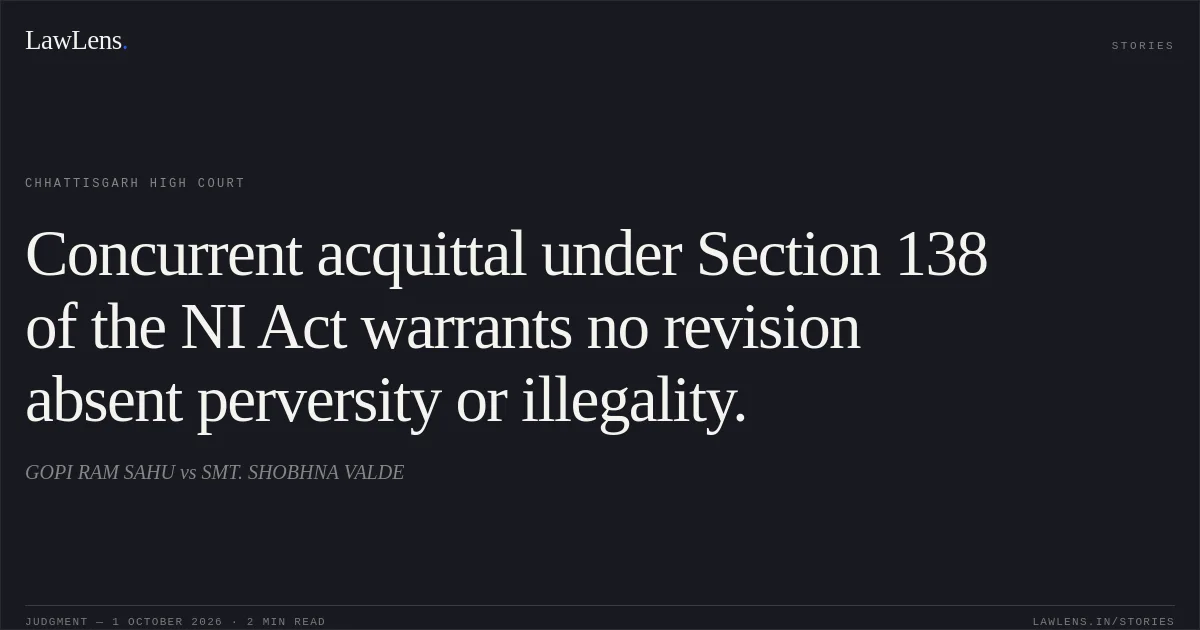
The complainant alleged that respondent No. 1 borrowed ₹3,00,000 and issued a cheque towards repayment; after the cheque was dishonoured and payment was not made following statutory notice, he filed a complaint under Section 138 of the Negotiable Instruments Act, 1881 (“NI Act”).
Source reference: para. 2The JMFC acquitted respondent No. 1, finding the alleged debt unproved, and the Sessions Court affirmed the acquittal on appeal.
Source reference: paras. 5, 17The complainant challenged the concurrent acquittals in revision under Sections 397 and 401 of the Code of Criminal Procedure, 1973.
Source reference: paras. 1, 5Issues
Whether the complainant established a legally enforceable debt and the requirements for an offence under Section 138 of the NI Act, notwithstanding the presumption arising from the respondent’s admitted signature on the cheque.
Source reference: paras. 10–16Whether the concurrent findings of acquittal disclosed perversity or illegality warranting interference in the High Court’s revisional jurisdiction.
Source reference: paras. 17–18Law Applied
Section 138 of the NI Act penalises dishonour of a cheque issued in discharge of a legally enforceable debt, subject to the statutory requirements. Under Section 139, once the drawer’s signature is admitted, a presumption arises that the cheque was received in discharge of a debt or liability; that presumption is rebuttable, and the accused may rebut it by raising a probable defence based on the record.
Source reference: para. 10The High Court’s revisional jurisdiction under Sections 397 and 401 of the Code of Criminal Procedure, 1973, is limited; interference with an acquittal is warranted where the findings are perverse, manifestly illegal, or result in a miscarriage of justice.
Source reference: para. 18Reasoning
Although respondent No. 1’s admitted signature triggered the Section 139 presumption, the Court found that the complainant’s evidence and documents raised a probable defence. His account differed as to the amount, mode, and dates of payment; the complaint alleged a ₹3,00,000 cash loan, while his cross-examination described ₹1,00,000 in cash and ₹2,00,000 by cheque. The agreement recorded ₹2,00,000 and a different repayment date, and the alleged cash payment was not documented.
Source reference: paras. 11–13The Court also noted the defence that blank cheques had been obtained in connection with earlier loans, and discrepancies between the stated deposit bank, the deposit slips, and the bank issuing the dishonour document, which were not explained through bank evidence.
Source reference: paras. 14–16In these circumstances, the concurrent findings that the debt and alleged dishonour were not established were not shown to be perverse or illegal.
Source reference: paras. 16–18Holding
The Court held that the complainant had not demonstrated grounds for revisional interference with the concurrent acquittals.
It affirmed the Sessions Court’s judgment upholding the JMFC’s acquittal and dismissed the criminal revision.
Source reference: paras. 18–20Acts & Sections Cited
4 provisions across 2 statutes referred to in this judgment. Each provision opens on LawLens.
Code of Criminal Procedure, 19732
Negotiable Instruments Act, 18812
Original Court PDF
GOPI RAM SAHUvsSMT. SHOBHNA VALDE
Click to open original judgment
Original judgment, available to read, download and summarize on LawLens.in