Facts
The appellant, claiming to be an agricultural tenant in possession of the respondents’ agricultural land, instituted Regular Civil Suit No. 134 of 2010 seeking protection against dispossession otherwise than by due process of law.
Source reference: para. 4.1, p. 2The respondents, claiming ownership and possession, filed a counterclaim seeking a permanent injunction restraining the appellant from interfering with their possession.
Source reference: para. 4.1–4.2, pp. 2–3The Trial Court held that the appellant failed to prove either his tenancy or possession and decreed the respondents’ counterclaim.
Source reference: para. 4.2, p. 3The Principal District Judge, Patan, dismissed the appellant’s appeals in Regular Civil Suit Nos. 43 and 44 of 2019 and affirmed the Trial Court’s judgment and decree dated 2 May 2019.
Source reference: para. 3, p. 2; para. 4.3, p. 3The appellant thereafter preferred the present second appeals under Section 100 of the Code of Civil Procedure, 1908, which were heard together because they involved a common issue.
Source reference: paras. 2–3, pp. 1–2Issues
Whether the second appeals raised any substantial question of law warranting interference under Section 100 of the CPC with the concurrent findings that the appellant was neither in possession of the suit land nor proved to be an agricultural tenant.
Source reference: paras. 8–10, pp. 6–8Whether the concurrent factual findings of the Trial Court and the First Appellate Court were perverse, grossly erroneous, contrary to law, or based on inadmissible or no evidence so as to justify interference in second appeal.
Source reference: paras. 8–9.2, pp. 6–8Law Applied
The Court applied Section 100 of the Code of Civil Procedure, 1908, under which a second appeal lies only where a substantial question of law arises.
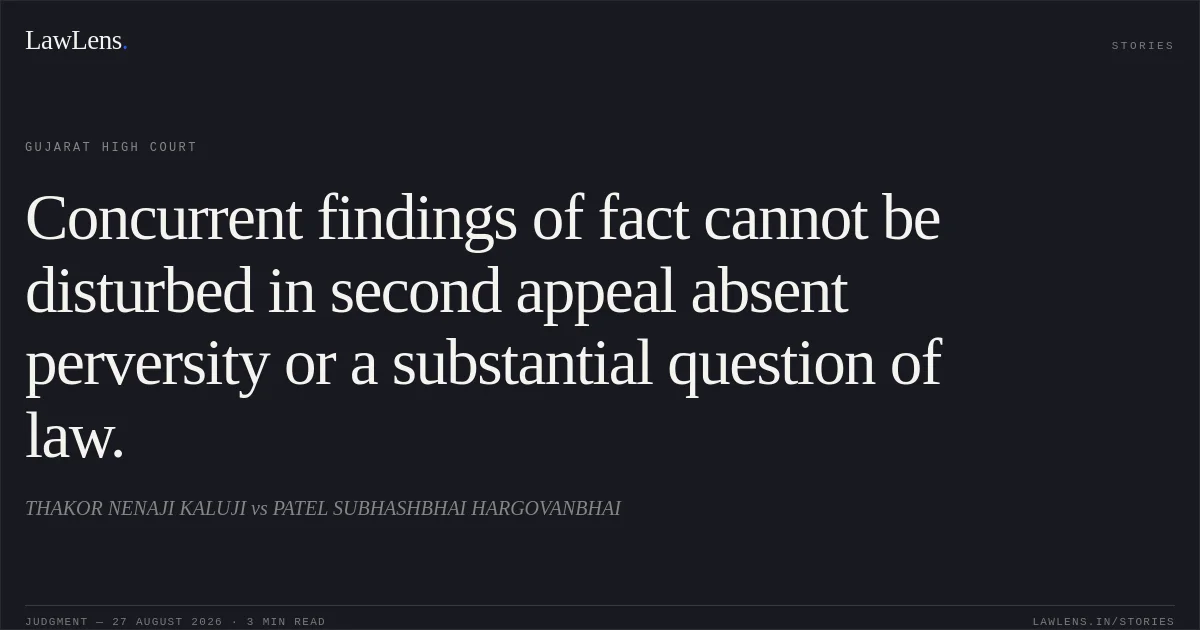
Source reference: paras. 8–10, pp. 6–8It held that concurrent findings of fact ordinarily cannot be disturbed unless they are perverse, grossly erroneous, contrary to mandatory legal provisions, based on inadmissible evidence, or unsupported by evidence.
Source reference: paras. 8–10, pp. 6–8Relying on Russi Fisheries (P) Ltd. v. Bhavna Seth, 2026 SCC OnLine SC 555, the Court reiterated that even erroneous findings of fact do not justify interference in second appeal in the absence of a clear error of law or perversity.
Source reference: para. 9.1, p. 7Relying on Jaichand (Dead) through LRs v. Sahnulal, 2024 SCC OnLine SC 3864, and the principles stated in Kondira Dagadu Kadam v. Savitribai Sopan Gujar, AIR 1999 SC 2213, the Court further held that the High Court cannot substitute its view for that of the First Appellate Court unless the findings are legally unsustainable, based on inadmissible evidence, or arrived at without evidence.
Source reference: para. 9.2, pp. 7–8Reasoning
The Court found that both courts below had concurrently determined, on appreciation of the evidence, that the appellant neither possessed the suit property nor established the alleged tenancy, while the respondents’ possession and entitlement to an injunction against interference had been accepted.
Source reference: para. 8, p. 6The appellant’s challenge essentially sought reappreciation of the evidence, including reliance on the respondent’s alleged admissions concerning his occupation and knowledge of crops.
Source reference: para. 5.1, p. 4However, the Court held that the appellant could not demonstrate perversity, absence of evidence, reliance on inadmissible evidence, or any gross error of law in the concurrent findings.
Source reference: para. 8, p. 6Consequently, the proposed questions in the memoranda of appeal were held to be factual questions, rather than substantial questions of law contemplated by Section 100 CPC.
Source reference: para. 10, p. 8Holding
The Gujarat High Court held that no substantial question of law arose and that the concurrent findings against the appellant did not warrant interference under Section 100 CPC.
Both Second Appeal Nos. 449 and 501 of 2026 were dismissed in limine, without an order as to costs.
Source reference: para. 11, p. 8The connected Civil Applications for stay were consequently disposed of as having become infructuous.
Source reference: para. 12, p. 9Acts & Sections Cited
2 provisions across 2 statutes referred to in this judgment. Each provision opens on LawLens.
Code of Civil Procedure, 19081
Indian Penal Code, 18601
Original Court PDF
THAKOR NENAJI KALUJIvsPATEL SUBHASHBHAI HARGOVANBHAI
Click to open original judgment
Original judgment, available to read, download and summarize on LawLens.in
![Courts will not interfere with transfers absent mala fides or violation of statutory rules.. M Ramya vs EMPLOYEES STATE INSURANCE CORPORATION (ESIC). CAT - ['Chennai']. LawLens](/stories/thumbnails/courts-will-not-interfere-with-transfers-absent-mala-fides-or-violation-of-statutory-rules-a6845e9ca6f548fca284c51c8351957f.webp)
![Courts cannot direct one-time recruitment age relaxation absent authority in the governing rules or advertisement.. UT OF PUDUCHERRY vs M ANDAL. CAT - ['Chennai']. LawLens](/stories/thumbnails/courts-cannot-direct-one-time-recruitment-age-relaxation-absent-authority-in-the-governing-895d78fde47143e2a8ed0207c4b6a44f.webp)
![A review cannot correct an allegedly erroneous decision absent an error apparent on the record.. Ajit Kumar Jha vs RAILWAY BOARD. CAT - ['Delhi']. LawLens](/stories/thumbnails/a-review-cannot-correct-an-allegedly-erroneous-decision-absent-an-error-apparent-on-the-re-8ac952fd4eba470c92f7da20af72a220.webp)