01Facts
Petitioner No. 2, an Army officer, was declared a "Battle Casualty" after sustaining 40% disability during "Operation Rakshak" in 2001.
¶ 4Under the Army Policy of 1997, he was retained in service rather than being "boarded out" and eventually took premature retirement (PMR) in 2011.
¶ 5His son, Petitioner No. 1, sought admission to Delhi University under the Children/Widows (CW) quota.
¶ 3The Ministry of Defence's Policy dated 21.05.2018 ("2018 Policy") restricted "Priority-II" (higher preference) to wards of those "disabled in action and boarded out from service".
¶ 8Wards of disabled personnel who were retained in service and later retired (like the Petitioner) were categorized under "Priority-VI" (Wards of ESM).
¶ 52Petitioner No. 1 challenged the 2018 Policy as discriminatory and sought "Priority-II" status.
¶ 1-202Issues
i.Whether the 2018 Policy is arbitrary and violative of Article 14 by discriminating between "soldiers disabled in action and boarded out" and "soldiers disabled in action and retained in service."
¶ 1, 11ii.Whether the 2018 Policy and the 2020 SOP can be applied retrospectively to a battle casualty that occurred in 2001.
¶ 14, 69iii.Whether the "deemed invalidation" under Rule 4 of the Entitlement Rules for pensionary benefits entitles the Petitioner to "Priority-II" status for educational reservations.
¶ 18, 6203Law Applied
The Court applied the principle of Reasonable Classification under Article 14 of the Constitution, which permits differentiation based on an intelligible differentia with a rational nexus to the object.
¶ 64It relied on *Binoy Viswam v. Union of India* regarding the limits of mechanical equality.
¶ 100-103The Doctrine of Legitimate Expectation was evaluated through *State of Bihar v. Sachindra Narayan*, establishing that expectations must have a legal or customary basis.
¶ 67The Court followed the principle that Vested Rights only accrue when a legal right has crystallized under an existing statute or policy, citing *MGB Gramin Bank v. Chakrawarti Singh*.
¶ 69Finally, it applied the rule that there is no Negative Equality against perpetuating administrative errors, as held in *Tinku v. State of Haryana*.
¶ 7104Reasoning
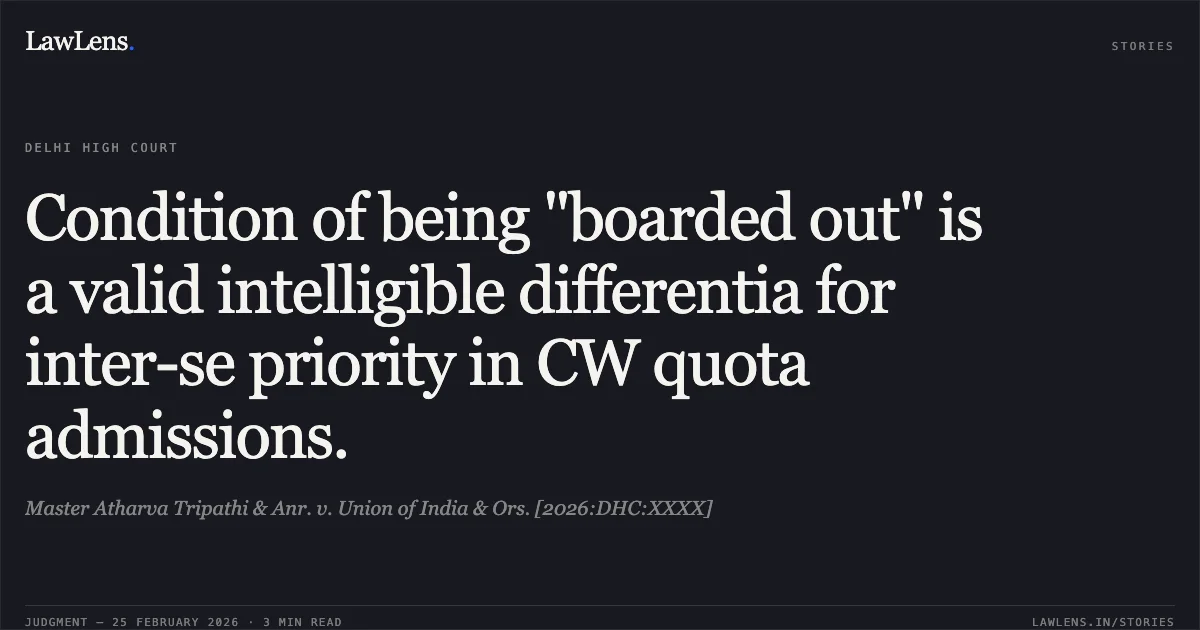
The Court found that the 2018 Policy’s classification is rational because "boarded out" personnel suffer immediate loss of salary and career progression, unlike those retained in service who continue to receive full pay and benefits.
¶ 60This creates an "intelligible differentia" justified by the objective of compensating those with greater financial/professional hardship.
¶ 60The Court rejected the "retrospectivity" argument, noting that as of 2011 (retirement date), there was no policy for reservations in non-medical courses; thus, no vested right existed to be taken away.
¶ 48, 69The Court further clarified that Rule 4 of the Entitlement Rules (pension) is a legal fiction for financial benefits and cannot be imported into educational reservation policies.
¶ 62Regarding the administrative error where the Petitioner was briefly granted "Priority-IV," the Court held it could not compel the State to perpetuate an illegality.
¶ 7105Holding
The Court dismissed the petition, upholding the 2018 Policy and the 2020 SOP as constitutional and non-arbitrary.
¶ 65, 74"Priority-II" is strictly for those disabled in action and boarded out via an Invalided Medical Board (IMB).
¶ 56Personnel who took premature retirement after being retained in service fall correctly under "Priority-VI".
¶ 58Previous instances of admission (e.g., *Aditi Singh*) or administrative errors do not create a right to "negative equality".
¶ 70-71No relief was granted.
¶ 74Original Court PDF
Master Atharva Tripathi & Anr. v. Union of India & Ors. [2026:DHC:XXXX]
Click to open original judgment
Original judgment, available to read, download and summarize on LawLens.in