Facts
The petitioners filed Special Civil Suit No. 50 of 2017 challenging a 2010 Sale Deed for ancestral land
Source reference: p. 2During the suit's pendency, the land was acquired for a National Highway, and compensation was made payable to Respondent No. 1
Source reference: p. 2On 25.04.2023, the parties entered into a Compromise Decree wherein Respondent No. 1 agreed to pay the petitioners Rs. 1,31,50,000/- with 9% interest p.a.
Source reference: p. 2The decree stipulated that compensation would first be deposited into Respondent No. 1’s account, who would then pay the petitioners
Source reference: p. 2-3Despite receiving approximately Rs. 22.91 crores in 2023, Respondent No. 1 failed to pay
Source reference: p. 3The petitioners filed Execution Application No. 18 of 2023. The Executing Court rejected the application on 09.09.2025, labeling it "premature" because the entire compensation amount had not yet been received
Source reference: p. 3Issues
1. Whether the Executing Court erred in interpreting the compromise decree as "premature" and conditional upon the receipt of the entire compensation amount
Source reference: p. 3, 62. Whether the Executing Court failed to exercise its jurisdiction by going behind the decree and preventing the judgment creditors from receiving the fruits of the decree
Source reference: p. 5-6Law Applied
The Court observed that a compromise decree has the force of a contract with the seal of the Court and is fully executable like any other decree
Source reference: p. 3Under the principles governing execution, an Executing Court cannot go behind the decree or modify its effect
Source reference: p. 3The primary duty of the Executing Court is to ensure that the judgment creditor receives the fruits of the decree
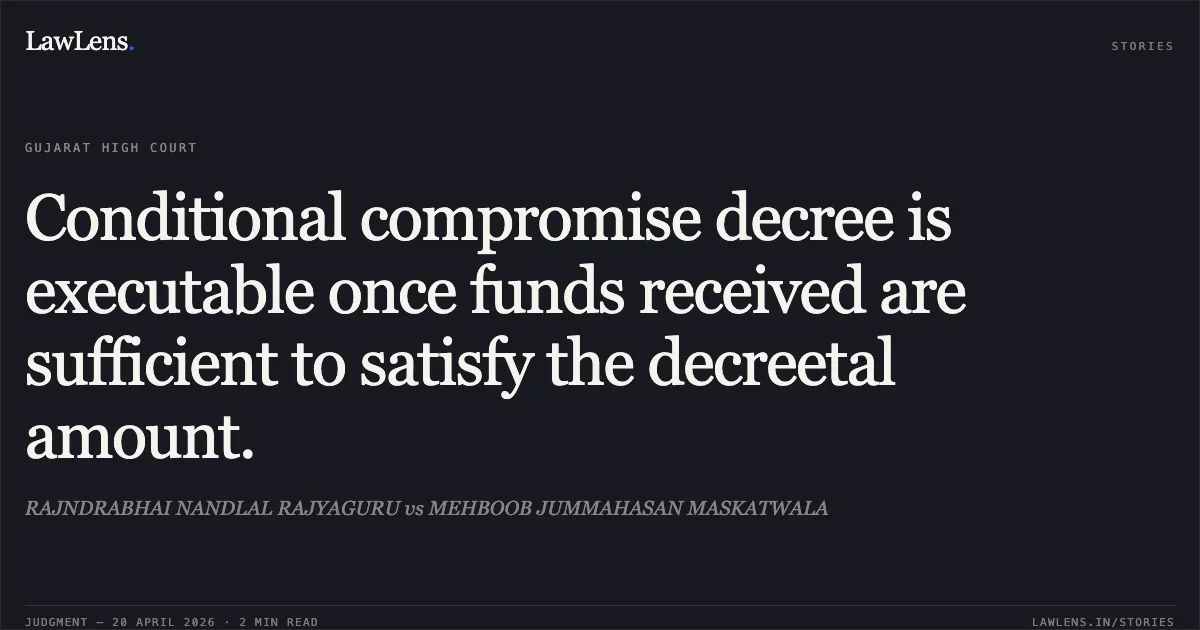
Source reference: p. 6Furthermore, when a decree links payment to the receipt of funds, the obligation to pay crystallizes as soon as sufficient funds (even if partial) are received to satisfy the decretal amount
Source reference: p. 3, 6Reasoning
The High Court found that the Executing Court committed a jurisdictional error by misinterpreting the Compromise Decree
Source reference: p. 5The lower court’s reasoning—that execution was premature until all compensation was received—was deemed an error of fact and law
Source reference: p. 6The High Court noted that Respondent No. 1 had already received Rs. 22.91 crores, which was significantly higher than the decretal amount of Rs. 1.31 crores owed to the petitioners
Source reference: p. 3, 6Therefore, the condition for payment had effectively been met.
Source reference: p. 3, 6The Court reasoned that the lower court failed to properly examine the nature of the decree and the extent of compliance, resulting in a failure to exercise the jurisdiction vested in it
Source reference: p. 5-6Holding
The High Court quashed and set aside the order dated 09.09.2025 passed by the learned Additional Senior Civil Judge, Rajula
It held that the execution was not premature since the respondent had received sufficient funds to satisfy the decree
Source reference: p. 6The matter was remanded to the Executing Court for adjudication afresh on merits
Source reference: p. 6The High Court directed the Executing Court to dispose of the application as expeditiously as possible and ordered both parties to cooperate without seeking unnecessary adjournments
Source reference: p. 7Interim relief was vacated
Source reference: p. 7Original Court PDF
RAJNDRABHAI NANDLAL RAJYAGURUvsMEHBOOB JUMMAHASAN MASKATWALA
Click to open original judgment
Original judgment, available to read, download and summarize on LawLens.in


![Subsequent exoneration does not retrospectively invalidate a finalized promotion select list.. UNNIKRISHNAN M vs M/o Environment And Forests. CAT - ['Ernakulam']. LawLens](/stories/thumbnails/subsequent-exoneration-does-not-retrospectively-invalidate-a-finalized-promotion-select-li-ce80a0e84f2f4887857271e8b4341c42.webp)