Facts
The respondent filed a summary suit under Order 37 CPC seeking recovery of ₹17,19,565, comprising ₹16,53,428 as principal and ₹66,137 as interest, on the basis of a cheque allegedly issued by petitioner No. 1, proprietor of petitioner No. 2, towards liability arising from the purchase of diesel, lubricants and other petroleum products.
Source reference: pp. 1–2; paras 2, 7The petitioners, after their ex parte proceedings were set aside, applied under Order 37 Rule 3 CPC for unconditional leave to defend. They alleged that blank signed cheques had been taken as security and misused, that the respondent had improperly merged the accounts of the petitioners with those of the petitioner’s father and brother, and that payments of ₹1,50,000 and ₹2,00,000 had not been credited.
Source reference: p. 2; para 3The Trial Court granted leave to defend but made it conditional upon furnishing a bank guarantee or fixed deposit for ₹16,53,428 by 21.08.2026.
Source reference: pp. 2–6; paras 3.2, 7.1The petitioners challenged only this condition under Article 227 of the Constitution and did not dispute the grant of leave to defend itself.
Source reference: p. 6; para 5The revision petition was filed on 31.08.2026, after expiry of the date fixed by the Trial Court.
Source reference: p. 6; para 8Issues
Whether the Trial Court was justified in granting leave to defend subject to the petitioners furnishing a bank guarantee or fixed deposit for the entire principal amount of ₹16,53,428?
Source reference: pp. 6–9; paras 7.1–10Whether the conditional leave order warranted interference by the High Court in exercise of its supervisory jurisdiction under Article 227 of the Constitution?
Source reference: pp. 1, 6, 9; paras 1, 5, 10–11Law Applied
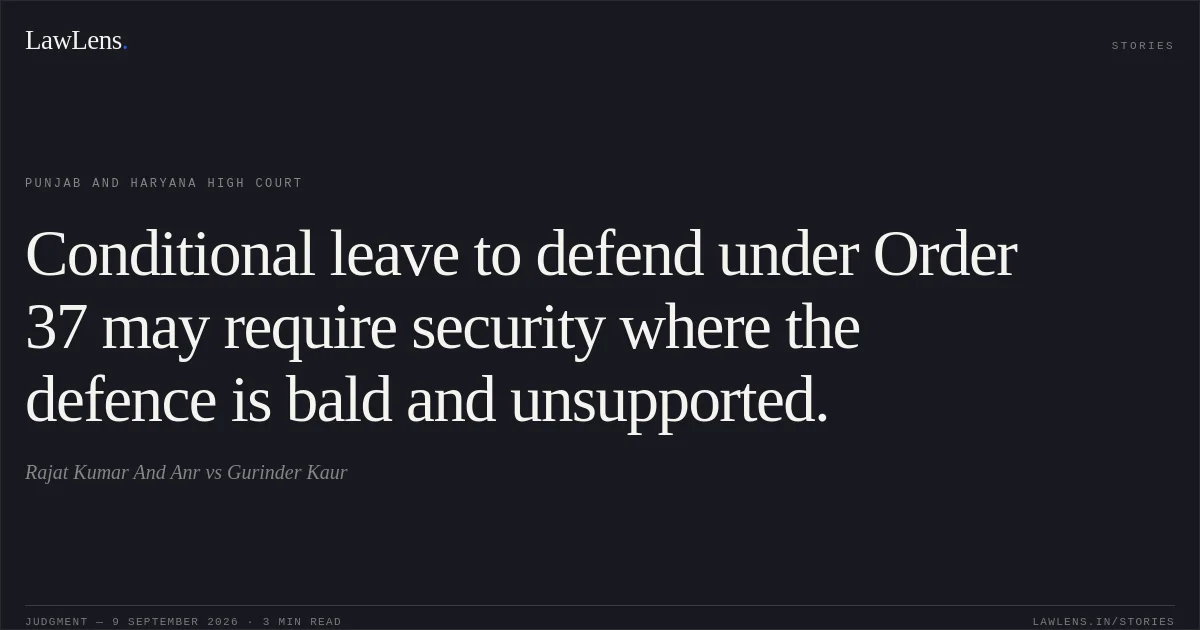
Order 37 Rule 3(5) CPC empowers the Court to grant leave to defend either unconditionally or upon such terms as may appear just.
Source reference: p. 9; para 10Applying Mechalec Engineering and Manufacturers v. Basic Equipment Corporation, AIR 1977 SC 577, the Court reiterated that unconditional leave is appropriate where the defendant discloses a good, fair, bona fide or reasonable defence raising a triable issue; where the defence is weak, conditions may be imposed; and where the defence is sham, illusory or moonshine, leave may ordinarily be refused, though conditional leave may be granted in appropriate cases.
Source reference: pp. 6–7; para 9The Court also relied on M/s V.K. Enterprises v. M/s Shiva Steels, 2010 (4) RCR (Civil) 365, which holds that a plausible defence supported by material may justify leave, whereas a bare oral denial against documentary evidence does not necessarily constitute a triable issue.
Source reference: pp. 7–9; para 9.1The supervisory jurisdiction under Article 227 does not warrant interference merely because another view is possible, absent a compelling error or jurisdictional infirmity.
Source reference: pp. 1, 9; paras 1, 11Reasoning
The Trial Court found that the parties’ commercial relationship and purchases of diesel, petrol and lubricants were admitted, while the respondent produced acknowledgments of supplies, ledger entries, WhatsApp communications supported by the requisite electronic-evidence certificate, and the cheque corresponding to the claimed liability.
Source reference: pp. 3–5; para 7.1Against this material, the petitioners’ allegations regarding security cheques, prior misuse, an alleged panchayat settlement, wrongful clubbing of accounts and uncredited payments were unsupported by complaints, correspondence, bank records, reconciliation statements or other corroborative documents.
Source reference: pp. 4–5; para 7.1The High Court nevertheless accepted that the petitioners should have an opportunity to defend, consistent with the principle that leave in a summary suit is ordinarily granted, but held that their unsupported and weak defence did not justify unconditional leave.
Source reference: pp. 5–6; para 7.2Since Order 37 Rule 3(5) permits conditional leave and the condition secured only the principal amount claimed, the High Court found no compelling reason to interfere, notwithstanding that the revision was filed after the compliance date.
Source reference: pp. 6, 9; paras 8, 10–11Holding
The High Court upheld the Trial Court’s order granting leave to defend subject to the petitioners furnishing a bank guarantee or fixed deposit of ₹16,53,428.
The Court held that the petitioners’ defence was sufficiently arguable to warrant leave, but was weak and unsupported enough to justify imposing a security condition under Order 37 Rule 3(5) CPC.
Source reference: p. 9; para 10The civil revision petition was accordingly dismissed, and all pending applications, if any, were closed.
Source reference: p. 9; paras 11–12Acts & Sections Cited
1 provisions across 1 statute referred to in this judgment. Each provision opens on LawLens.
Bharatiya Sakshya Adhiniyam, 20231
Original Court PDF
Rajat Kumar And AnrvsGurinder Kaur
Click to open original judgment
Original judgment, available to read, download and summarize on LawLens.in