Facts
The opposite parties’ predecessors instituted Title Suit No. 85 of 1949 for partition. The predecessors-in-interest of the petitioners were defendants in the suit and had filed a written statement contesting the proceedings.
Source reference: para. 7On 6 August 1992, the suit was adjourned on the plaintiffs’ representation that compromise negotiations were underway. A compromise petition was subsequently filed on 29 July 1994 between the plaintiffs and defendant Nos. 5(a)–5(d), and the suit was decreed on the basis of that compromise, allegedly without the petitioners’ knowledge or consent.
Source reference: para. 8The petitioners claimed that they first learned of the decree on 30 August 1995 and thereafter filed an application under Order 47 Rule 1 read with Section 151 of the Code of Civil Procedure, 1908, seeking review and recall of the decree.
Source reference: para. 8As the review application was filed beyond limitation, they also sought condonation of delay under Section 5 of the Limitation Act, 1963.
Source reference: para. 9The Trial Court dismissed the Section 5 application, principally holding that the petitioners had failed to satisfactorily explain the delay and that the medical certificate produced for petitioner No. 2 did not establish incapacity or a requirement of bed rest.
Source reference: paras. 10–11The petitioners challenged that order in the present revisional application.
Source reference: no citationIssues
Whether the Trial Court was justified in refusing to condone the delay in filing the review application under Section 5 of the Limitation Act, 1963, on the ground that the petitioners had not sufficiently explained the delay?
Source reference: paras. 5–6, 10–12Whether the Trial Court improperly scrutinised the place of medical treatment and the absence of an express direction for bed rest while assessing the petitioners’ explanation for delay?
Source reference: paras. 10–12Whether the impugned order rejecting the petitioners’ application under Section 5 of the Limitation Act ought to be set aside?
Source reference: paras. 12–14Law Applied
The Court applied Section 5 of the Limitation Act, 1963, which permits the Court to admit an application filed after the prescribed period where the applicant establishes “sufficient cause” for the delay.
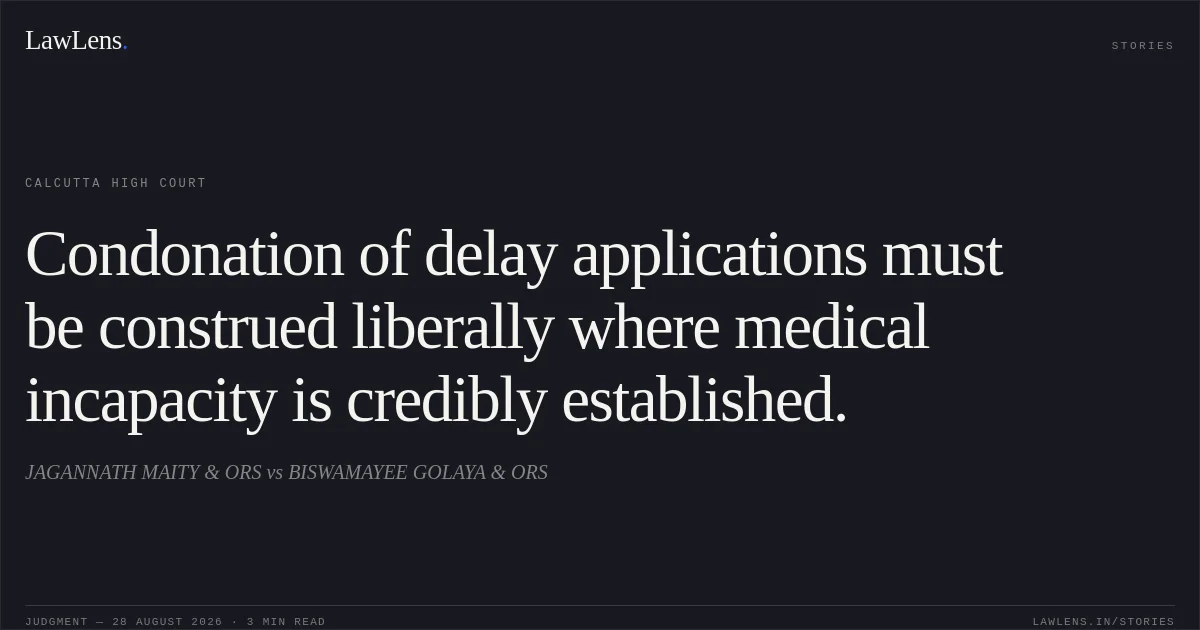
Source reference: no citationThe Court reiterated the settled principle that applications for condonation of delay should receive a liberal construction.
Source reference: para. 12The underlying review proceeding was filed under Order 47 Rule 1 read with Section 151 of the Code of Civil Procedure, 1908, seeking recall or review of the decree allegedly passed pursuant to a compromise to which the petitioners had not consented.
Source reference: para. 8The Court further held that the assessment of sufficient cause should not be based on hyper-technical or unwarranted assumptions concerning the applicant’s medical treatment.
Source reference: paras. 11–12Reasoning
The petitioners relied on medical material showing that petitioner No. 2 suffered from jaundice and underwent treatment between 8 August 1994 and 1 August 1995.
Source reference: paras. 10–11The Trial Court rejected this explanation because the medical certificate did not specifically advise bed rest and because treatment had been obtained at Arambagh, approximately 60 kilometres from the petitioner’s residence.
Source reference: paras. 10–11The High Court held that these considerations did not justify rejecting the explanation for delay.
Source reference: para. 12It found no proper basis for questioning why treatment was taken at that location or for treating the absence of an express bed-rest direction as conclusive proof that petitioner No. 2 could have taken steps in the review proceeding.
Source reference: para. 12Applying the liberal approach required under Section 5, the Court concluded that the Trial Court had adopted an unduly technical approach and had failed to properly assess the explanation advanced by the petitioners.
Source reference: paras. 11–13Holding
The High Court allowed the revisional application and set aside the order dated 21 February 2009 passed by the learned 1st Civil Judge, Senior Division, Howrah in Misc. Case No. 8 of 1995.
The petitioners’ application under Section 5 of the Limitation Act, 1963 was allowed, thereby condoning the delay in filing the review application.
Source reference: para. 13The Trial Court was directed to consider and dispose of the review application as early as possible.
Source reference: para. 13CO 809 of 2009 was accordingly disposed of.
Source reference: para. 14Acts & Sections Cited
2 provisions across 2 statutes referred to in this judgment. Each provision opens on LawLens.
Limitation Act, 19631
Code of Civil Procedure, 19081
Original Court PDF
JAGANNATH MAITY & ORSvsBISWAMAYEE GOLAYA & ORS
Click to open original judgment
Original judgment, available to read, download and summarize on LawLens.in
![Courts will not interfere with transfers absent mala fides or violation of statutory rules.. M Ramya vs EMPLOYEES STATE INSURANCE CORPORATION (ESIC). CAT - ['Chennai']. LawLens](/stories/thumbnails/courts-will-not-interfere-with-transfers-absent-mala-fides-or-violation-of-statutory-rules-a6845e9ca6f548fca284c51c8351957f.webp)
![Courts cannot direct one-time recruitment age relaxation absent authority in the governing rules or advertisement.. UT OF PUDUCHERRY vs M ANDAL. CAT - ['Chennai']. LawLens](/stories/thumbnails/courts-cannot-direct-one-time-recruitment-age-relaxation-absent-authority-in-the-governing-895d78fde47143e2a8ed0207c4b6a44f.webp)
![A review cannot correct an allegedly erroneous decision absent an error apparent on the record.. Ajit Kumar Jha vs RAILWAY BOARD. CAT - ['Delhi']. LawLens](/stories/thumbnails/a-review-cannot-correct-an-allegedly-erroneous-decision-absent-an-error-apparent-on-the-re-8ac952fd4eba470c92f7da20af72a220.webp)