Facts
The appellant society filed a civil suit for declaration and permanent injunction, which was dismissed by the Trial Court on 22/02/2011.
Source reference: p.1The appellant filed a regular first appeal on 09/05/2013, resulting in a delay of 2 years and 46 days.
Source reference: p.2The appellant submitted an application under Section 5 of the Limitation Act, contending that their counsel failed to communicate the judgment and they only discovered the status of the case when the respondent began construction on the site on 10/04/2013.
Source reference: p.2The First Appellate Court rejected the condonation application on 10/05/2013.
Source reference: p.2The appellant subsequently challenged this rejection through the present Second Appeal under Section 100 of the CPC.
Source reference: p.2Issues
1. Whether the learned First Appellate Court erred in dismissing the appeal on the ground of limitation?
Source reference: p.2 / para. 2Law Applied
Section 5 of the Limitation Act, 1963, regarding the condonation of delay for "sufficient cause".
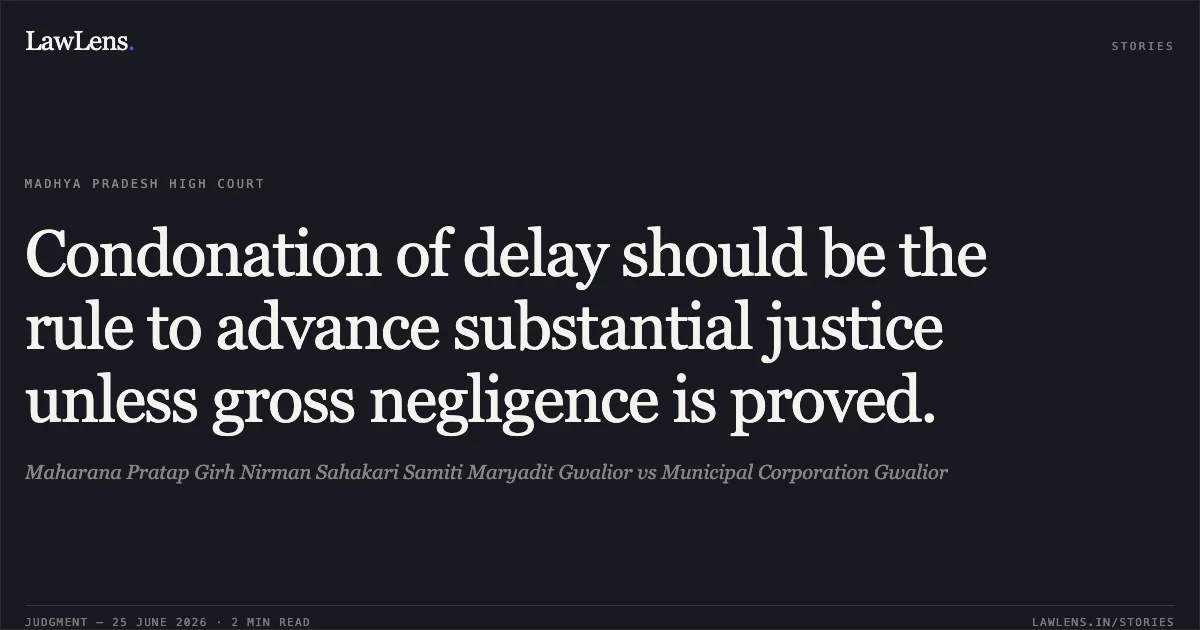
Source reference: p.2-4The term “sufficient cause” must receive a liberal construction to advance substantial justice.
Source reference: p.3Acceptance of an explanation for delay should be the rule, while rejection should be the exception, provided there is no gross negligence, inaction, or lack of bona fides.
Source reference: para. 8Reasoning
The Court reasoned that the appellant society stood to gain no benefit from delaying the appeal and, conversely, its members would suffer irreparable injury if the case were not heard on merits.
Source reference: p.4The Court observed that the First Appellate Court had adopted a "pedantic and hyper-technical" approach.
Source reference: para. 8It accepted the appellant’s explanation that a change in the Society’s President, coupled with the counsel's failure to communicate the Trial Court's decision, constituted a bona fide mistake rather than intentional negligence.
Source reference: para. 9Following the balancing test established in Ram Nath Sao, the Court held that since the stakes were high and the explanation plausible, the interest of justice required a liberal approach over a technical dismissal.
Source reference: para. 8-9Holding
The Court answered the substantial question of law in favor of the appellant, holding that the First Appellate Court erred in its dismissal.
The High Court set aside the order dated 10/05/2013, allowed the application under Section 5 of the Limitation Act, and condoned the delay. The matter was remitted to the First Appellate Court for a decision on merits, with a direction for the parties to appear on 21st July 2026.
Source reference: p.5Acts & Sections Cited
3 provisions across 2 statutes referred to in this judgment. Each provision opens on LawLens.
Limitation Act, 19631
Code of Civil Procedure, 19082
Original Court PDF
Maharana Pratap Girh Nirman Sahakari Samiti Maryadit GwaliorvsMunicipal Corporation Gwalior
Click to open original judgment
Original judgment, available to read, download and summarize on LawLens.in