Facts
The petitioners, owners of land at Survey No. 1659 in Agar Malwa, obtained a partition order from the Tehsildar under Section 178 of the M.P. Land Revenue Code (MPLRC) on 04.02.2022.
Source reference: para. 2After a delay of twenty-three months, Respondent No. 4 challenged this order before the Sub-Divisional Officer (SDO) under Section 44(2) of the MPLRC, along with an application under Section 5 of the Limitation Act, 1963.
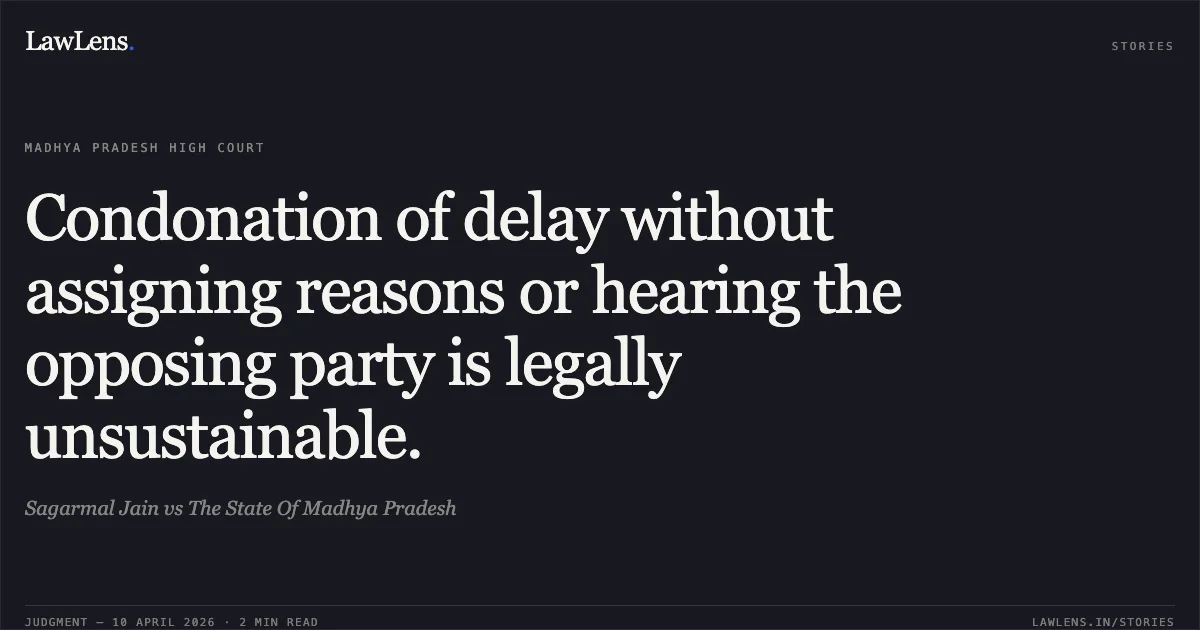
Source reference: para. 2On 07.11.2024, the SDO condoned the delay without issuing notice to the petitioners or providing an opportunity for a hearing.
Source reference: para. 2The petitioners’ subsequent revision petition against this order was dismissed by the Additional Collector on 22.01.2025 via a "non-speaking" order.
Source reference: para. 2Following further procedural orders by the SDO, a second revision was dismissed on 18.06.2025.
Source reference: para. 2The petitioners challenged these orders before the High Court under Article 227 of the Constitution.
Source reference: para. 1Issues
1. Whether the SDO’s order condoning a twenty-three-month delay without notice or hearing to the affected parties violated the principles of natural justice.
Source reference: para. 2 / para. 52. Whether the revisional orders passed by the Additional Collector were legally sustainable given the lack of specific reasoning for affirming the condonation of delay.
Source reference: para. 7Law Applied
Principles of Natural Justice, specifically the right to a fair hearing (audi alteram partem), which necessitates notice to the opposing party before prejudicial orders are passed.
Source reference: para. 4Section 5 of the Limitation Act, 1963, which requires "sufficient cause" to be shown for delay condonation, and established that such applications cannot be allowed mechanically.
Source reference: para. 7necessity of "Speaking Orders," holding that judicial and quasi-judicial authorities must assign specific reasons for their conclusions to ensure legal sustainability.
Source reference: para. 7Reasoning
The High Court observed that the SDO’s initial order dated 07.11.2024 was procedurally flawed as it condoned a significant delay of twenty-three months without affording the petitioners an opportunity to object.
Source reference: para. 2Upon reviewing the Additional Collector’s revisional order dated 22.01.2025, the court found it "not sustainable in the eyes of law" because it failed to assign any substantive reasons for allowing the limitation application.
Source reference: para. 7The court rejected the lower authority’s logic that the delay could be condoned simply because "no harm is being caused to any of the parties," noting that such a rationale does not satisfy the legal requirement for a reasoned adjudication on the merits of a Section 5 application.
Source reference: para. 7Consequently, the lack of notice and the perfunctory nature of the impugned orders constituted a gross illegality.
Source reference: para. 7Holding
The High Court allowed the petition and set aside the impugned orders dated 18.06.2025 and 22.01.2025.
The court remanded the matter, directing the SDO to decide the application filed under Section 5 of the Limitation Act afresh by passing a "speaking and reasoned order" after providing both parties a proper opportunity to be heard.
Source reference: para. 7The SDO was ordered to dispose of the application within sixty days of the filing of the High Court's order.
Source reference: para. 7Acts & Sections Cited
6 provisions across 3 statutes referred to in this judgment. Each provision opens on LawLens.
MP Land Revenue Code 19594
Limitation Act, 19631
Code of Civil Procedure, 19081
Original Court PDF
Sagarmal JainvsThe State Of Madhya Pradesh
Click to open original judgment
Original judgment, available to read, download and summarize on LawLens.in