Facts
The petitioner’s predecessor, Late Kunwar Devi, obtained a mutation order for agricultural land on 30.12.2015, which was affirmed by the Additional Collector on 28.07.2017
Source reference: p. 2Consequently, the Tehsildar implemented these orders on 22.06.2018, correcting the revenue records
Source reference: p. 3Meanwhile, Respondents No. 3 to 5 filed a civil suit (No. 139-A/2016) claiming rights over the same property, which was dismissed in 2019 and affirmed in appeal in 2022, concluding they had no title
Source reference: p. 3On 10.01.2025, nearly seven years later, the respondents challenged the Tehsildar’s 2018 order before the Sub-Divisional Officer (SDO). They claimed they only gained knowledge of the order on 09.01.2025
Source reference: p. 4The SDO condoned the delay without specific findings of "sufficient cause," and the Additional Collector dismissed the petitioner's revision against this condonation on 24.07.2025
Source reference: p. 4Issues
1. Whether the revenue authorities exercised their jurisdiction arbitrarily by condoning an unexplained delay of nearly seven years under Section 5 of the Limitation Act
Source reference: p. 4-52. Whether the respondents' plea of "lack of knowledge" was sustainable in light of their own pleadings in prior civil litigation
Source reference: p. 6Law Applied
The court applied Section 5 of the Limitation Act, 1963, which requires the applicant to demonstrate "sufficient cause" for delay
Source reference: p. 5It emphasized the principle that while "sufficient cause" should receive a liberal, justice-oriented interpretation to avoid defeating substantive justice, it cannot be used to condone gross negligence or validate demonstrably false explanations that render the law of limitation otiose
Source reference: p. 7, 10The court also relied on the principle of Public Policy, which dictates that limitation ensures certainty and finality in litigation, preventing the unsettling of crystallized rights through stale claims
Source reference: p. 8, 11Reasoning
The Court found that the respondents had categorical knowledge of the revenue proceedings as early as 2016, evidenced by paragraph 3 of their own civil suit plaint, where they specifically mentioned the SDO's 2015 mutation order and the subsequent appeal
Source reference: p. 6, 10Therefore, their claim of discovering the Tehsildar's consequential 2018 order only in 2025 was factually incorrect and lacked bona fides
Source reference: p. 6The Court reasoned that the SDO acted mechanically by failing to record an objective satisfaction of "sufficient cause" and by ignoring the finality of the Civil Court judgments which had already negatived the respondents' title
Source reference: p. 7, 11The Court held that a "liberal approach" cannot save a party who "approbates and reprobates" regarding their knowledge of judicial records
Source reference: p. 6Holding
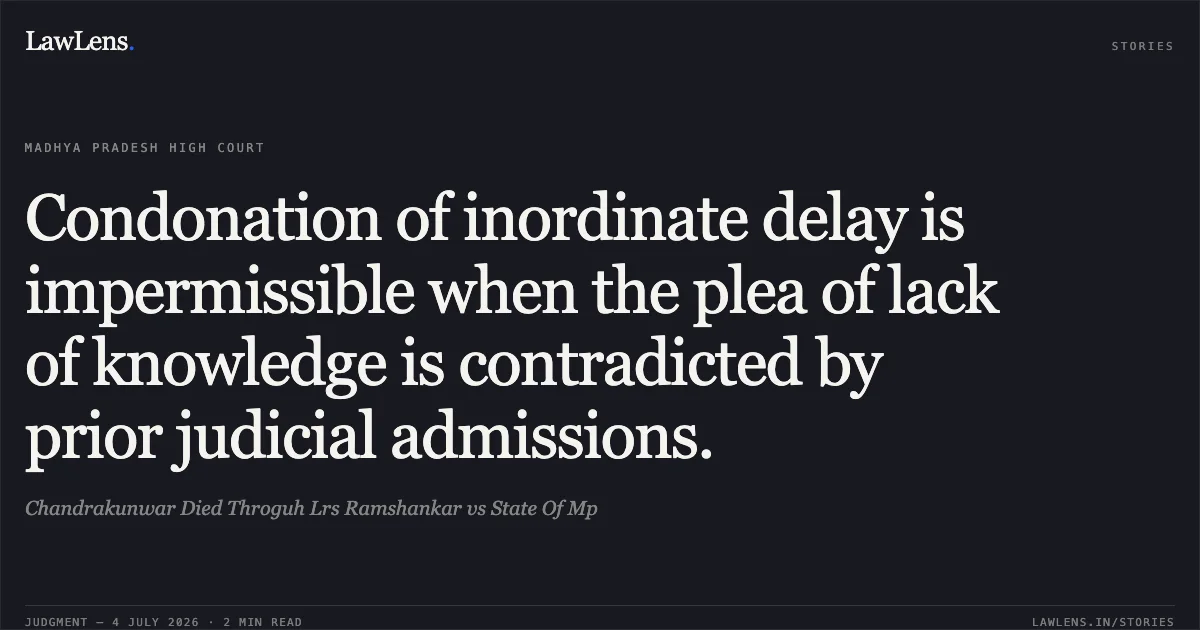
The Court held that the application under Section 5 of the Limitation Act stood dismissed as the respondents failed to show sufficient cause and their explanation was contradicted by the record
The Court allowed the writ petition and quashed the impugned orders of the SDO (24.04.2025) and the Additional Collector (24.07.2025). Consequently, the statutory appeal filed by Respondents No. 3 to 5 against the Tehsildar's 2018 order was dismissed as barred by limitation
Source reference: p. 11-12Acts & Sections Cited
1 provisions across 1 statute referred to in this judgment. Each provision opens on LawLens.
Limitation Act, 19631
Original Court PDF
Chandrakunwar Died Throguh Lrs RamshankarvsState Of Mp
Click to open original judgment
Original judgment, available to read, download and summarize on LawLens.in


![Subsequent exoneration does not retrospectively invalidate a finalized promotion select list.. UNNIKRISHNAN M vs M/o Environment And Forests. CAT - ['Ernakulam']. LawLens](/stories/thumbnails/subsequent-exoneration-does-not-retrospectively-invalidate-a-finalized-promotion-select-li-ce80a0e84f2f4887857271e8b4341c42.webp)