Facts
The respondent, a solvent dealer, had a tanker containing 12,000 liters of FA Residual Oil intercepted on June 25, 2007. Following an FSL report suggesting the oil was furnace oil mixed with water, the Mamlatdar alleged irregularities, including lack of a furnace oil license and maintenance of false accounts.
Source reference: pp. 2-3Consequently, the Collector, Bhavnagar, ordered the confiscation of the stock (valued at ₹2,74,560) and 5% of the tanker’s value.
Source reference: p. 3The respondent appealed this to the Additional Sessions Judge, Bhavnagar, who quashed the confiscation order on October 5, 2011.
Source reference: p. 3The State filed this revision application challenging that acquittal.
Source reference: p. 1Issues
1. Whether the confiscation of goods is sustainable in the absence of evidence regarding black-marketing or improper sampling procedures.
Source reference: p. 52. Whether technical breaches, such as failure to maintain a stock register, justify the extreme measure of confiscation under the Essential Commodities Act.
Source reference: p. 5Law Applied
The court applied Sections 397 (Section 438 BNSS) and 401 (Section 442 BNSS) of the CrPC regarding revisional jurisdiction.
Source reference: p. 1Substantively, it relied on Section 3 of the Solvent Refrinate and Slop (Purchase, Sale Stock and Prohibition of use in Automobiles) Order, 2000, and Sections 8 and 9 of the Gujarat Essential Commodities (Control and Regulation of Business) Order, 1977.
Source reference: p. 2The court reinforced the principle from Karan Oil Industries v. District Collector and N. Nagender Rao & Co. v. State of Andhra Pradesh that technical breaches do not warrant confiscation unless accompanied by allegations of black-marketing.
Source reference: pp. 5-6Reasoning
The High Court observed that the FSL report was unreliable because the sampling procedure violated natural justice; specifically, the respondent was not provided a sample for independent testing.
Source reference: p. 5The Court noted that the respondent provided reasonable explanations for the purchase and supply origins and found no evidence of past involvement in illegal trade.
Source reference: p. 5Critically, the Court reasoned that while technical irregularities like failure to maintain a stock register or address discrepancies on vouchers were present, these do not automatically prove "black-marketing".
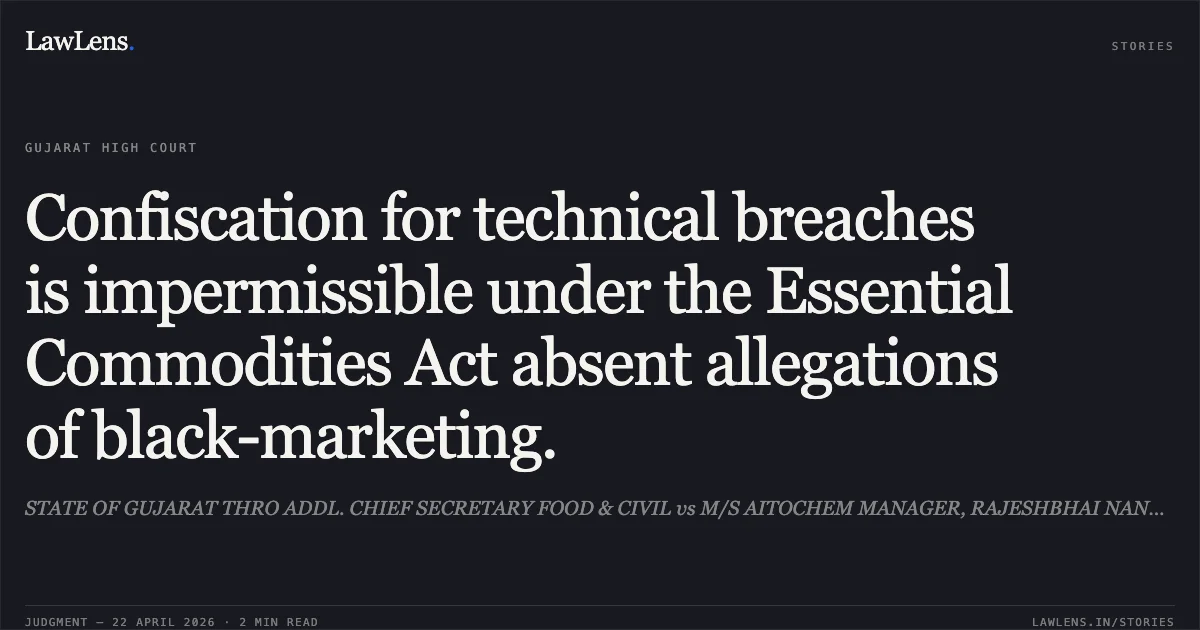
Source reference: p. 5Following established precedents, the Court determined that the seizure and confiscation of essential commodities are disproportionate penalties for mere technical or clerical errors in the absence of a proven intent to bypass the regulated market.
Source reference: pp. 5-6Holding
It held that the confiscation of goods was impermissible due to the lack of evidence of black-marketing and the failure of the authorities to follow proper sampling procedures.
The High Court dismissed the State's revision application and upheld the Additional Sessions Judge's judgment. The order dated April 21, 2011 (as per judgment date) finalized the release of the confiscated goods to the respondent.
Source reference: p. 6Acts & Sections Cited
5 provisions across 3 statutes referred to in this judgment. Each provision opens on LawLens.
Code of Criminal Procedure, 19732
Bharatiya Nagarik Suraksha Sanhita, 20232
Essential Commodities Act, 19551
Original Court PDF
STATE OF GUJARAT THRO ADDL. CHIEF SECRETARY FOOD & CIVILvsM/S AITOCHEM MANAGER, RAJESHBHAI NANDLAL PAREKH
Click to open original judgment
Original judgment, available to read, download and summarize on LawLens.in


![Subsequent exoneration does not retrospectively invalidate a finalized promotion select list.. UNNIKRISHNAN M vs M/o Environment And Forests. CAT - ['Ernakulam']. LawLens](/stories/thumbnails/subsequent-exoneration-does-not-retrospectively-invalidate-a-finalized-promotion-select-li-ce80a0e84f2f4887857271e8b4341c42.webp)