Facts
The respondent, a dealer in free-sale kerosene operating as Maruti Traders, was inspected by the Mamlatdar on April 29, 2002, during which irregularities in stock maintenance were discovered
Source reference: p. 2Consequently, a seizure order was passed for the kerosene stock, and the District Supply Officer (DSO) issued a show-cause notice under the Essential Commodities Act on May 23, 2002
Source reference: p. 2On June 19, 2002, the DSO ordered the confiscation of 2,000 liters out of the 6,630 liters of kerosene seized
Source reference: p. 2The respondent challenged this before the Additional Sessions Judge, Rajkot, in Appeal No. 08 of 2002.
Source reference: p. 2On June 15, 2009, the appellate court partly allowed the appeal, modifying the DSO's order by releasing 1,000 liters of the confiscated kerosene
Source reference: p. 2The State of Gujarat filed the present revision application seeking to quash the appellate court's order and reinstate the full confiscation
Source reference: p. 1Issues
1. Whether the Additional Sessions Judge was justified in modifying the confiscation order due to procedural lapses and lack of evidence regarding black-marketing
Source reference: p. 3-42. Whether a technical breach, such as failure to maintain stock registers, warrants the confiscation of goods under the Essential Commodities Act in the absence of proof of black-marketing
Source reference: p. 4Law Applied
The court examined the exercise of revisional powers under Section 397 (Section 438 of BNSS) and Section 401 (Section 442 of BNSS) of the CrPC
Source reference: p. 1It applied Section 6A of the Essential Commodities Act, which governs the confiscation of seized commodities
Source reference: p. 2The court relied on the established principle that technical breaches, such as failure to maintain stock registers, do not justify confiscation unless accompanied by evidence of black-marketing, as held in Karan Oil Industries v. District Collector (1996 (1) GLH 614), Patel Ambaram Dubebhai v. State of Gujarat (1999 Cri.L.J 628), and N. Nagender Rao & Co. v. State of Andhra Pradesh (AIR 1994 SC 2663)
Source reference: p. 4Reasoning
The High Court observed that while the DSO found a stock deficit of 2,740 liters and suspected black-marketing, the appellate court correctly identified significant procedural and evidentiary gaps
Source reference: p. 3Specifically, the respondent was denied the opportunity to cross-examine panchwitnesses during the inquiry, rendering the procedure flawed
Source reference: p. 3-4Furthermore, the court noted that apart from the inspecting officer's report, there was no independent evidence or admission on record to prove black-marketing or the sale of kerosene at higher prices
Source reference: p. 4Following judicial precedents, the court reasoned that in cases involving only technical breaches—such as improper maintenance of stock statements—confiscation of goods is not permissible under the Essential Commodities Act
Source reference: p. 4Thus, the appellate court's decision to provide partial relief was deemed legally sound
Source reference: p. 4Holding
The High Court held that the Additional Sessions Judge, Rajkot, committed no error in modifying the confiscation order from 2,000 liters to 1,000 liters
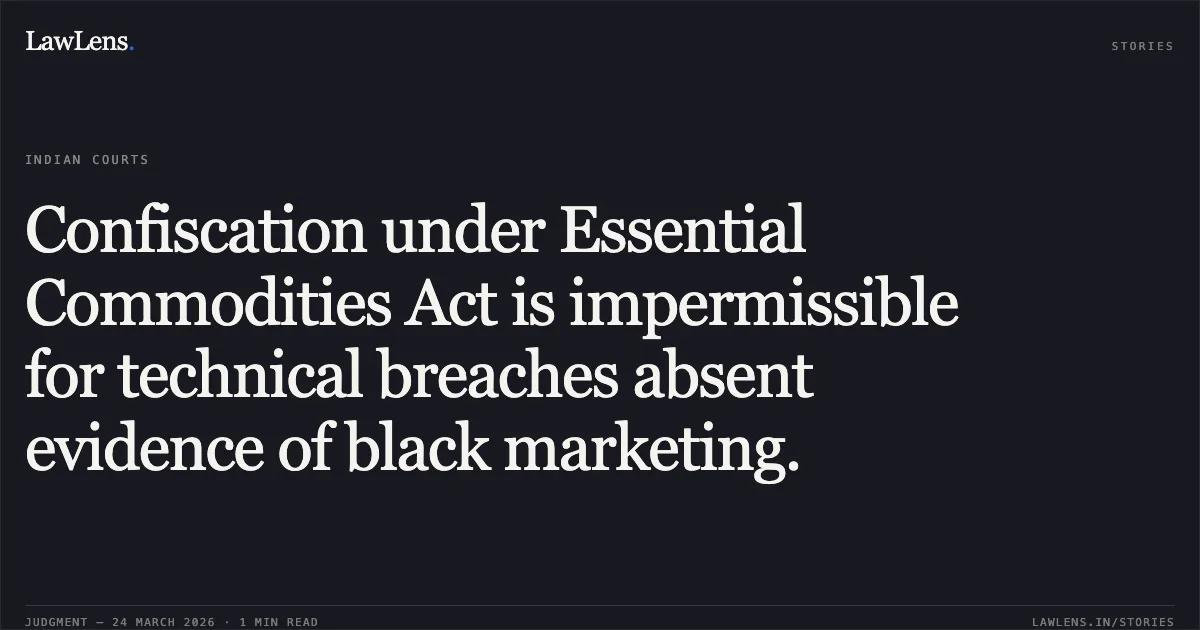
The court affirmed that in the absence of proven black-marketing, full confiscation for a technical breach is unwarranted
Source reference: p. 4Consequently, the revision application filed by the State was dismissed as meritless
Source reference: p. 5Acts & Sections Cited
4 provisions across 2 statutes referred to in this judgment. Each provision opens on LawLens.
Code of Criminal Procedure, 19732
Bharatiya Nagarik Suraksha Sanhita, 20232
Original Court PDF
STATE OF GUJARATvsRANJITBHA GANGABHAI KHUNTI
Click to open original judgment
Original judgment, available to read, download and summarize on LawLens.in


![Subsequent exoneration does not retrospectively invalidate a finalized promotion select list.. UNNIKRISHNAN M vs M/o Environment And Forests. CAT - ['Ernakulam']. LawLens](/stories/thumbnails/subsequent-exoneration-does-not-retrospectively-invalidate-a-finalized-promotion-select-li-ce80a0e84f2f4887857271e8b4341c42.webp)