Facts
The Appellants, while resident in Canada, opened Non-Resident (Non-Repatriable) Rupee Accounts (NRNR Accounts) in India
Source reference: para. 4In 2001, fearing the financial instability of their cooperative banks, the Appellants withdrew funds as loans against these NRNR Accounts and reinvested the proceeds into new NRNR Accounts with different banks
Source reference: para. 5The Respondent issued Show Cause Notices (SCNs) between 2008 and 2009, alleging that reinvesting loan proceeds into subsequent NRNR accounts (rather than using funds remitted from abroad) violated Section 6(3)(f) of the Foreign Exchange Management Act (FEMA), 1999, and Regulation 5(1)(iv) of the FEMA (Deposit) Regulations, 2000
Source reference: para. 4The Adjudicating Authority (AA) imposed penalties and ordered the confiscation of the account balances on 17.08.2010
Source reference: para. 6The Appellate Tribunal dismissed the Appellants' appeals on 31.05.2012
Source reference: para. 7Issues
1. Whether a penalty for contravention of Regulation 5(1)(iv) and Schedule 4 of the FEMA (Deposit) Regulations can be imposed on the account holder, or if the liability rests solely with the "Authorised Dealer"
Source reference: para. 8 / 192. Whether the omission of Regulation 5(1)(iv) by a notification dated 01.03.2002 rendered the subsequently issued SCNs non-maintainable
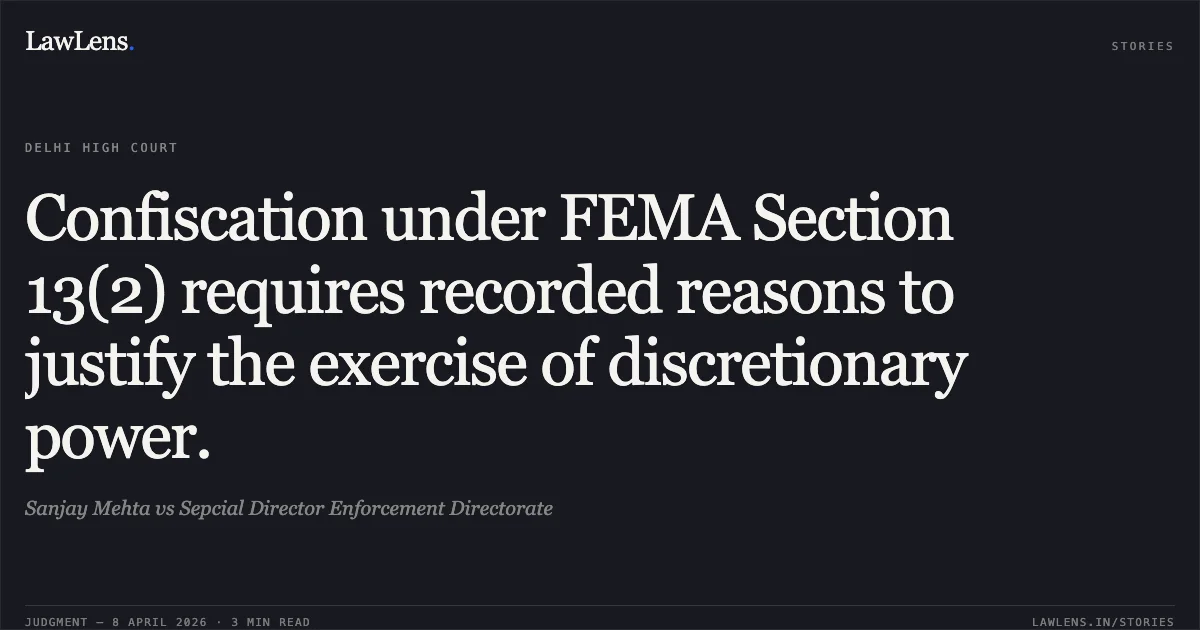
Source reference: para. 9 / 233. Whether the Adjudicating Authority is required to provide specific reasons for ordering the confiscation of property under Section 13(2) of FEMA in addition to imposing a penalty
Source reference: para. 11 / 28Law Applied
The court applied Section 13(1) of FEMA, which prescribes penalties for "any person" who contravenes the Act or its regulations
Source reference: para. 19Section 13(2), which grants the Adjudicating Authority discretionary power to order confiscation "if he thinks fit"
Source reference: para. 27The court relied on Schedule 4 of the FEMA (Deposit) Regulations, 2000, which stipulates that NRNR accounts must be opened using funds remitted from outside India and prohibits the use of loans for "re-lending"
Source reference: para. 18Regarding the effect of legislative omission, the court applied Sections 6 and 6A of the General Clauses Act, 1897, which provide that the repeal or omission of an enactment does not affect previously incurred liabilities or pending investigations unless a different intention appears
Source reference: para. 21The court followed the precedent in Shree Bhagwati Steel Rolling Mills v. Commissioner of Central Excise, which established that "omission" is tantamount to "repeal" for the purposes of the General Clauses Act
Source reference: para. 22Reasoning
The Court rejected the Appellants' first contention, holding that although Regulation 5(1)(iv) addresses the Authorised Dealer, Schedule 4 imposes conditions on the account holder; thus, Section 13(1) of FEMA broadly penalizes "any person" involved in the contravention
Source reference: para. 19-20On the second issue, the Court held that the 2002 amendment omitting the NRNR scheme did not provide an "obliteration" of past violations
Source reference: para. 23Citing Shree Bhagwati Steel Rolling Mills, the Court distinguished the Appellants’ reliance on Rayala Corporation (P) Ltd., noting that the 2002 amendment actually allowed existing NRNR deposits to continue until maturity, proving the legislature did not intend to absolve prior contraventions
Source reference: para. 25-26Finally, regarding confiscation, the Court observed that the power under Section 13(2) is quasi-judicial and discretionary. Consequently, the AA must provide reasons to justify why a penalty alone is insufficient and why the extreme step of confiscation is warranted
Source reference: para. 28The Court noted that the AA's order was "non-speaking" on this front and failed to consider that the loans were repaid and no foreign exchange loss occurred
Source reference: para. 29Holding
The Court partially allowed the appeals.
It upheld the imposition of penalties under Section 13(1), finding the Appellants had technically contravened the NRNR scheme by reinvesting loan proceeds.
Source reference: para. 31The Court set aside the order for the confiscation of the amounts lying in the NRNR accounts, ruling that the order was non-speaking and lacked the necessary reasoning required for discretionary quasi-judicial actions.
Source reference: para. 29-31Given the passage of time since the 2008-2010 proceedings, the Court declined to remand the matter for fresh consideration and directly quashed the confiscation orders.
Source reference: para. 30-31Acts & Sections Cited
6 provisions across 2 statutes referred to in this judgment. Each provision opens on LawLens.
Foreign Exchange Management Act, 19995
General Clauses Act, 18971
Original Court PDF
Sanjay MehtavsSepcial Director Enforcement Directorate
Click to open original judgment
Original judgment, available to read, download and summarize on LawLens.in