Facts
The Commissioner of Police, Pune City, passed a detention order against the petitioner on 10 October 2025 under the Maharashtra Prevention of Dangerous Activities Act, 1981 (MPDA Act), with a separate order directing his detention at Chandrapur.
Source reference: para. 1, p. 1The grounds of detention referred to the petitioner’s past offences and preventive action, as well as one registered offence and two in-camera witness statements.
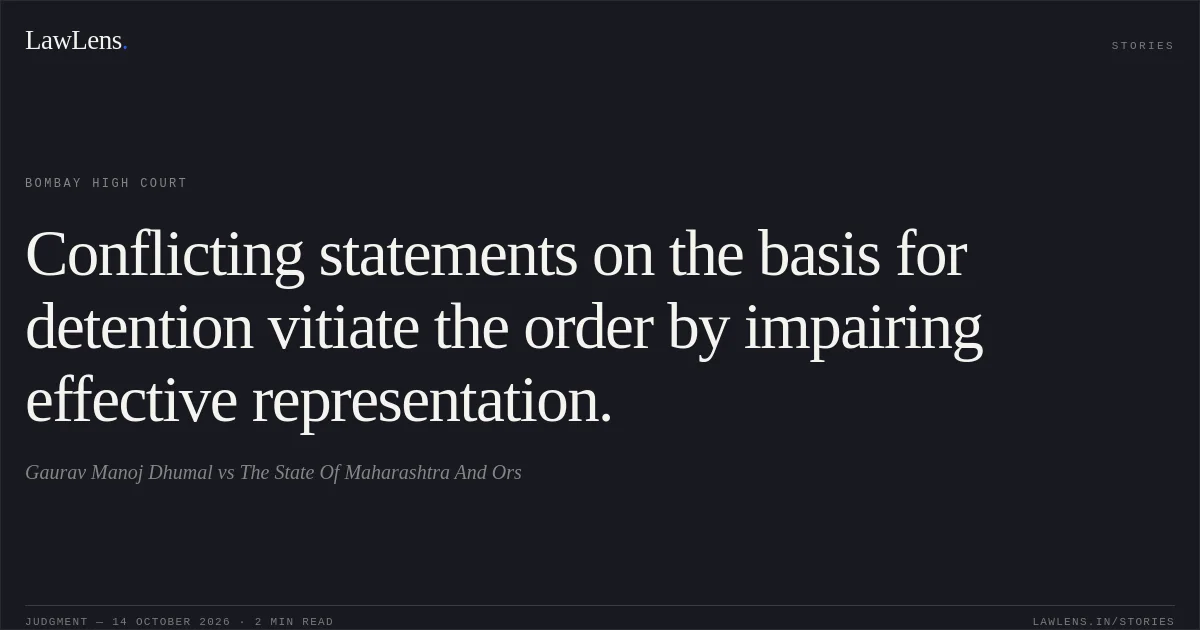
Source reference: paras. 6–10, pp. 3–5The petitioner argued that paragraphs 2 and 8 of the grounds gave conflicting accounts of the material relied upon, impairing his ability to make an effective representation.
Source reference: paras. 3–4, p. 2The State opposed the contention.
Source reference: para. 4, p. 2Issues
Whether the grounds of detention contained conflicting statements about the material relied upon by the Detaining Authority to reach its subjective satisfaction.
Source reference: paras. 11, 13, pp. 5–7Whether that conflict prejudiced the petitioner’s right to make his earliest effective representation and rendered the detention order unsustainable.
Source reference: para. 13, p. 7Law Applied
Section 2(b-1) of the MPDA Act defines a “dangerous person” as one who habitually commits, attempts to commit, or abets specified offences under Chapters XVI or XVII of the Indian Penal Code or Chapter V of the Arms Act, 1959.
Source reference: para. 12, p. 6Section 2(a)(iv) provides that, in the case of a dangerous person, conduct is prejudicial to the maintenance of public order where the person is engaged, or preparing to engage, in activities as a dangerous person that adversely affect or are likely to adversely affect public order.
Source reference: para. 12, p. 6The Court treated strict compliance with these requirements, and clarity in the grounds enabling an effective representation, as essential to the validity of the detention.
Source reference: paras. 12–13, pp. 6–7Reasoning
Paragraph 2 of the grounds linked the petitioner’s status as a dangerous person and the alleged prejudice to public order to his past criminal activities, including IPC offences.
Source reference: paras. 6, 13, pp. 3, 6By contrast, paragraph 8 stated that the Detaining Authority had relied on the latest registered offence and two in-camera statements to reach the same subjective satisfaction.
Source reference: paras. 11, 13, pp. 5–7The Court found these accounts to be in conflict, creating uncertainty about the basis of detention.
Source reference: para. 13, p. 7That uncertainty directly affected the petitioner’s ability to make his earliest effective representation; accordingly, the detention order could not stand.
Source reference: para. 13, p. 7Holding
The Court held that the conflicting statements in the grounds of detention prejudiced the petitioner’s right to make an effective representation and rendered the detention order unsustainable.
It made the rule absolute in terms of prayer clause (B) and ordered the petitioner’s release forthwith, unless required in another case.
Source reference: Order, p. 7Acts & Sections Cited
7 provisions across 3 statutes referred to in this judgment. Each provision opens on LawLens.
Bharatiya Nyaya Sanhita, 20235
Code of Criminal Procedure, 19731
Bharatiya Nagarik Suraksha Sanhita, 20231
Original Court PDF
Gaurav Manoj DhumalvsThe State Of Maharashtra And Ors
Click to open original judgment
Original judgment, available to read, download and summarize on LawLens.in