Facts
Applicant No. 3 and Opposite Party No. 2 (OP2) met through Shaadi.com and became engaged on 30.10.2021
Source reference: para. 2-3Marriage dates were fixed for November 2022
Source reference: para. 3In February 2022, Applicant No. 3 received obscene photographs of OP2 from a third party, Haris Javed Ansari, revealing prior undisclosed relationships
Source reference: para. 4Despite a religious oath of fidelity by OP2 and an apology from Ansari, the relationship strained
Source reference: para. 4-5OP2 subsequently fixed her marriage with another person for the same date originally set with the Applicant
Source reference: para. 5OP2 then filed a criminal complaint alleging rape under the false promise of marriage
Source reference: para. 6The applicants sought quashing of the complaint and the summoning order dated 19.11.2022
Source reference: para. 1Issues
1. Whether the act of Applicant No. 3, as alleged in the complaint, constitutes the offence of rape under Section 376 IPC or is a case of consensual sex
Source reference: para. 142. Whether the allegation of rape on the false promise of marriage is prima facie established given the attending circumstances
Source reference: para. 143. Whether the criminal proceedings were instituted with an ulterior motive for wreaking vengeance, warranting interference under Section 482 Cr.P.C.
Source reference: para. 16-17Law Applied
The court applied the distinction between "rape" and "consensual sex" under Section 375 and 376 IPC, noting that "misconception of fact" under Section 90 IPC only vitiates consent if a promise was false from its inception.
Source reference: para. 12It relied on Pramod Suryabhan Pawar v. State of Maharashtra (2019), which holds that a breach of promise made in good faith is not a "false promise".
Source reference: para. 12The court utilized the four-step veracity test from Pradeep Kumar Kesharwani v. State of U.P. (2025) to evaluate material of "sterling quality".
Source reference: para. 19The guidelines in State of Haryana v. Bhajan Lal (1992) regarding the quashing of maliciously instituted proceedings.
Source reference: para. 22It also referenced Mohammad Wajid v. State of U.P. (2023) regarding the duty of the court to "read between the lines" in vexatious litigations.
Source reference: para. 16Reasoning
The court observed that the relationship was initially aimed at marriage, evidenced by the formal engagement and fixing of dates, indicating the Applicant’s bona fide intention.
Source reference: para. 14-15The marriage failed not due to the Applicant's deceit, but because of intervening "unfortunate developments" regarding OP2’s conduct and her prior relationships, which she admitted by way of not rebutting the allegations in her counter-affidavit.
Source reference: para. 15, 21The court found that OP2 committed the breach of promise by marrying another person on the same date.
Source reference: para. 22Consequently, the essential ingredient of Section 376—a false promise made solely to obtain sexual consent without intent to fulfill it—was missing.
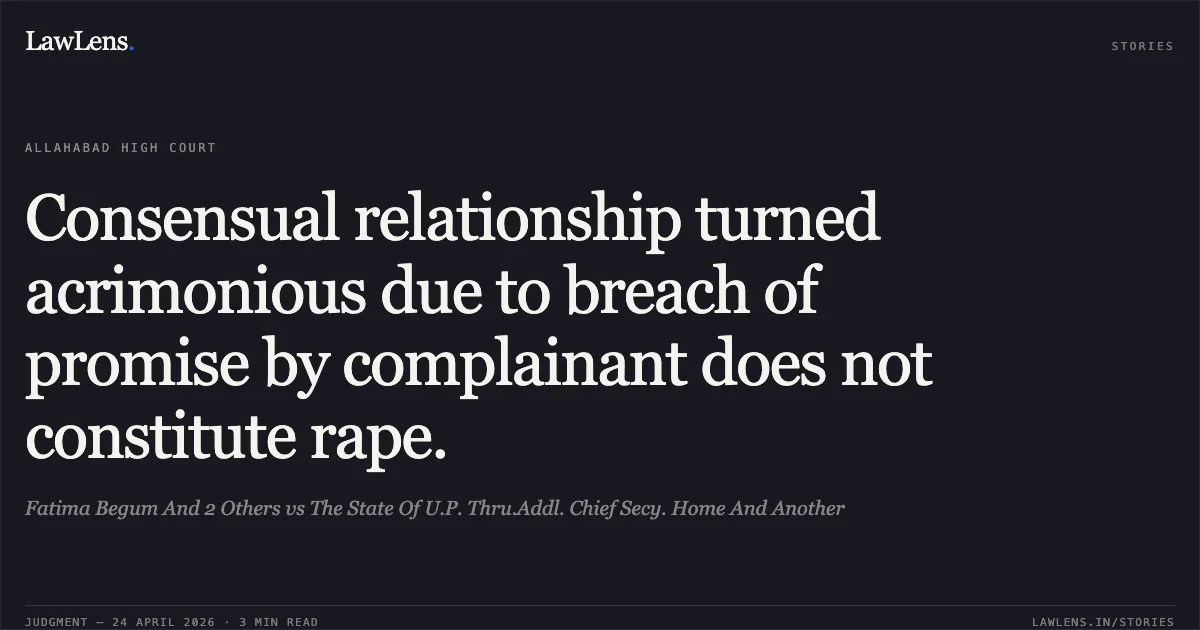
Source reference: para. 15The court determined the complaint was a "classic case of a consensual relationship turning acrimonious" and was filed to settle a personal score after the Applicant discovered OP2's conduct.
Source reference: para. 15, 17Holding
The court answered the issues in the negative, holding that the allegations did not constitute the necessary ingredients of the alleged offences and that the proceedings were manifestly attended with mala fides.
The court held that permitting the trial would be an abuse of process as there was no reasonable prospect of conviction. The application was allowed, and the entire proceedings of Complaint Case No. 53786 of 2022 along with the summoning order dated 19.11.2022 were quashed.
Source reference: para. 24, 25Acts & Sections Cited
5 provisions across 3 statutes referred to in this judgment. Each provision opens on LawLens.
Indian Penal Code, 18603
Hindu Marriage Act, 19551
Special Marriage Act, 19541
Original Court PDF
Fatima Begum And 2 OthersvsThe State Of U.P. Thru.Addl. Chief Secy. Home And Another
Click to open original judgment
Original judgment, available to read, download and summarize on LawLens.in


![Subsequent exoneration does not retrospectively invalidate a finalized promotion select list.. UNNIKRISHNAN M vs M/o Environment And Forests. CAT - ['Ernakulam']. LawLens](/stories/thumbnails/subsequent-exoneration-does-not-retrospectively-invalidate-a-finalized-promotion-select-li-ce80a0e84f2f4887857271e8b4341c42.webp)