Facts
The petitioners, both major adults and neighbors, entered into a consensual love relationship and solemnized their marriage on 27.02.2026 at Arya Samaj, Jaipur, Rajasthan, against the wishes of the second petitioner’s family.
Source reference: p. 3The marriage was subsequently registered before competent authorities.
Source reference: p. 3Following the union, the petitioners alleged they were subjected to continuous threats of "honour killing" and false criminal implication by Respondent Nos. 6 to 11 (the family of Petitioner No. 2).
Source reference: p. 3-4Despite filing written complaints with the police, the petitioners claimed no effective action was taken to ensure their safety.
Source reference: p. 4Consequently, they filed this writ petition seeking police protection and the recording of their statements to fortify their marital status.
Source reference: p. 2-3Issues
1. Whether the petitioners, as consenting adults who married of their own free will, are entitled to police protection against threats to their life and liberty from family members.
Source reference: p. 4 / para. 72. Whether the state authorities are mandated to take preventive measures when a major couple alleges harassment following an inter-caste or controversial marriage.
Source reference: p. 5-6 / para. 8Law Applied
Article 21 of the Constitution of India, which guarantees the right to life and personal liberty, identifying the right to marry a person of one's choice as an integral facet of this fundamental right.
Source reference: p. 4-5The precedent set by the Hon’ble Supreme Court in Lata Singh v. State of U.P. and Another (2006) 5 SCC 475, which established that inter-caste and inter-faith marriages are in the national interest and that the administration must ensure major couples are not harassed or subjected to violence.
Source reference: p. 5Reasoning
The Court observed that since both petitioners are majors and married by choice, their union is legally valid.
Source reference: p. 4-5In applying the Lata Singh doctrine, the Court reasoned that while parents may disapprove of a marriage and sever social ties, they have no legal authority to threaten, harass, or instigate violence against the couple.
Source reference: p. 5The Court found that the apprehension of the petitioners regarding their safety necessitated judicial intervention to uphold their constitutional rights.
Source reference: p. 6It rejected the State's contention that the lack of specific incident details rendered the petition meritless, prioritizing the proactive protection of personal liberty over procedural technicalities of a prior cognizable offense.
Source reference: p. 4, 6Holding
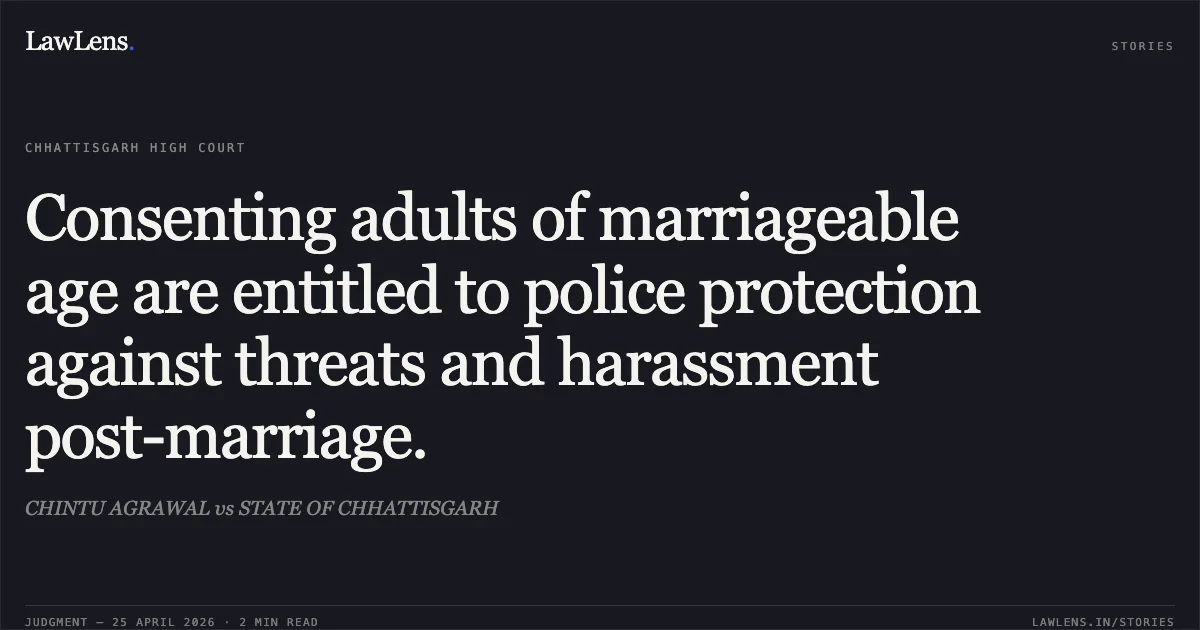
The Court answered the issues in the affirmative, holding that the petitioners’ right to life and liberty must be protected.
The Court directed the Superintendent of Police and the concerned Station House Officer to ensure no harm is caused to the petitioners and to provide necessary protection.
Source reference: p. 6It further ordered that any complaints made by the petitioners be promptly examined for preventive measures and directed the private respondents (family members) not to interfere in the petitioners' peaceful matrimonial life.
Source reference: p. 6The petition was disposed of with no order as to costs.
Source reference: p. 6Original Court PDF
CHINTU AGRAWALvsSTATE OF CHHATTISGARH
Click to open original judgment
Original judgment, available to read, download and summarize on LawLens.in


