Facts
On September 13, 2013, PW2 (the victim's father) filed a missing person report alleging that his 16-year-old daughter (PW4) had been kidnapped by the appellant, Naveen
Source reference: p. 7The prosecution alleged that the appellant took PW4 to Bihar and committed rape between September 12 and September 22, 2013
Source reference: p. 2PW4, in her Section 164 Cr.P.C. statement, claimed she left home voluntarily due to fear of her parents and denied any fault on the appellant's part
Source reference: p. 8-10During the trial, she deposed that they had established "physical relations" with her consent while in Bihar
Source reference: p. 10The Trial Court convicted the appellant under Section 376 IPC and Section 4 of the POCSO Act based on this testimony and medical evidence of a torn hymen
Source reference: p. 5, 12The appellant challenged this conviction, asserting the relationship was consensual and that they had since married
Source reference: p. 4, 6Issues
1. Whether the conviction of the appellant under Section 376 IPC and Section 4 of the POCSO Act is sustainable given the inconsistencies in the prosecutrix's testimony
Source reference: p. 7 / p. 122. Whether the non-compliance with the mandatory hearing under Section 232 Cr.P.C. vitiated the trial proceedings
Source reference: p. 4Law Applied
Under Section 376 of the Indian Penal Code (IPC) and Section 4 of the Protection of Children from Sexual Offences (POCSO) Act, 2012, the consent of a minor is legally immaterial once minority is established.
Source reference: p. 6Section 232 of the Cr.P.C. regarding the discharge of the accused, and the precedent Moidu K. vs. State of Kerala, holds that non-compliance with Section 232 does not vitiate proceedings unless it results in "serious and substantial prejudice" to the accused.
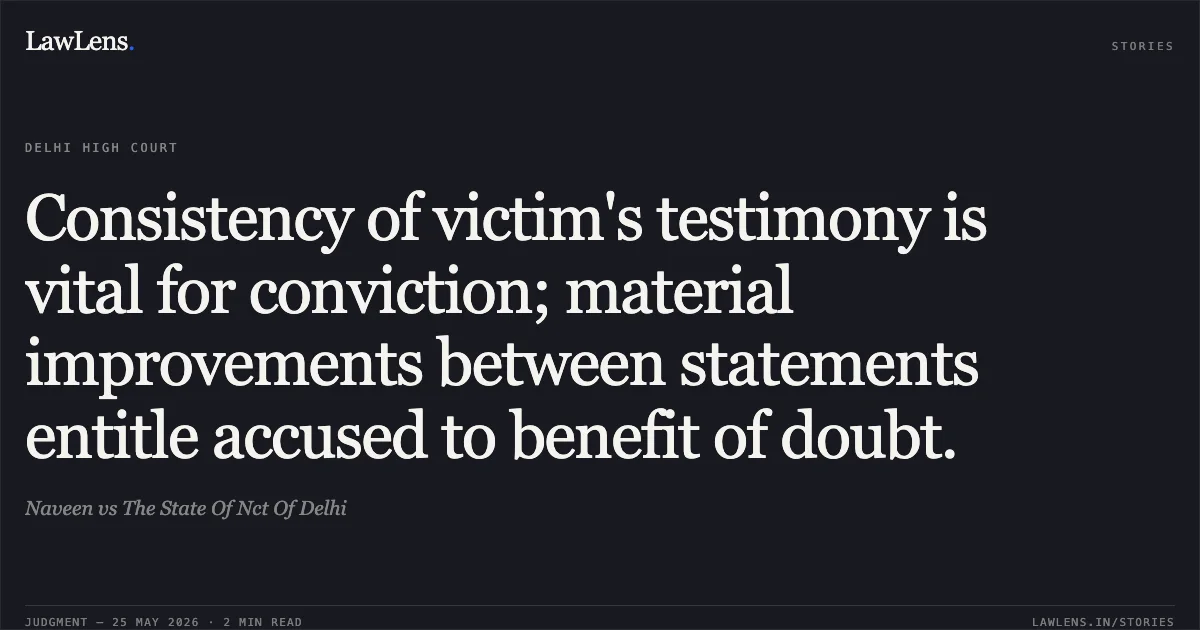
Source reference: p. 4-5While the sole testimony of a prosecutrix can sustain a conviction, such testimony must be of "sterling quality" and free from material improvements.
Source reference: p. 12-13Reasoning
The court first addressed the procedural lapse regarding Section 232 Cr.P.C., concluding that since the appellant failed to show any prejudice, the omission did not invalidate the trial.
Source reference: p. 5The court verified through school records (Ext. PW3/A) that the victim was approximately 15 years and 5 months old at the time of the incident, confirming her status as a minor under the POCSO Act.
Source reference: p. 11The court noted a "material improvement" between her Section 164 statement—where she explicitly stated there was no fault on the appellant’s part and mentioned no sexual contact—and her court deposition, where she alleged physical relations.
Source reference: p. 12-13The court reasoned that because the victim's testimony was inconsistent and failed the "sterling quality" test, it could not be the sole basis for conviction, even when coupled with medical evidence of a torn hymen.
Source reference: p. 13Holding
The court held that the appellant was entitled to the benefit of the doubt due to the unsatisfactory and inconsistent nature of the prosecutrix's testimony.
The High Court allowed the appeal, set aside the judgment and sentencing order, acquitted Naveen of the charges under Section 376 IPC and Section 4 of the POCSO Act, and ordered him to be set at liberty immediately.
Source reference: p. 13-14Acts & Sections Cited
10 provisions across 3 statutes referred to in this judgment. Each provision opens on LawLens.
Code of Criminal Procedure, 19736
Indian Penal Code, 18603
Protection of Children from Sexual Offences Act, 20121
Original Court PDF
NaveenvsThe State Of Nct Of Delhi
Click to open original judgment
Original judgment, available to read, download and summarize on LawLens.in


