Facts
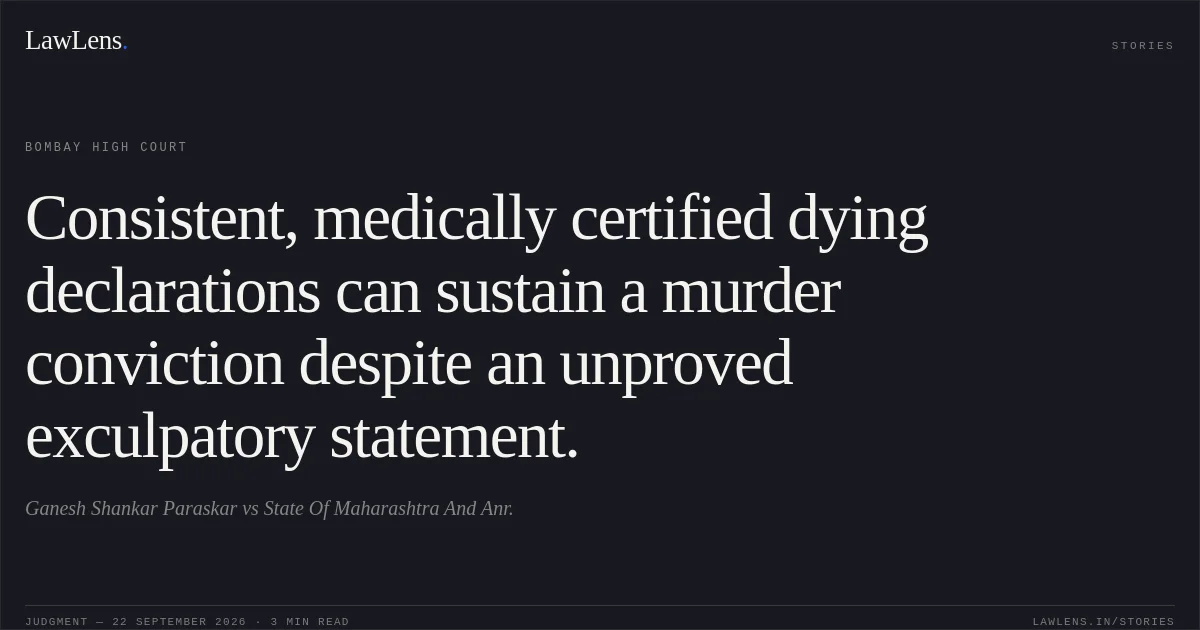
The appellant was convicted by the Additional Sessions Court, Pune, in Sessions Case No. 33 of 2016 for offences under Sections 302, 307, 323 and 506 of the Indian Penal Code, while being acquitted under Sections 498A and 504 IPC.
Source reference: para. 1The prosecution alleged that, after a quarrel, the appellant poured kerosene on his wife, Manisha Paraskar, and set her on fire at about 4:00 a.m. on 12 September 2015.
Source reference: para. 3She sustained approximately 87% burns and was taken first to Saswad PHC and thereafter to Sassoon Hospital, where she died on 14 September 2015.
Source reference: para. 19The prosecution relied principally on two written dying declarations recorded on 13 September 2015, both bearing medical endorsements that Manisha was conscious, oriented and capable of making a statement.
Source reference: paras. 7–10, 13The appellant maintained that the fire was accidental and had resulted from a stove bursting.
Source reference: para. 5Issues
Whether the two written dying declarations, supported by medical endorsements and other evidence, were reliable and sufficient to establish that the appellant intentionally poured kerosene on the deceased and set her on fire?
Source reference: paras. 23–27Whether the alleged earlier statement dated 12 September 2015, stating that the deceased had caught fire because of a bursting stove, required the Court to draw an adverse inference against the prosecution or created reasonable doubt in favour of the appellant?
Source reference: paras. 11–12, 23–24, 29Whether the oral dying declarations and the appellant’s conduct at the scene corroborated the written dying declarations and disproved the defence of accidental burning?
Source reference: paras. 27–29Whether the evidence supported the appellant’s convictions under Sections 307, 323 and 506 IPC in addition to the conviction under Section 302 IPC?
Source reference: para. 29Law Applied
The Court applied Section 302 IPC concerning the offence of murder, and considered the evidentiary value of dying declarations as substantive evidence where the declarant was medically certified to be conscious, oriented and capable of making a statement.
Source reference: paras. 25–26It also applied the principle under Section 106 of the Indian Evidence Act that facts especially within the knowledge of an accused may require explanation by him, particularly where the incident occurred inside a room occupied only by the accused and the deceased.
Source reference: para. 22The Court further applied the rule that an unproved document cannot be relied upon as substantive evidence; accordingly, the alleged statement dated 12 September 2015 was not treated as proved because neither its maker nor the doctor who allegedly endorsed it was examined.
Source reference: paras. 11, 23Conviction under Sections 307, 323 and 506 IPC required independent evidentiary support for the ingredients of those offences, which the Court found absent.
Source reference: para. 29The appellant was also entitled to set-off under Section 428 of the Code of Criminal Procedure.
Source reference: para. 30(iv)Reasoning
The Court found the written dying declarations reliable because the police-recorded declaration was made in the presence of the medical officer, who certified that Manisha was conscious and capable of giving a statement, while the declaration recorded by the Nayab Tahsildar contained medical endorsements at the beginning, middle and end of the recording.
Source reference: paras. 25–26The Court held that the greater detail in the police-recorded declaration did not by itself make it unreliable.
Source reference: paras. 25–26The Tahsildar’s declaration specifically stated that the appellant poured kerosene on Manisha while she was sleeping and set her on fire, thereby attributing a direct and specific role to him.
Source reference: para. 26The alleged earlier exculpatory statement was not proved through competent evidence and therefore could not undermine the prosecution case.
Source reference: paras. 11, 23The oral declarations made immediately to PW-7 and PW-8 were considered consistent with the written declarations and were treated as natural corroboration, since both witnesses had reached the room immediately after hearing the commotion.
Source reference: para. 27The appellant’s conduct—remaining in the room, failing to extinguish the fire or call for help, and offering no satisfactory explanation—was inconsistent with his defence that the fire was accidental.
Source reference: para. 28Taken together, the dying declarations, oral evidence, medical evidence and surrounding circumstances established the appellant’s guilt for murder beyond reasonable doubt.
Source reference: para. 29However, the Court found no sufficient evidence to sustain the separate convictions under Sections 307, 323 and 506 IPC.
Source reference: para. 29Holding
The appeal was partly allowed.
The conviction and sentence under Section 302 IPC—life imprisonment and a fine of Rs. 10,000—were maintained.
Source reference: para. 30(ii)The convictions and sentences under Sections 307, 323 and 506 IPC were set aside for want of sufficient supporting evidence.
Source reference: para. 30(iii)The appellant was granted set-off under Section 428 Cr.P.C.
Source reference: para. 30(iv)Acts & Sections Cited
8 provisions across 2 statutes referred to in this judgment. Each provision opens on LawLens.
Indian Penal Code, 18605
Code of Criminal Procedure, 19733
Original Court PDF
Ganesh Shankar ParaskarvsState Of Maharashtra And Anr.
Click to open original judgment
Original judgment, available to read, download and summarize on LawLens.in