Facts
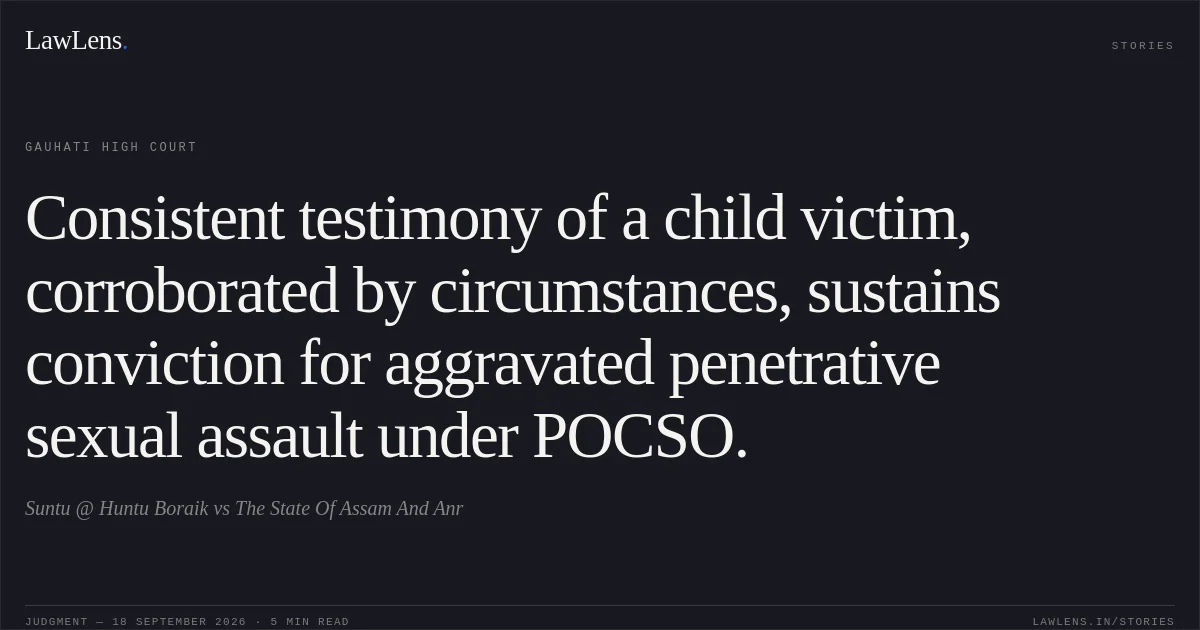
The appellant was prosecuted in POCSO Case No. 43/2021 for allegedly entering the informant’s house area and repeatedly sexually assaulting his minor daughter, aged approximately 10 years, on or about 19.08.2021. The FIR was lodged by the victim’s stepfather, PW-1, on 20.08.2021, leading to registration of Bihubor P.S. Case No. 39/2021 under Section 376(3) IPC read with Section 4 of the POCSO Act.
Source reference: paras. 3–5The Trial Court framed charges under Sections 448 and 376(AB) IPC and Section 6 of the POCSO Act. After examining the prosecution witnesses and the accused under Section 313 CrPC, the Trial Court acquitted the appellant of the charge under Section 448 IPC but convicted him under Section 376(AB) IPC and Section 6 of the POCSO Act. He was sentenced to 20 years’ rigorous imprisonment and a fine of ₹10,000, with six months’ further rigorous imprisonment in default.
Source reference: paras. 6–8, 14; para. 2The prosecution case primarily rested on the testimony of the victim child, who stated that the appellant took her to a bamboo grove and inserted his penis into her vagina. PW-4 deposed that the victim disclosed the assault to her shortly after the occurrence, while PW-6 stated that he saw the appellant and the victim emerging from the bamboo grove and that the appellant fled when questioned.
Source reference: para. 18; paras. 21, 23The medical examination disclosed no external injuries or signs of recent sexual intercourse, although the hymen was recorded as absent. The victim’s age was sought to be established through her birth certificate and other evidence, showing that she was below 12 years of age at the relevant time.
Source reference: para. 25; para. 34Issues
Whether the prosecution proved beyond reasonable doubt that the victim was below 12 years of age at the time of the occurrence, thereby attracting Section 376(AB) IPC and the aggravated offence under Section 6 of the POCSO Act?
Source reference: paras. 12–14, 34Whether the conviction could be sustained primarily on the testimony of the victim child despite the absence of an eyewitness to the actual sexual assault and the absence of injuries or signs of recent intercourse in the medical examination?
Source reference: paras. 30–37Whether the evidence of the surrounding witnesses and the statutory presumptions under Sections 29 and 30 of the POCSO Act corroborated the victim’s version sufficiently to sustain the conviction?
Source reference: paras. 32–40Whether the appellant was entitled to interference with the conviction and sentence in appeal under Section 374 CrPC?
Source reference: para. 2Law Applied
The Court applied Section 374 CrPC governing appeals against conviction; Sections 376(AB) and 448 IPC; and Section 6 of the POCSO Act concerning aggravated penetrative sexual assault on a child below 12 years of age.
Source reference: paras. 2, 6–8It relied on the principle that the credible and trustworthy testimony of a prosecutrix or victim of sexual assault can, by itself, sustain a conviction without mandatory corroboration, and that the absence of injuries or medical signs of recent intercourse is not conclusive where the oral testimony is reliable.
Source reference: para. 38Relying on Rai Sandeep @ Deepu v. State (NCT of Delhi), the Court explained that a “sterling witness” is one whose testimony is consistent, natural, unimpeachable and withstands cross-examination.
Source reference: para. 37It also relied on Ganesan v. State, which recognizes that conviction may be based on the sole testimony of a child victim if it is trustworthy, reliable and of sterling quality.
Source reference: para. 38The Court further applied the statutory presumptions under Sections 29 and 30 of the POCSO Act, as considered by the Trial Court, and the principle that the evidence of a competent child witness may form the basis of conviction if it inspires confidence.
Source reference: para. 39Reasoning
The Court found the victim’s account materially consistent across her statements under Sections 161 and 164 CrPC and her deposition before the Trial Court: she consistently attributed the penetrative sexual assault to the appellant and identified the bamboo grove as the place of occurrence.
Source reference: paras. 18, 26, 37The Court treated the victim as a competent witness after the Trial Court conducted a preliminary assessment of her understanding and ability to answer questions.
Source reference: para. 17Her evidence was considered corroborated by PW-4’s account of the immediate disclosure, PW-6’s evidence that he saw the appellant and the victim emerging together from the bamboo grove and that the appellant fled when questioned, and the evidence regarding the appellant’s subsequent apprehension.
Source reference: paras. 32–33, 35The Court rejected the defence argument based on the lack of physical injuries or recent sexual-intercourse findings. It reasoned that the victim had disclosed earlier instances of sexual intercourse by the appellant and had stated that she did not experience pain or bleeding during the particular incident; consequently, the medical findings did not discredit her testimony.
Source reference: paras. 25, 36The Court also held that the omission concerning earlier assaults was not a material contradiction and did not affect the core prosecution case.
Source reference: para. 37The birth certificate, corroborated by the evidence of the hospital official and the victim’s father, established that the victim was below 12 years of age.
Source reference: para. 34On the allegation of repeated sexual assault, the Court held that Section 6 of the POCSO Act was attracted.
Source reference: para. 40Accordingly, the Court found no infirmity in the Trial Court’s reliance on the victim’s testimony and supporting circumstances.
Source reference: no citationHolding
The High Court dismissed the criminal appeal and affirmed the appellant’s conviction under Section 376(AB) IPC and Section 6 of the POCSO Act, along with the sentence of 20 years’ rigorous imprisonment and a fine of ₹10,000, with six months’ further rigorous imprisonment in default.
The Court held that the victim’s testimony was trustworthy and sufficiently corroborated by the surrounding evidence, that the absence of medical injuries did not create reasonable doubt, and that the victim was below 12 years of age.
Source reference: no citationThe Trial Court’s acquittal of the appellant under Section 448 IPC was not disturbed.
Source reference: para. 14The record was directed to be returned to the Trial Court, and payment of fees to the Legal Aid Counsel was directed.
Source reference: paras. 42–43Acts & Sections Cited
12 provisions across 3 statutes referred to in this judgment. Each provision opens on LawLens.
Code of Criminal Procedure, 19734
Indian Penal Code, 18602
Protection of Children from Sexual Offences Act, 20126
Original Court PDF
Suntu @ Huntu BoraikvsThe State Of Assam And Anr
Click to open original judgment
Original judgment, available to read, download and summarize on LawLens.in