01Facts
The prosecution alleged that Accused No. 1 (A1), while in judicial custody, called Accused No. 2 (A2) and conspired to commit dacoity at the house of CW-4 (PW-1 Saraswathi) on the intervening night of 13/14.01.2012.
¶ 3A2 to A7 allegedly attempted the dacoity at 12:45 a.m., armed with deadly weapons.
¶ 3The Srirangapatna Police filed a charge-sheet under Sections 399, 400, 402 and 120B IPC; the case was committed to the Sessions Court as S.C. No. 39/2013.
¶ 3 · ¶ 4The trial court framed charges, and the prosecution examined PWs 1–11 and marked Exs. P1–P11 and MOs 1–9.
¶ 5The defence examined no witnesses but marked Ex. D1 (FIR in Crime No. 35/2012 relating to a road accident) during cross-examination.
¶ 5 · ¶ 6By judgment dated 17.03.2015, the trial court acquitted A1 and A2 under Section 400 IPC, convicted A1 under Section 120B IPC, and convicted A2 to A7 under Sections 399 and 402 IPC.
¶ 7The appellants contended that PWs 3 and 6–10 (police and jail officials) falsely implicated them out of revenge arising from a road-accident dispute and an allegedly obstructed "galata" in front of the police station.
¶ 8 · ¶ 9The appellants contended that PWs 1, 4 and 5 did not support the prosecution, and that Ex. P11 (jail Visitors' Register extract) was unreliable.
¶ 10The State supported the conviction.
¶ 1102Issues
i.1. Whether the appellants made out grounds to interfere with the trial court's judgment of conviction and order on sentence, i.e., whether the prosecution proved the conspiracy under Section 120B IPC and the offences under Sections 399 and 402 IPC beyond reasonable doubt.
¶ 12 · ¶ 13ii.2. Whether the prosecution established that A1, from jail, instigated A2 by telephone to commit dacoity, given the absence of call detail records and the unexplained evidentiary discrepancies in Ex. P11 and the charge-sheet addresses.
¶ 14–para. 23iii.3. Whether the FIR and the complaint process support the prosecution case, given that no complaint was lodged by PW-1 and A1 was not named in the FIR.
¶ 20 · ¶ 2403Law Applied
Section 120B IPC (criminal conspiracy), which required proof of an agreement and its object.
¶ 21Section 399 IPC (making preparation to commit dacoity), whose essential ingredients are that the accused was one of five or more persons, that the accused or some of them were making preparation, and that the preparation was for dacoity.
¶ 21Section 402 IPC (assembly for the purpose of dacoity), requiring proof of (1) an assembly of five or more persons, (2) constituted for committing dacoity, and (3) the accused being members of that assembly.
¶ 22The prosecution must establish each ingredient, and unexplained gaps in investigation create substantial reasonable doubt, such that conviction cannot stand.
¶ 25Provisions in the judgment · 8 · Linked ones open on LawLens
Code of Criminal Procedure, 1973 Section 374
Indian Penal Code, 1860 Section 102Section 279Section 304Section 337Section 399Section 400Section 402
04Reasoning
Jail records (PW-8, Ex. P9–P10; PW-9, Ex. P11) showed that a person named Gururaja visited A1 on 12.01.2012, but this did not establish that A1 called A2 or instructed him to commit dacoity.
¶ 15 · ¶ 16 · ¶ 23The Investigating Officer did not collect call detail records to identify the number from which the alleged call was made, and did not explain this omission.
¶ 20 · ¶ 23A1's address (Koppa Town, Maddur Taluk) was distant from PW-1's residence at Paschima Vahini, Srirangapatna, and no evidence showed that A1 had contacted A2 to A7 or disclosed their names before the alleged dacoity.
¶ 17The address of A2 in Ex. P11(a) (Turigere, Ankere Post) did not match the charge-sheet address (Harijana Colony, Kodiyala), and the IO offered no explanation.
¶ 18PW-1 never lodged a complaint, and the case arose from a suo motu report by PW-10 (Ex. P2), which relied on A2's alleged statement.
¶ 20A1 was not named in the FIR, though Section 120B was inserted, and the IO did not explain this.
¶ 24Through Ex. D1, the defence established an earlier FIR arising from the fatal road accident in which A2's uncle died, which lent weight to the revenge theory, although the court's reasoning rests principally on the evidentiary gaps.
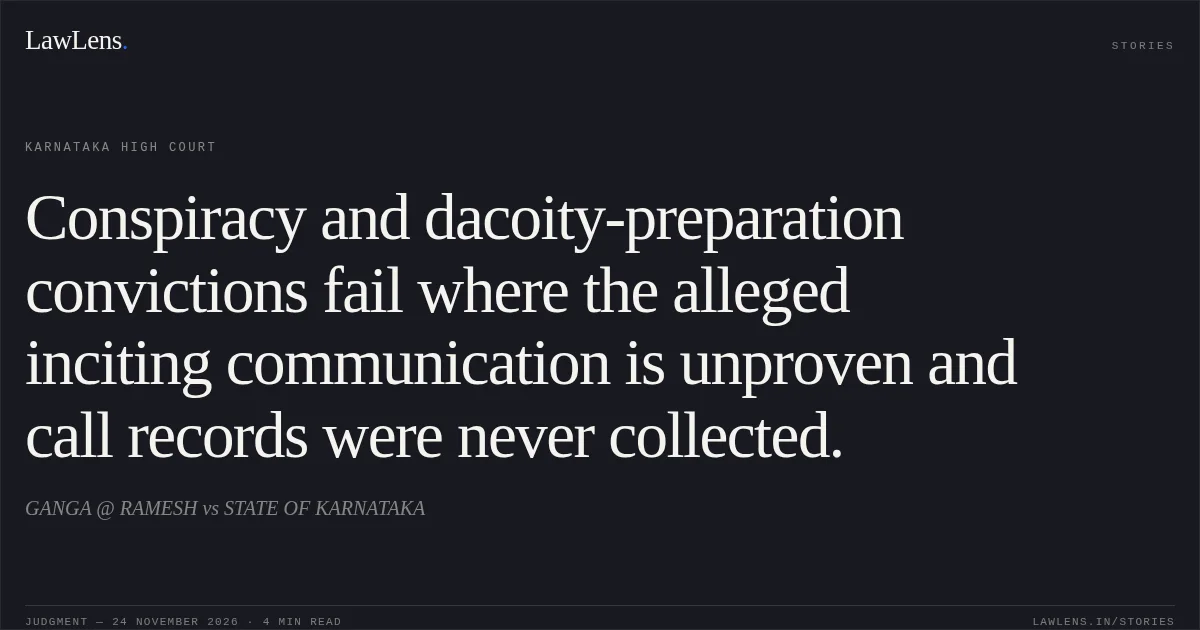
¶ 19Applying the ingredients of Sections 399 and 402 IPC, the prosecution failed to prove the alleged conversation between A1 and A2 at the relevant time, and therefore failed to establish preparation for dacoity or the assembly of five or more persons with a common purpose.
¶ 21 · ¶ 22 · ¶ 23Viewed "from any angle," the evidence left substantial reasonable doubt, and the conviction under Sections 399 and 402 read with 120B IPC was unsustainable.
¶ 2505Holding
The appellants had made out grounds for interference (Point No. 1, answered in the affirmative).
¶ 13 · ¶ 25The prosecution failed to prove the ingredients of Sections 399 and 402 IPC, and there was no evidence to establish the offence under Section 120B IPC.
¶ 25The appeal is allowed; the judgment of conviction and order on sentence dated 17.03.2015 in S.C. No. 39/2013 is set aside; A1 to A7 are acquitted of the offences under Sections 120B r/w 399 IPC and 399 r/w 402 IPC; bail bonds are cancelled; the trial court is directed to refund any fine deposited; and the Registry is to send the judgment and TCR to the trial court.
¶ 26Original Court PDF
GANGA @ RAMESHvsSTATE OF KARNATAKA
Click to open original judgment
Original judgment, available to read, download and summarize on LawLens.in