Facts
The parties entered into three agreements on 26 August 2025: a Manufacturing Agreement, a Supply and Distribution Agreement, and an Intellectual Property Agreement. The Manufacturing Agreement contemplated exclusive manufacture of vehicles for the appellant, together with exclusivity and non-compete obligations, and prescribed a contractual term of twenty years.
Source reference: para. 2A dispute arose regarding the respondent’s manufacture, marketing and sale of Mayuri-branded auto-shaped electric three-wheelers, including Mayuri Rattan, and other proposed vehicles. The appellant alleged that these vehicles fell within the contractual exclusivity and non-compete obligations. The respondent contended that the Mayuri vehicles formed part of its pre-existing business, that the contractual definition of “Vehicles” was narrower, and that the contemplated commercial arrangement had not commenced because no purchase order had been issued and no substantial consideration had passed.
Source reference: para. 3The appellant sought interim protection under Section 9 of the Arbitration and Conciliation Act, 1996. The Commercial Court found a prima facie case, balance of convenience and risk of irreparable injury, and restrained the respondent from launching, manufacturing, marketing, supplying, distributing or selling specified new and existing vehicles. The protection was to operate for three months or until constitution of the arbitral tribunal, whichever was earlier.
Source reference: para. 4The respondent appealed under Section 37 of the Act. At the first hearing, the High Court stayed the Commercial Court’s order, observing that the arrangement resembled a joint venture which had not commenced and that no tangible consideration appeared to have passed. It nevertheless directed the respondent not to launch any new vehicle and to maintain accounts of auto-shaped vehicles manufactured by it.
Source reference: para. 5Issues
Whether the High Court was justified in staying, at the first hearing, the interim protection granted by the Commercial Court under Section 9 of the Arbitration and Conciliation Act, 1996
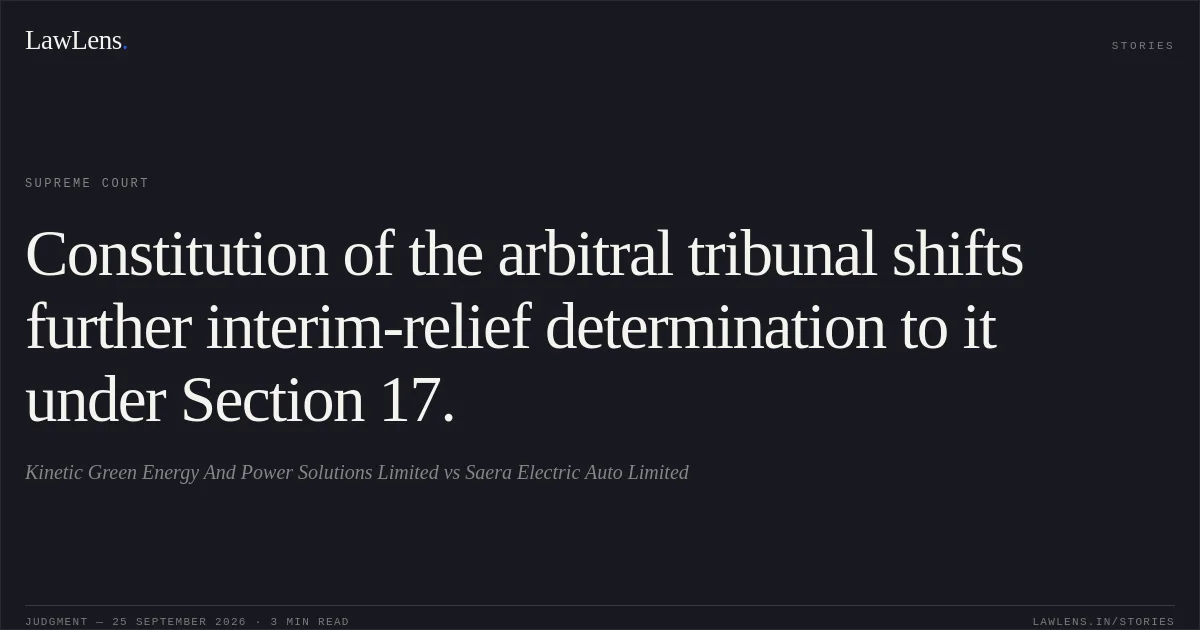
Source reference: paras. 4–5, 9Whether, after constitution of the arbitral tribunal, the parties should be relegated to the remedy under Section 17 of the Arbitration and Conciliation Act, 1996 for determination of appropriate interim measures
Source reference: paras. 6–8What interim arrangement should operate pending the arbitral tribunal’s determination of the parties’ application under Section 17
Source reference: para. 8Law Applied
The Court applied Sections 9, 17 and 37 of the Arbitration and Conciliation Act, 1996. Section 9 empowers a court to grant interim measures before or during arbitral proceedings; Section 17 enables the constituted arbitral tribunal to grant interim protection; and Section 37 provides for an appeal against specified orders, including orders under Section 9.
Source reference: paras. 6–8Once the arbitral tribunal is constituted, the parties may seek appropriate interim relief before that tribunal under Section 17, and the tribunal must determine the application independently and in accordance with law.
Source reference: paras. 6–8The Court did not finally adjudicate the contractual scope of the exclusivity, non-compete or “Vehicles” provisions.
Source reference: paras. 6–8Reasoning
The Supreme Court considered that the appropriate course was to constitute the arbitral tribunal rather than finally determine the competing contractual contentions at the interim appellate stage.
Source reference: para. 7Since both parties consented to arbitration by a sole arbitrator, the Court appointed Justice R.V. Raveendran. It permitted the parties to seek appropriate interim measures under Section 17, thereby transferring the primary consideration of interim protection to the constituted tribunal.
Source reference: para. 8Pending that determination, the Court modified the High Court’s restraint: the respondent was prohibited from launching or manufacturing the vehicles described in Annexures A and B to the agreement dated 26 August 2026, read with Clause 1.1 concerning specifications and vehicles.
Source reference: para. 8The Court directed that this limited protection would continue until orders were passed on the Section 17 application, while leaving the remaining portion of the High Court’s order undisturbed.
Source reference: para. 8The arbitral tribunal was directed to consider the Section 17 application uninfluenced by observations in the earlier orders.
Source reference: para. 8Holding
The Court appointed Justice R.V. Raveendran, former Judge of the Supreme Court, as the sole arbitrator to adjudicate disputes arising from the three agreements.
The parties were permitted to file applications under Section 17 of the Arbitration and Conciliation Act, 1996.
Source reference: para. 8The High Court’s blanket restraint was modified so that the respondent would not launch or manufacture the vehicles identified in Annexures A and B, read with Clause 1.1, until the arbitral tribunal passed orders on the Section 17 application.
Source reference: para. 8The Commercial Court’s order dated 6 August 2026 and the High Court’s order dated 20 August 2026 were accordingly set aside/modified, and the appeal was disposed of.
Source reference: paras. 9–10Acts & Sections Cited
3 provisions across 1 statute referred to in this judgment. Each provision opens on LawLens.
Arbitration and Conciliation Act, 19963
Original Court PDF
Kinetic Green Energy And Power Solutions LimitedvsSaera Electric Auto Limited
Click to open original judgment
Original judgment, available to read, download and summarize on LawLens.in