Facts
The petitioner (Accused No. 1) was arrested on 16.09.2025 in connection with ECIR/BGZO/25/2024 for alleged money laundering under Sections 3 and 4 of the PMLA.
Source reference: para 3.1, 67The case originated from a private complaint involving a predicate offence (Crime No. 11 of 2024).
Source reference: no citationA coordinate Bench had previously rejected the petitioner's bail on 20.01.2026 but reserved liberty to re-approach the court after three months if the trial did not progress or if circumstances changed.
Source reference: para 3.2, 97Since the original rejection, the petitioner was granted bail in the predicate offence, a final report was filed in the PMLA case, and supplementary complaints were filed against co-accused who were notably not arrested by the ED.
Source reference: para 8, 11The petitioner moved the High Court again citing these developments and the continued pre-cognizance status of the trial.
Source reference: para 4Issues
1. Whether the petitioner has established "changed circumstances" subsequent to the previous rejection of bail to warrant a fresh consideration under Section 483 of the BNSS (Section 439 Cr.P.C.)
Source reference: para 8, 112. Whether the right to a speedy trial under Article 21 of the Constitution overrides the statutory rigours of Section 45 of the PMLA when there is prolonged incarceration and a remote possibility of timely trial conclusion
Source reference: para 3.3/para 80, 83Law Applied
Section 45 of the Prevention of Money Laundering Act (PMLA), 2002, regarding the "twin conditions" for bail.
Source reference: para 3.3/para 64Manish Sisodia v. Directorate of Enforcement (2024), which established that Article 21's mandate for a speedy trial is a "higher law" that can relax PMLA statutory rigours.
Source reference: para 3.3/para 35, 71V. Senthil Balaji v. Deputy Director (2024) regarding the limits of pre-trial detention in cases where the maximum sentence is seven years.
Source reference: para 3.3/para 79, 81Arvind Dham v. Directorate of Enforcement (2026) which mandates that economic offences should not be a blanket ground for denial of bail if the state lacks the wherewithal for a speedy trial.
Source reference: para 9.5Reasoning
The court found that five distinct "changed circumstances" existed: (i) the petitioner’s release on bail in the predicate offence; (ii) the filing of the charge sheet in the predicate offence; (iii) the filing of a supplementary PMLA complaint against co-accused who were not arrested, placing the petitioner on a different footing; (iv) the formal taking of cognizance in the PMLA case; and (v) the lack of actual progress in the trial, which remained at a pre-cognizance stage despite the lapse of the three-month liberty period.
Source reference: para 11The court distinguished the respondent's reliance on NCB v. Mohit Aggarwal, noting it involved drug trafficking with 20-year sentences, whereas the current offence carries a maximum of seven years.
Source reference: para 12Applying the judicial landscape of "bail is the rule, jail is the exception," the court reasoned that with 12,000 pages of documents and numerous witnesses, the trial was unlikely to conclude soon, making continued incarceration punitive rather than preventive.
Source reference: para 13, 3.3/para 92Holding
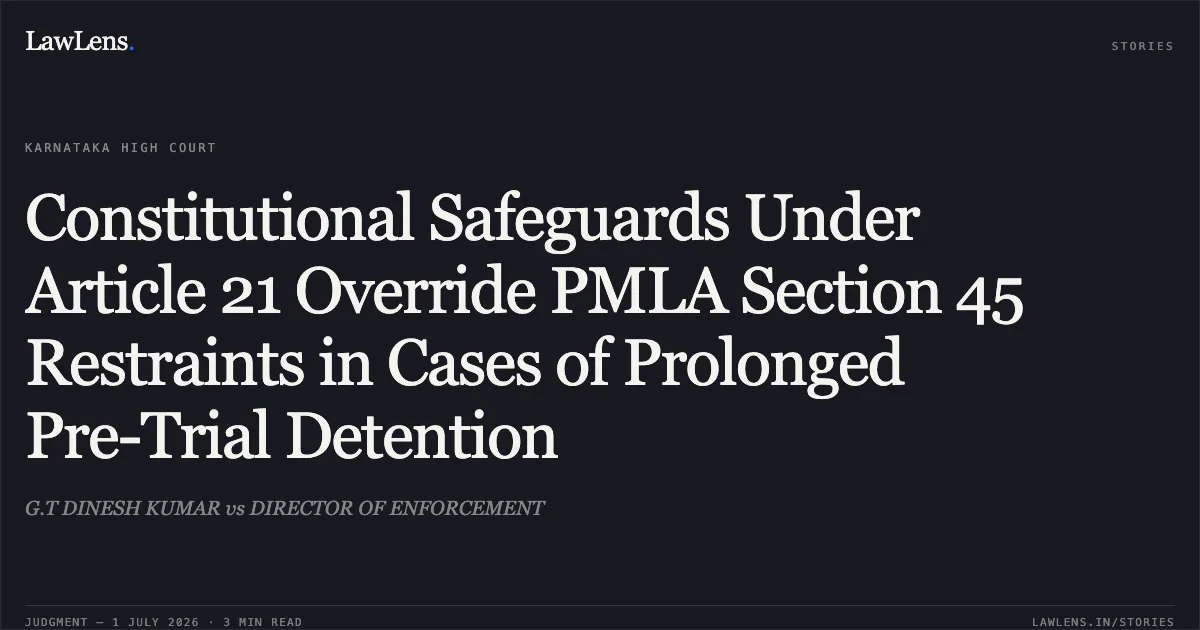
The court answered both issues in the affirmative, holding that constitutional safeguards under Article 21 must prevail over Section 45 PMLA in light of established changed circumstances.
The Criminal Petition was allowed. The petitioner was ordered to be released on bail subject to executing a personal bond of Rs. 5,00,000/- with two solvent sureties, and conditions including non-tampering of evidence and regular appearance before the jurisdictional Court.
Source reference: para 14Acts & Sections Cited
15 provisions across 4 statutes referred to in this judgment. Each provision opens on LawLens.
Bharatiya Nagarik Suraksha Sanhita, 20233
Code of Criminal Procedure, 19735
Prevention of Money-Laundering Act, 20025
National Investigation Agency Act, 20082
Original Court PDF
G.T DINESH KUMARvsDIRECTOR OF ENFORCEMENT
Click to open original judgment
Original judgment, available to read, download and summarize on LawLens.in