Facts
In 1960, Mahabir Rai transferred 95.80 acres of land to his mother and his son, the appellant.
Source reference: para. 2In 1962, a General Power of Attorney (GPA) was executed in favor of Rambhajan (respondent's predecessor), who used it in 1969 to sell two portions of the land (21.43 acres and 33.76 acres) to third parties.
Source reference: para. 2The appellant (as a minor through guardians) unsuccessfully filed two prior suits seeking the cancellation of these specific sale deeds.
Source reference: para. 2, 10In 1985, Rambhajan sought to mutate his name in revenue records for the remaining land, prompting the appellant to file the present suit for declaration of title and possession of the 43.69 acres remaining after the 1969 alienations.
Source reference: para. 2-4The High Court set aside the lower courts' decrees, dismissing the suit on the ground that it was barred by the doctrine of constructive res judicata.
Source reference: para. 3Issues
1. Whether the present suit for declaration of title and possession was barred by the principle of constructive res judicata under Section 11, Explanation IV of the CPC.
Source reference: p. 4 / para. 4, 92. Whether the appellant "might and ought" to have raised his claim of ownership over the entire property based on the 1960 sale deed in the earlier litigations which were limited to challenging specific sale deeds.
Source reference: p. 8 / para. 9, 13Law Applied
Section 11 of the Code of Civil Procedure, 1908, specifically Explanation IV, which defines "constructive res judicata" as any matter which might and ought to have been a ground of attack or defense in a former suit.
Source reference: p. 4-5The rule is based on public policy to prevent individuals from being "vexed twice" for the same litigation, as established in Henderson v. Henderson and Daryao v. State of U.P.
Source reference: para. 7.3, para. 7.2The principle that "ought" implies a threshold above mere possibility and requires "reasonable diligence".
Source reference: para. 8.4-8.5Reasoning
The Court reasoned that the High Court erred in its premise that the appellant was required to assert his ownership over the entire 95.80-acre parcel in previous suits that were limited to challenging specific unauthorized sale deeds.
Source reference: para. 12-13The Court noted that since the appellant’s title over the larger parcel was undisputed by the 1960 deed, there was no occasion or "legitimate purview" to litigate his entire title until the respondent attempted to mutate the remaining land in 1985.
Source reference: para. 13The Court observed that the "might and ought" rule must be applied with regard to the "ambit of the earlier proceedings" and the "nexus" of the controversy; here, the earlier suits were defensive actions against specific threats to the property, whereas the current suit was a response to a new threat to the remaining land.
Source reference: para. 8.2, para. 13-14The Court further emphasized that applying constructive res judicata in a way that leads to "unduly harsh and unjust" consequences in family disputes is offensive to law and equity.
Source reference: para. 14Holding
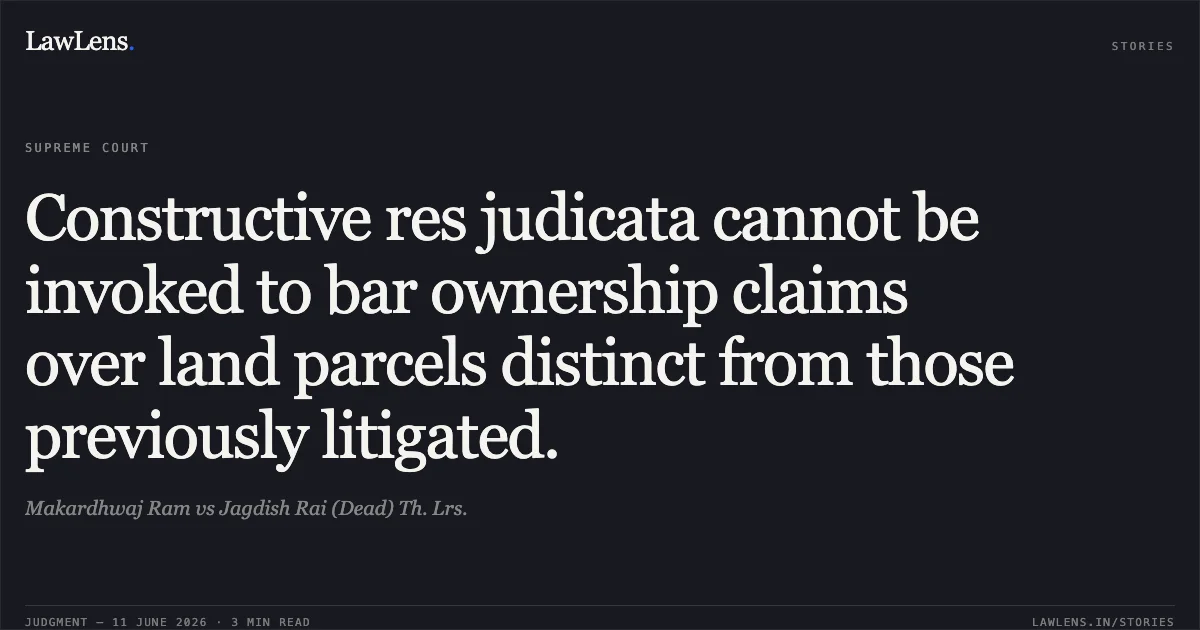
The Supreme Court allowed the appeal and set aside the High Court's judgment, holding that the suit was not barred by constructive res judicata because the appellant had no reason to assert his title over the remaining land in the earlier proceedings, which were distinct in subject matter.
The Court restored the appellant's right to pursue his claim for declaration of title and possession of the remaining 43.69 acres.
Source reference: para. 3, 15Acts & Sections Cited
1 provisions across 1 statute referred to in this judgment. Each provision opens on LawLens.
Code of Civil Procedure, 19081
Original Court PDF
Makardhwaj RamvsJagdish Rai (Dead) Th. Lrs.
Click to open original judgment
Original judgment, available to read, download and summarize on LawLens.in


![Subsequent exoneration does not retrospectively invalidate a finalized promotion select list.. UNNIKRISHNAN M vs M/o Environment And Forests. CAT - ['Ernakulam']. LawLens](/stories/thumbnails/subsequent-exoneration-does-not-retrospectively-invalidate-a-finalized-promotion-select-li-ce80a0e84f2f4887857271e8b4341c42.webp)