Facts
The appellants were agricultural electricity consumers of Purvanchal Vidyut Vitran Nigam Ltd. (“distribution licensee”) and used the connection for a private tubewell.
Source reference: para. 3, p. 3Following an inspection on 25 November 2018, the licensee allegedly detected prima facie theft of electricity and disconnected the supply on the same date.
Source reference: para. 3, p. 3An FIR was lodged on 27 November 2018, beyond the 24-hour period prescribed under Clause 8.1(xi) of the Uttar Pradesh Electricity Supply Code, 2005.
Source reference: para. 3, p. 3No police report or complaint before the competent Special Court was filed thereafter within the prescribed period.
Source reference: para. 3, p. 3A final assessment under Section 126 of the Electricity Act, 2003 was issued on 9 April 2019.
Source reference: para. 4, p. 3The appellants filed Petition No. 1497/2019 before the Uttar Pradesh Electricity Regulatory Commission (“Commission”) under Section 57 of the Electricity Act and Clauses 8.1 and 8.2 of the Supply Code, seeking restoration of supply and compensation for the licensee’s alleged non-compliance.
Source reference: para. 5, p. 4The Commission initially dismissed the petition on maintainability grounds, but the Appellate Tribunal revived the proceedings in Appeal No. 140/2020 and directed adjudication on merits.
Source reference: para. 5, p. 4Upon revival, the Commission directed the appellants to pay the final assessment and ordered restoration of supply within 24 hours of payment.
Source reference: para. 6, p. 4The appellants paid Rs. 42,896 in 2021 after adjustment of amounts already paid through monthly bills.
Source reference: para. 6, p. 4The Commission subsequently held that compensation was unavailable because the appellants had arrears arising from the final assessment.
Source reference: para. 7, p. 5It nevertheless found that the licensee had failed to lodge the FIR within 24 hours and had not filed a case before the Special Court within 30 days, and directed initiation of separate suo motu proceedings, including possible action under Section 142 of the Electricity Act.
Source reference: para. 7, pp. 5–7Issues
Whether the distribution licensee’s failure to lodge the FIR within 24 hours and to file a case before the Special Court within 30 days constituted failure to meet the applicable standards of performance under Section 57 of the Electricity Act, 2003 and the Uttar Pradesh Electricity Supply Code, 2005?
Source reference: paras. 9–10, pp. 7–11Whether the appellants were entitled to compensation under Section 57 despite having arrears of electricity dues arising from the final assessment at the time of filing their compensation claim?
Source reference: paras. 12–15, pp. 13–17Law Applied
Section 57(1)–(3) of the Electricity Act, 2003 empowers the Appropriate Commission to prescribe standards of performance and requires a licensee failing to meet those standards to pay compensation determined by the Commission to the affected person.
Source reference: para. 11, pp. 11–13Clauses 8.1(xi) and 8.2(i) of the Uttar Pradesh Electricity Supply Code, 2005 require the licensee to lodge an FIR within 24 hours of disconnection in theft cases and to file a case before the Special Court within 30 days; failure to do so is treated as failure to achieve and maintain the prescribed standards of performance.
Source reference: paras. 9–10, pp. 7–11However, Clause 7.9(b)(i) of the Supply Code limits compensation to consumers who have no arrears of electricity dues, and Regulation 8.1 of the UPERC (Standards of Performance) Regulations, 2019 similarly provides that no compensation is payable where the consumer has arrears outstanding for more than 30 days on the date of filing the claim.
Source reference: paras. 12–14, pp. 13–16Reasoning
The Tribunal held that the licensee had breached the procedural obligations under Clauses 8.1 and 8.2 because the FIR was lodged beyond 24 hours and no case was filed before the Special Court within 30 days.
Source reference: para. 10, pp. 10–17Such conduct amounted to failure to maintain the prescribed standards of performance and justified the Commission’s decision to initiate separate suo motu proceedings and consider action under Section 142.
Source reference: paras. 10 and 16, pp. 10–17Nevertheless, the right to compensation was subject to the specific eligibility condition that the consumer should not have arrears beyond the permitted period.
Source reference: para. 15, p. 17The appellants filed their compensation petition on 2 August 2019, whereas the final assessment had been issued on 9 April 2019 and had not been challenged.
Source reference: para. 15, p. 17Since the assessment amount remained unpaid when the claim was filed, the appellants were admittedly in arrears at the relevant time.
Source reference: para. 15, p. 17Their subsequent payment in 2021 could not retrospectively cure the statutory and regulatory disqualification existing on the date of filing the claim.
Source reference: para. 15, p. 17Holding
The Tribunal answered the first issue in favour of the appellants by recognising that the distribution licensee failed to comply with the prescribed FIR and Special Court filing requirements.
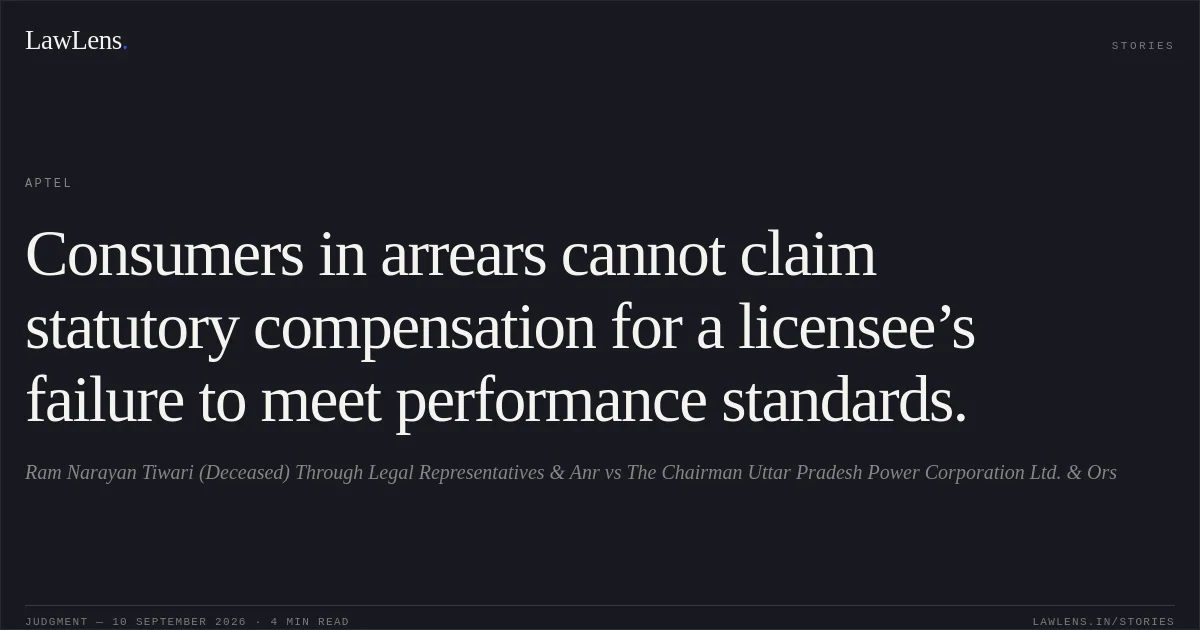
However, it answered the second issue against the appellants: their arrears arising from the final assessment disentitled them from compensation under Section 57.
Source reference: para. 16, p. 17The Commission’s order rejecting compensation was therefore upheld, and Appeal No. 299 of 2021 was dismissed as devoid of merit.
Source reference: para. 16, p. 17Acts & Sections Cited
11 provisions across 2 statutes referred to in this judgment. Each provision opens on LawLens.
Electricity Act, 2003
Code of Criminal Procedure, 19731
Original Court PDF
Ram Narayan Tiwari (Deceased) Through Legal Representatives & AnrvsThe Chairman Uttar Pradesh Power Corporation Ltd. & Ors
Click to open original judgment
Original judgment, available to read, download and summarize on LawLens.in