Facts
On 26.04.2023, Sh. Sompal (the deceased) was traveling from Haridwar to Moradabad with a valid ticket.
Source reference: p.2, para 3He allegedly fell from a running train between Nagina and Puraini Railway Stations, sustained injuries, and was subsequently run over by another train.
Source reference: p.2, para 3The Railway Claims Tribunal (“Tribunal”) dismissed the appellants' claim on 10.09.2024, concluding the deceased committed suicide and was neither a bona fide passenger nor a victim of an "untoward incident".
Source reference: p.1-2, para 2The Tribunal relied on a DRM report and an affidavit by the loco pilot (RW-1) asserting the deceased jumped in front of a goods train.
Source reference: p.2, para 5The appellants challenged this, noting that a valid journey ticket was recovered from the deceased and that the loco pilot’s initial memo did not mention suicide.
Source reference: p.2, para 4Issues
1. Whether the deceased was a bona fide passenger within the meaning of the Railways Act, 1989?
Source reference: p.3, para 7-82. Whether the incident in question constitutes an “untoward incident” as defined under Section 123(c) read with Section 124-A of the Railways Act, 1989?
Source reference: p.3, para 7; p.4, para 12Law Applied
The Court primarily applied Section 124-A of the Railways Act, 1989, which mandates strict liability for compensation in cases of "untoward incidents," subject to specific exceptions like suicide or self-inflicted injury.
Source reference: p.5, para 13It relied on Union of India v. Rina Devi (2019) 3 SCC 572, establishing that once a ticket is found on a deceased, the burden shifts to the Railways to disprove bona fide travel.
Source reference: p.3, para 8Furthermore, it cited Union of India v. Prabhakaran Vijaya Kumar (2008) 9 SCC 527, which held that Section 124-A is beneficial legislation and must be construed liberally.
Source reference: p.5, para 13Reasoning
The Court found that the deceased was a bona fide passenger because a valid journey ticket (No. UAF 02392738) was recovered from his person and verified by the booking office.
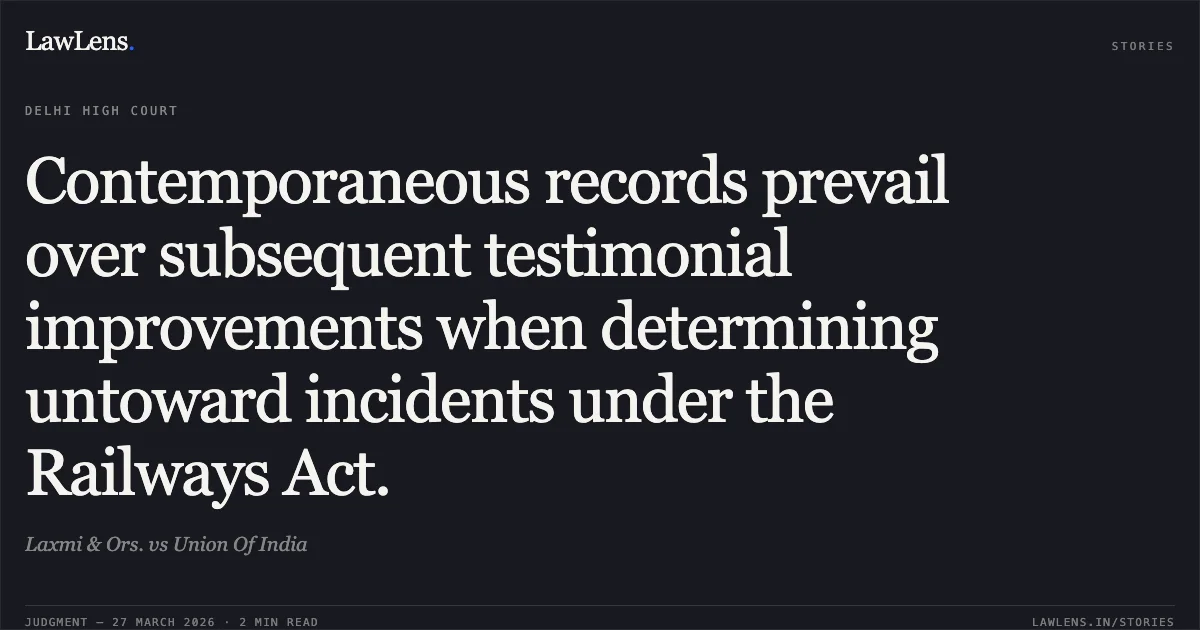
Source reference: p.3, para 8Regarding the nature of the incident, the Court observed that contemporaneous records—including the Station Master’s memo and RPF daily diary—described the event only as a “run over” (MRO) and did not mention suicide.
Source reference: p.3-4, para 9The Court noted that the loco pilot (RW-1) introduced the "jumping" allegation for the first time in his affidavit, which contradicted his own initial written memo.
Source reference: p.4, para 10Consequently, the DRM report’s conclusion of suicide was deemed unsubstantiated by direct evidence.
Source reference: p.4, para 11The Court reasoned that in the absence of cogent evidence of suicide, the version of an accidental fall from a running train followed by being run over was more probable and consistent with the record.
Source reference: p.4-5, para 12Holding
The Court answered both issues in the affirmative, holding that the deceased was a bona fide passenger and the death resulted from an "untoward incident".
The High Court set aside the Tribunal’s judgment and allowed the appeal. The matter was remanded to the Tribunal to assess the compensation amount and direct its disbursement within two months. The parties were directed to appear before the Tribunal on 06.04.2026.
Source reference: p.5, para 14-15Acts & Sections Cited
1 provisions across 1 statute referred to in this judgment. Each provision opens on LawLens.
Railway Claims Tribunal Act, 19871
Original Court PDF
Laxmi & Ors.vsUnion Of India
Click to open original judgment
Original judgment, available to read, download and summarize on LawLens.in