Facts
The Plaintiff sought a decree of permanent injunction concerning the first, second and third floors of property bearing Municipal No. XVI/2105, Block-G, Desh Bandhu Gupta Road, Karol Bagh, New Delhi.
Source reference: p.1–2; paras. 1–2She claimed ownership under two registered Gift Deeds dated 04 February 2000 and a Will dated 08 April 2022, and alleged interference by the Defendant with her possession, ingress and egress, and use of common areas, water tanks and solar panels.
Source reference: p.1–2; paras. 1–2On 12 October 2023, the Court directed the parties to maintain status quo as to title and possession pending further proceedings, while also granting interim protection to the Plaintiff.
Source reference: p.2–4; para. 3The order remained operative and was never vacated.
Source reference: p.4; para. 4While the order was subsisting, the Plaintiff executed a registered Sale Deed dated 16 April 2025 transferring her rights in the first, second and third floors to M/s Easy Builders Private Limited.
Source reference: p.5; para. 6The Defendant consequently filed an application under Order XXXIX Rule 2A CPC, Section 14 of the Contempt of Courts Act, 1971, and Article 215 of the Constitution, alleging wilful disobedience of the status quo order.
Source reference: p.5–6; para. 7On 09 July 2026, the Plaintiff sought unconditional withdrawal of the Suit.
Source reference: p.6; para. 8The Defendant opposed withdrawal on the ground that the Plaintiff had violated the Court’s order and created third-party rights.
Source reference: p.6; para. 8The Plaintiff tendered an apology, but her reply also sought to justify the sale.
Source reference: p.6–7; para. 12Issues
Whether the Plaintiff could be permitted to withdraw the Suit unconditionally despite having transferred the Suit Property in alleged violation of the subsisting status quo order?
Source reference: p.6; paras. 8–9, 24–26Whether the Plaintiff’s qualified apology could be accepted in the contempt proceedings?
Source reference: p.6–12; paras. 12–18Whether the Sale Deed executed during the operation of the status quo order was legally protected by Section 52 of the Transfer of Property Act, 1882, or was liable to be treated as an unlawful transaction?
Source reference: p.13–22; paras. 20–23Whether the Plaintiff was liable to be punished for wilful disobedience of the Court’s order and, if so, what penalty was appropriate?
Source reference: p.11–13; paras. 15–19Law Applied
Order XXXIX Rule 2A CPC provides consequences for disobedience of an injunction or order, while Section 12 of the Contempt of Courts Act, 1971 and Article 215 of the Constitution empower the High Court to punish contempt.
Source reference: p.7–11; paras. 12–14An apology must be voluntary, unconditional, bona fide, and indicative of genuine remorse; justification and apology are legally incompatible, as held in Surat Singh v. Des Raj, 1967 SCC OnLine Del 169, and H. Syama Sundara Rao v. Union of India, 2006 SCC OnLine Del 1392.
Source reference: p.7–11; paras. 12–14Contempt jurisdiction must be exercised cautiously and only where disobedience is deliberate and contumacious, as recognised in Jhareswar Prasad Paul v. Tarak Nath Ganguly, (2002) 5 SCC 352.
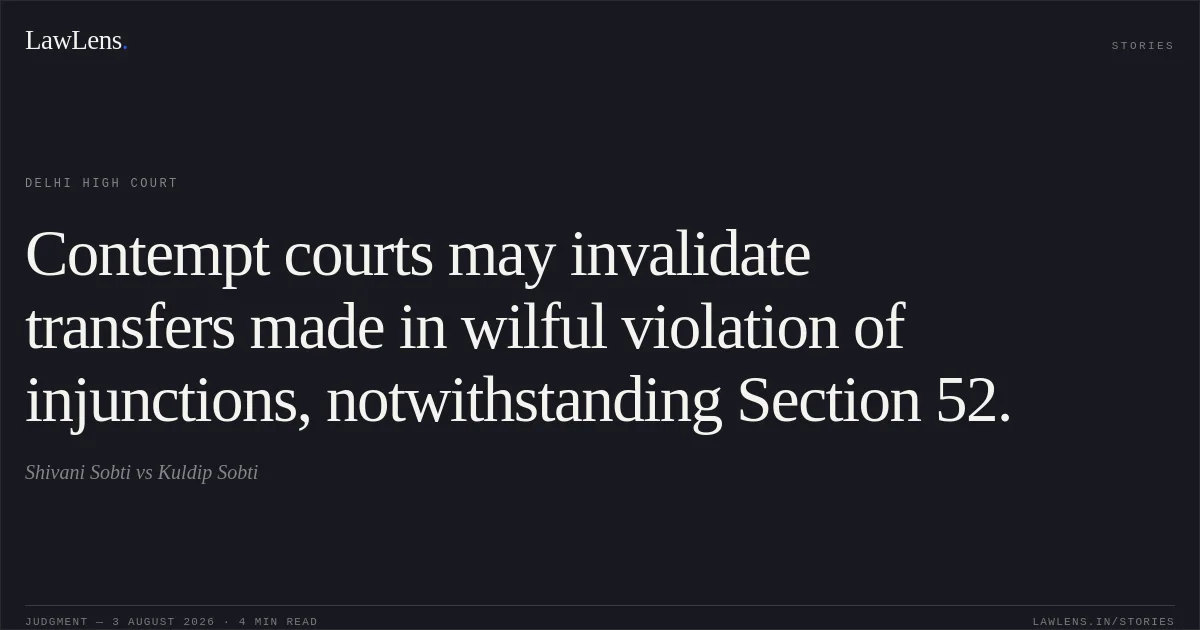
Source reference: p.11; para. 15Although Section 52 of the Transfer of Property Act ordinarily makes a pendente lite transfer subject to the outcome of the pending litigation rather than void ab initio, a transfer made in wilful breach of an injunction may be declared ineffective or otherwise neutralised by the contempt court.
Source reference: p.13–22; paras. 20–21The Court relied on Balwantbhai Somabhai Bhandari v. Hiralal Somabhai, (2023) 17 SCC 545; Satyabrata Biswas v. Kalyan Kumar Kisku, (1994) 2 SCC 266; DDA v. Skipper Construction Co. (P) Ltd., (1996) 4 SCC 622; Vidur Impex & Traders (P) Ltd. v. Tosh Apartments (P) Ltd., (2012) 8 SCC 384; and Jehal Tanti v. Nageshwar Singh, (2013) 14 SCC 689.
Source reference: p.13–22; paras. 20–21The underlying principle is that a contemnor cannot retain or confer the benefit of an act done in violation of a Court order.
Source reference: p.13–22; paras. 20–21Reasoning
The Court found that the Plaintiff was aware of the subsisting status quo order yet executed the Sale Deed during its operation, thereby deliberately altering the title position contrary to the Court’s direction.
Source reference: p.5–6; para. 7Her apology was not accepted because it was accompanied by a justification of the sale and was therefore conditional or alternative rather than a genuine admission of culpability.
Source reference: p.6–12; paras. 12–18Applying the contempt principles, the Court held that the Plaintiff’s conduct constituted wilful disobedience, although it declined imprisonment in view of her considerable age and imposed a monetary penalty instead.
Source reference: p.11–13; para. 19Regarding the Sale Deed, the Court held that Section 52 of the Transfer of Property Act did not protect a transaction executed in breach of the status quo order.
Source reference: p.13–22; paras. 20–22Relying on the Supreme Court authorities, it held that the transaction was bad and could not enable the purchaser to obtain an advantage from the Plaintiff’s contumacious conduct.
Source reference: p.13–22; paras. 20–22The Court clarified, however, that questions regarding the purchaser’s bona fides were not adjudicated in the Suit.
Source reference: p.22; para. 23Holding
The Court rejected the Plaintiff’s qualified apology and held that she had wilfully violated the order dated 12 October 2023.
It imposed a fine of ₹2,000 under Section 12 of the Contempt of Courts Act, 1971, while declining to impose imprisonment.
Source reference: p.11–13; para. 19The Sale Deed executed in favour of M/s Easy Builders Private Limited was held to be a transaction made in violation of the status quo order and not entitled to protection under Section 52 of the Transfer of Property Act; the purchaser was left to pursue remedies in accordance with law.
Source reference: p.21–22; paras. 21–22The Plaintiff was nevertheless permitted to withdraw the Suit unconditionally.
Source reference: p.22; paras. 24–26The Suit and all pending applications were disposed of as withdrawn.
Source reference: p.22; paras. 24–26Original Court PDF
Shivani SobtivsKuldip Sobti
Click to open original judgment
Original judgment, available to read, download and summarize on LawLens.in