Facts
The petitioners filed a Contempt Petition alleging willful disobedience of the Tribunal's order dated 02.05.2024, which directed the respondents to redraw the seniority list of Inspectors in accordance with K. Meghachandra Singh v. Ningam Siro and grant consequential promotions.
Source reference: p.4, 7In purported compliance, the respondents issued a revised seniority list on 03.07.2025 and conducted a Review DPC on 10.08.2025.
Source reference: p.6, 8However, the petitioners were denied promotion to the rank of Superintendent because they had not completed mandatory training—a criterion the petitioners claim was not raised in the original proceedings and was impossible to fulfill earlier due to the respondents' own previous errors in seniority.
Source reference: p.4-5Issues
1. Whether the respondents’ act of imposing a training criterion for promotion, which was not pleaded during the original adjudication, constitutes willful disobedience of the Tribunal’s directions.
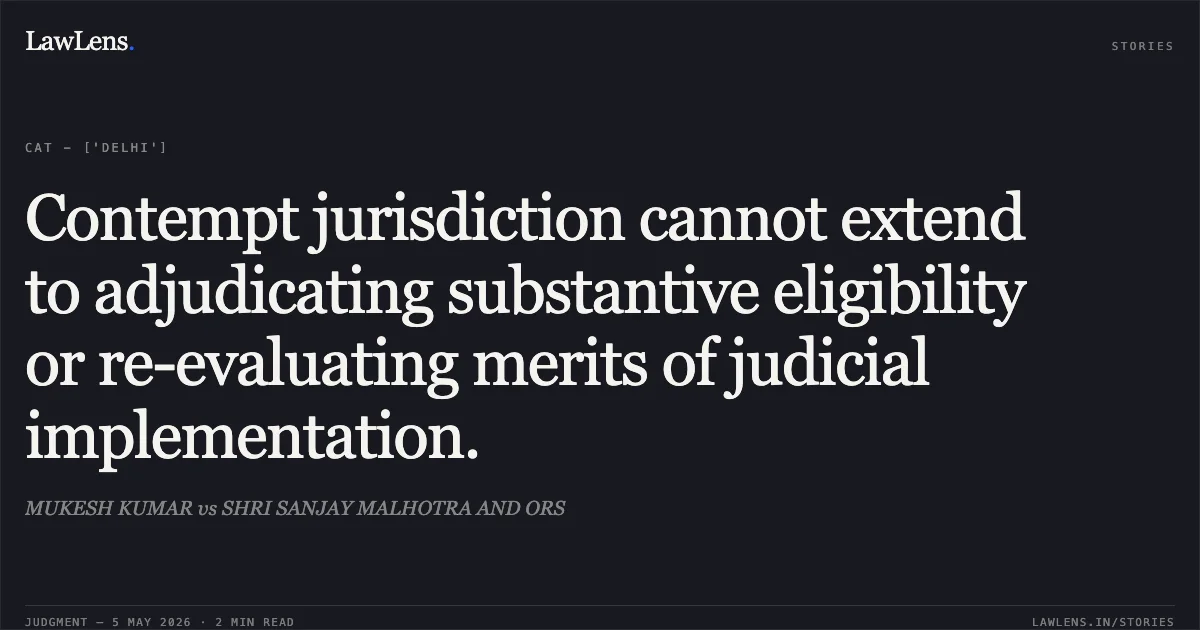
Source reference: p.4, 72. Whether the scope of contempt jurisdiction extends to adjudicating the merits of eligibility criteria applied during the implementation of a court order.
Source reference: p.10-11Law Applied
The Tribunal relied on the principle that contempt jurisdiction is limited to ensuring compliance with the express directions of the court and cannot be used to secure execution or re-adjudicate merits, as established in R.N. Dey v. Bhagyabati Pramanik.
Source reference: p.10It applied the standard from Sudhir Vasudeva v. M. George Ravishekaran, holding that courts cannot travel beyond the four corners of the order alleged to have been violated.
Source reference: p.7Furthermore, it followed Union of India v. Shashank Sharma, which dictates that a court in contempt proceedings cannot adjudicate substantive entitlements to promotion when the original direction was merely to consider the case as per rules.
Source reference: p.7, 9Reasoning
The Tribunal observed that the respondents had technically complied with the specific directions of the judgment dated 02.05.2024 by redrawing the seniority list and convening a Review DPC.
Source reference: p.8, 11The core of the petitioners' grievance was not the absence of action, but the manner of implementation—specifically, the application of the Recruitment Rules dated 27.08.2019, which require mandatory training for promotion to Superintendent.
Source reference: p.6, 9The Court reasoned that since the original order did not direct the grant of promotion "irrespective of eligibility," the respondents were bound to follow the prevailing Recruitment Rules.
Source reference: p.6-7Consequently, examining whether the training requirement was fair or whether the doctrine of constructive res judicata barred the respondents from raising it would require a fresh re-evaluation of the merits, which is impermissible in a contempt proceeding.
Source reference: p.10-11Holding
The Tribunal held that no case of willful disobedience was made out as substantial compliance (redrawing seniority and holding the DPC) had occurred.
The Contempt Petition was dismissed, with the holding that challenges to the correctness of the DPC's eligibility findings must be raised in fresh substantive proceedings rather than through contempt jurisdiction; the petitioners were granted liberty to ventilate their individual grievances regarding eligibility before the competent forum.
Source reference: p.11Acts & Sections Cited
1 provisions across 1 statute referred to in this judgment. Each provision opens on LawLens.
Code of Civil Procedure, 19081
Original Court PDF
MUKESH KUMARvsSHRI SANJAY MALHOTRA AND ORS
Click to open original judgment
Original judgment, available to read, download and summarize on LawLens.in