01Facts
The petitioner sought regular bail under Section 483 BNSS in FIR No. 0343/2026 dated 20.06.2026, P.S. Kanjhawala, registered under Sections 110, 115(2), 126(2), 351(2), 303(2) and 3(5) BNS. Sections 61 and 253 BNS were later added.
¶ 4 · p. 2The petitioner also sought quashing of the FIR on the basis of a settlement, filed along with his son, Harsh Vardhan Vats, as co-accused.
¶ 5 · p. 2The prosecution alleged that on 19.06.2026 at about 11:45 p.m., during a dispute over land ownership, about six persons, including the petitioner and his son, came armed with rods and axes and assaulted the complainant and his brother. The brother was struck on the head, lost consciousness, and a bag and purse containing Rs. 30,000 were taken.
¶ 6 · p. 2The petitioner was arrested on 30.10.2026. The chargesheet had not been filed.
¶ 7 · p. 2A settlement deed dated 01.11.2026 was executed on the petitioner's behalf, while he was in custody, and was signed by his son, "Bharat Vats".
¶ 8 · pp. 2–3The order names the son differently in paras 5 and 8. The court did not address this discrepancy.
¶ 5 · p. 2 · ¶ 8 · pp. 2–302Issues
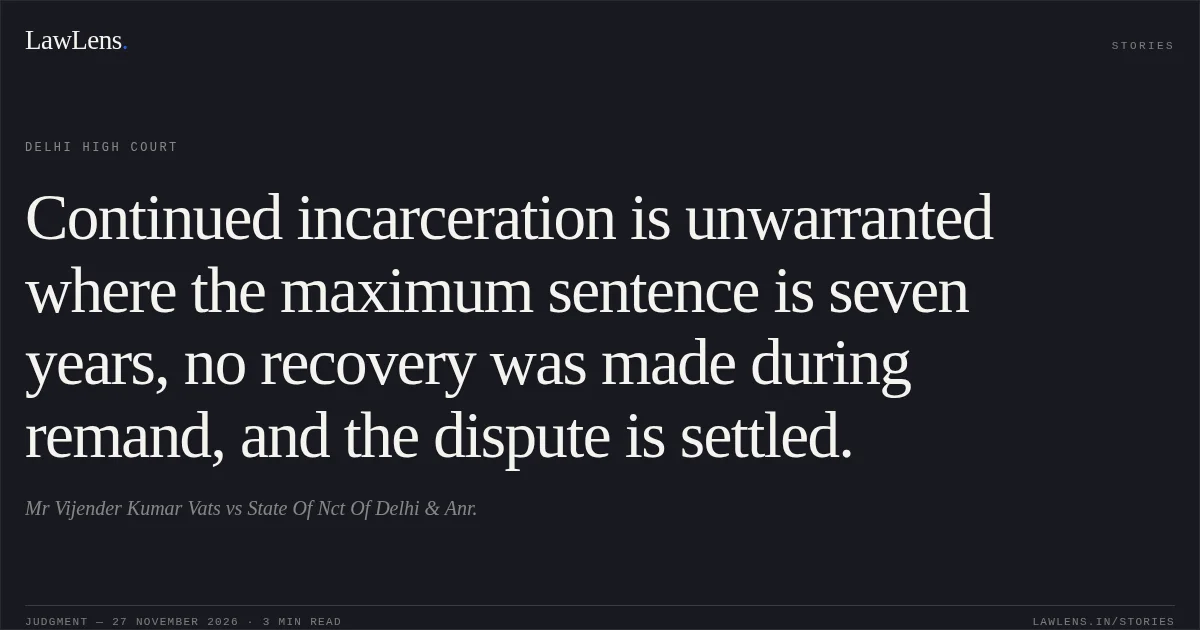
i.1. Whether the petitioner is entitled to regular bail under Section 483 BNSS, given the maximum sentence of seven years, his custody since 30.10.2026, the absence of recovery during police remand, and the lack of any shown necessity for continued incarceration.
¶ 9–10 · pp. 3–4ii.2. Whether a settlement executed on the petitioner's behalf by his son can support quashing of the FIR, given that the petitioner did not sign it personally.
¶ 19–20 · pp. 6–703Law Applied
The court relied on Section 483 BNSS, under which the bail application was filed.
¶ 4 · p. 2The court applied the principle, drawn from Gudikanti Narasimhulu v. Public Prosecutor, High Court of A.P., (1978) 1 SCC 240, that deprivation of liberty must be reasonable and not punitive, that bail serves the "bi-focal interests of justice" to the individual and society, and that mechanical detention should be avoided.
¶ 10 · p. 4The court relied on Sanjay Chandra v. CBI, (2012) 1 SCC 40, holding that the object of bail is neither punitive nor preventive, that detention is punishment unless required to secure the accused's trial, and that every person is presumed innocent until duly tried and found guilty.
¶ 11 · p. 5The court treated an inter se settlement of the parties' disputes as a relevant factor in the bail assessment.
¶ 12 · p. 5For the quashing petition, the order states no governing authority. It requires that a settlement be executed personally by the petitioner before the prayer can be considered.
¶ 19–20 · pp. 6–7Provisions in the judgment · 9 · Linked ones open on LawLens
Bharatiya Nagarik Suraksha Sanhita, 2023 Section 483
Bharatiya Nyaya Sanhita, 2023 Section 110Section 115Section 126Section 351Section 303Section 3Section 61Section 253
04Reasoning
The court weighed the maximum punishment of seven years, the petitioner's custody since 30.10.2026, and the absence of any recovery during police remand. It found that the petitioner's continued incarceration was not shown to be necessary for the remaining investigation.
¶ 10 · pp. 3–4Applying Gudikanti and Sanjay Chandra, the court held that detention could not be justified as punishment when it was not needed to secure the petitioner's trial. The inter se settlement between the parties reinforced this conclusion.
¶ 12 · p. 5The court then granted bail on conditions that address the risk of tampering or non-appearance.
¶ 13 · pp. 5–6On quashing, the court declined to act on the settlement because it had been signed by the son rather than the petitioner.
¶ 19 · p. 6Now that the petitioner was enlarged on bail, the court directed him to execute the settlement agreement himself. The quashing prayer was deferred to the next hearing, subject to any objections from the APP.
¶ 20 · pp. 6–7The court expressly limited its bail observations so as not to affect the trial or express any view on the merits.
¶ 17 · p. 605Holding
The petitioner is entitled to regular bail. The court admitted him to bail on a personal bond of Rs. 25,000 with one surety of the same amount, subject to the following conditions: he must join the investigation when called; not leave NCT of Delhi or the country without permission; disclose and update his addresses and mobile number; not contact the complainant or witnesses; not tamper with evidence or make inducements; appear on every date; not commit any offence; and report monthly to the SHO.
¶ 13 · pp. 5–6Any breach permits the State to seek cancellation of bail. The trial court was requested to expedite proceedings.
¶ 14 · p. 6 · ¶ 16 · p. 6The prayer for quashing on the basis of settlement is deferred. The petitioner must personally execute the settlement, and the matter is listed on 01.02.2027.
¶ 20–21 · pp. 6–7Original Court PDF
Mr Vijender Kumar VatsvsState Of Nct Of Delhi & Anr.
Click to open original judgment
Original judgment, available to read, download and summarize on LawLens.in