Facts
The petitioners were daily-wage irrigation patrolling labourers appointed in 1980 and 1991, respectively. They were orally terminated in 1997 after completing over 240 days of service annually.
Source reference: p. 3They raised an industrial dispute, resulting in Labour Court awards dated 18.12.2019, which declared their termination illegal under Sections 25F, 25G, and 25H of the Industrial Disputes Act, 1947. The awards directed reinstatement with continuity of status and 10% back wages.
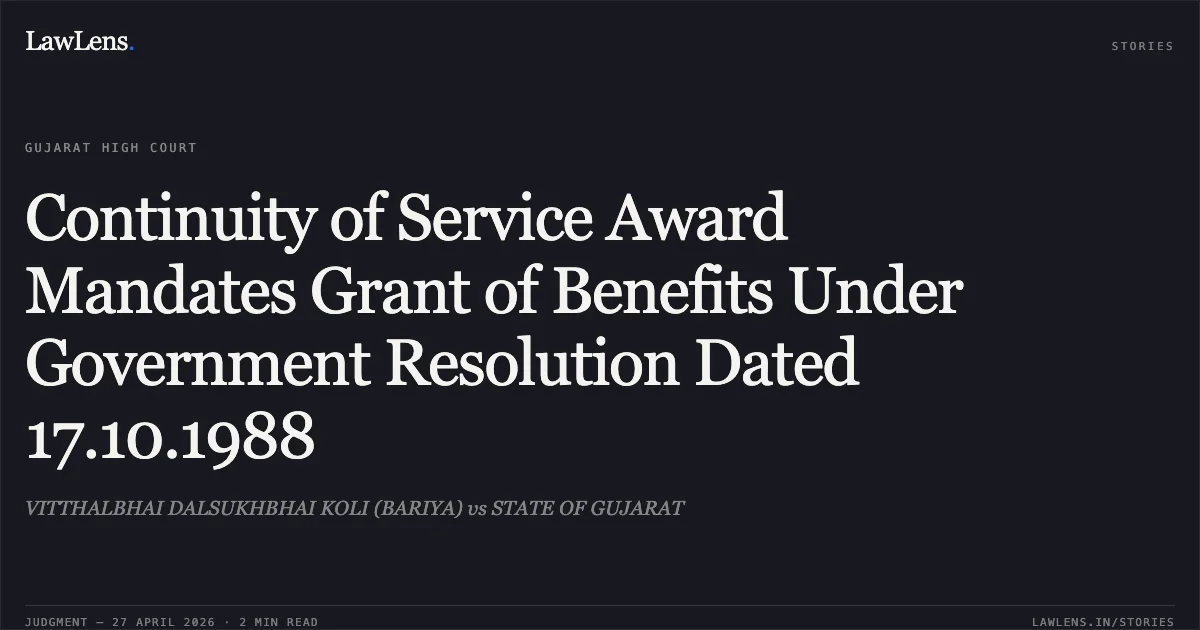
Source reference: p. 3Despite the awards becoming final, the respondents failed to reinstate the petitioners or grant benefits under Government Resolution (GR) dated 17.10.1988, which provides for the regularization and pay-scale of long-term daily wagers.
Source reference: p. 4The petitioners filed this writ petition seeking implementation of the awards and extension of GR benefits.
Source reference: p. 1-2Issues
1. Whether the respondents are legally bound to implement the Labour Court awards and grant benefits under the Government Resolution dated 17.10.1988 to workers granted continuity of service
Source reference: para. 52. Whether the denial of benefits on the grounds of non-completion of 240 days during the period of illegal termination is permissible
Source reference: para. 5.1Law Applied
Government Resolution dated 17.10.1988, which mandates the grant of permanency benefits, regular pay scales, and pensionary benefits to daily wagers based on their length of service
Source reference: para. 4The principle of "Continuity of Service," which restores a workman to their original position as if the termination never occurred
Source reference: para. 5.1Precedents cited include State of Gujarat v. PWD Employees’ Union (Supreme Court), Ashok Laxmanbhai Parmar v. Secretary, Govt. of Gujarat, and Jamnagar District Panchayat v. Girdharbhai Muljibhai Eradiya, which established that once continuity is granted by a court, the state cannot deny GR benefits by citing the lack of 240 days of actual work during the period of illegal litigation.
Source reference: para. 5.1, 5.2Reasoning
The Court observed that the issue was squarely covered by settled Division Bench judgments.
Source reference: para. 5It reasoned that since the Labour Court awarded "continuity of service," the petitioners are legally deemed to have been in continuous employment from their initial appointment dates.
Source reference: para. 4The Court rejected any attempt by the State to deny benefits on the grounds that the workers did not complete 240 days of work in preceding years, noting that the workers were "forced to live without work" solely due to the State's illegal termination.
Source reference: para. 5.1To allow the State to use this as a defense would be to permit them to take advantage of their own wrong.
Source reference: para. 5.2Consequently, because the petitioners were legally reinstated with continuity, the benefits of the 17.10.1988 GR must follow as a "necessary corollary".
Source reference: para. 5.2Holding
The High Court partly allowed the petition, holding that the petitioners are entitled to all consequential benefits under the GR dated 17.10.1988.
The Court directed the respondents to: (i) grant benefits notionally from 20.08.1997 up to 18.12.2019; (ii) pay actual salary differences from 18.12.2019 onwards; and (iii) provide regular salary and service benefits moving forward. All arrears must be paid by 31.08.2026, failing which a 6% interest rate will apply from 01.09.2026 until realization.
Source reference: para. 7Acts & Sections Cited
3 provisions across 1 statute referred to in this judgment. Linked provisions open on LawLens.
Industrial Disputes Act, 19473
Original Court PDF
VITTHALBHAI DALSUKHBHAI KOLI (BARIYA)vsSTATE OF GUJARAT
Click to open original judgment
Original judgment, available to read, download and summarize on LawLens.in