Facts
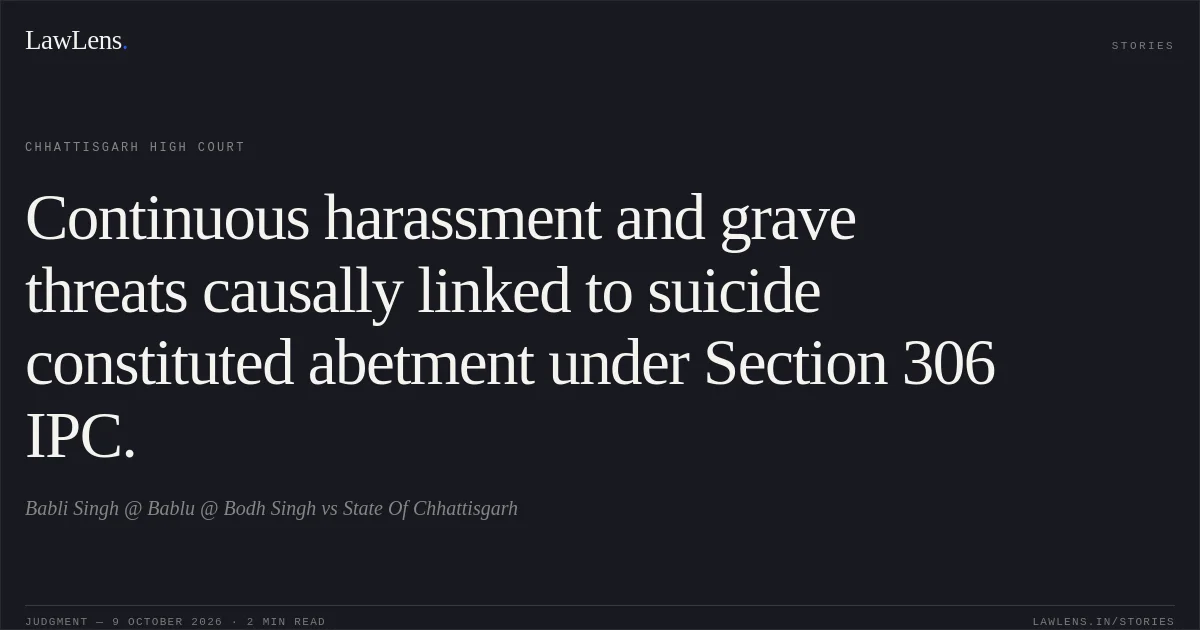
Manju Sharma died after consuming aluminium phosphide at a cinema hall.
Source reference: para. 1–5, 29A note recovered from her purse alleged that the appellant had persistently harassed and threatened her; an expert comparison established that the note’s signature was hers.
Source reference: para. 1–5, 29The Sessions Court convicted the appellant under Section 306 IPC and sentenced him to five years’ rigorous imprisonment and a fine.
Source reference: para. 1–5, 29He appealed, disputing the proof of abetment and the reliability and significance of the note
Source reference: para. 1–5, 29Issues
Whether the appellant’s conduct, as proved by the evidence, amounted to abetment of suicide under Section 107 IPC and attracted liability under Section 306 IPC
Source reference: para. 30Whether the prosecution proved beyond reasonable doubt that the appellant’s conduct had the requisite intention and nexus with the deceased’s suicide
Source reference: para. 30–34Law Applied
Sections 107 and 306 IPC require proof of abetment, including instigation, with the necessary mens rea and a reasonable nexus between the accused’s conduct and the suicide.
Source reference: para. 30, 35Instigation may be inferred from acts or a continuing course of conduct that creates circumstances in which the deceased is left with no other option, but mere harassment or a casual remark, without the requisite intention, is insufficient (*Ramesh Kumar v. State of Chhattisgarh*; *Chitresh Kumar Chopra v. State (Govt. of NCT of Delhi)*; *Amlendu Pal alias Jhantu v. State of West Bengal*; *Gangula Mohan Reddy v. State of Andhra Pradesh*; *Madan Mohan Singh v. State of Gujarat*).
Source reference: para. 30, 35The Court also relied on *Ude Singh v. State of Haryana*, which directs that instigation be assessed from the accused’s intention, the course of conduct, and its proximity to the suicide
Source reference: para. 36Reasoning
The Court treated the deceased’s note as central evidence: although the handwriting was not authenticated, the signature was proved to be hers, and the note described repeated harassment, coercive conduct, and threats to kill her or throw acid on her; it also expressly attributed her decision to take her life to the appellant.
Source reference: para. 25, 29, 31The note was supported by the mother’s evidence of prior disclosures and threats, and by material admissions or testimony from other witnesses concerning harassment.
Source reference: para. 32On that cumulative evidence, the Court found a sustained course of conduct—not merely ordinary harassment or an isolated quarrel—together with the requisite mens rea and causal nexus.
Source reference: para. 33–36Holding
The Court held that the prosecution proved abetment of suicide under Sections 107 and 306 IPC beyond reasonable doubt.
It dismissed the appeal and affirmed the conviction and sentence; as the appellant was on bail, it directed him to surrender before the trial Court within four weeks, failing which he was to be taken into custody
Source reference: para. 37–40Acts & Sections Cited
5 provisions across 2 statutes referred to in this judgment. Each provision opens on LawLens.
Code of Criminal Procedure, 19733
Indian Penal Code, 18602
Original Court PDF
Babli Singh @ Bablu @ Bodh SinghvsState Of Chhattisgarh
Click to open original judgment
Original judgment, available to read, download and summarize on LawLens.in