Facts
The Respondent No. 1 (employee) was engaged as an Office Clerk by the Appellant corporation in 1999
Source reference: para. 2Although he worked continuously for over 240 days annually, his service was terminated in 2004, but he was reinstated on a fixed salary following a settlement
Source reference: para. 3He continued in service for over 10 years thereafter, totaling nearly 25 years of service
Source reference: para. 4, 9In 2016, the Appellant corporation passed a resolution recommending his regularization and the grant of a minimum pay scale, but the State Government (the approving authority) failed to pass any orders
Source reference: para. 5The employee filed a writ petition, which the learned Single Judge allowed, directing his regularization and payment of the minimum pay scale as an Office Assistant (Class-III) effective from June 1, 2016
Source reference: para. 6, 7Issues
1. Whether the court can direct regularization of an employee in the absence of formal Government approval when the employer corporation has already recommended such regularization
Source reference: para. 112. Whether a writ petition for regularization is maintainable when an alternative remedy under the Industrial Disputes Act exists
Source reference: para. 12Law Applied
The Court applied the settled legal principles established by the Supreme Court of India regarding unfair labor practices, which prohibit the State and its instrumentalities from employing individuals on a daily wage, contract, or outsourcing basis for extended periods to perform work of a permanent nature
Source reference: para. 11Furthermore, the court exercised its discretionary jurisdiction under Article 226, noting that the existence of an alternative remedy (such as the Industrial Disputes Act) is not an absolute bar to a writ petition when there are no disputed questions of fact and the employer’s own resolutions support the petitioner’s claim
Source reference: para. 13Reasoning
The Court reasoned that the nature of the employee's work was permanent and that a regular establishment existed to accommodate him
Source reference: para. 2A critical factor in the court's analysis was the Appellant corporation’s own 2016 resolution, which acknowledged the employee’s two decades of service and the necessity of his regularization
Source reference: para. 5, 10The Court found that the lack of Government approval was not a valid ground for denial, as the Single Judge’s order merely gave effect to the Appellant's original intent
Source reference: para. 10Regarding the maintainability of the writ, the Court held that since the Appellant had already resolved to regularize the employee, there were no "disputed questions of fact" requiring adjudication by an Industrial Tribunal, thus justifying the High Court's intervention
Source reference: para. 13Holding
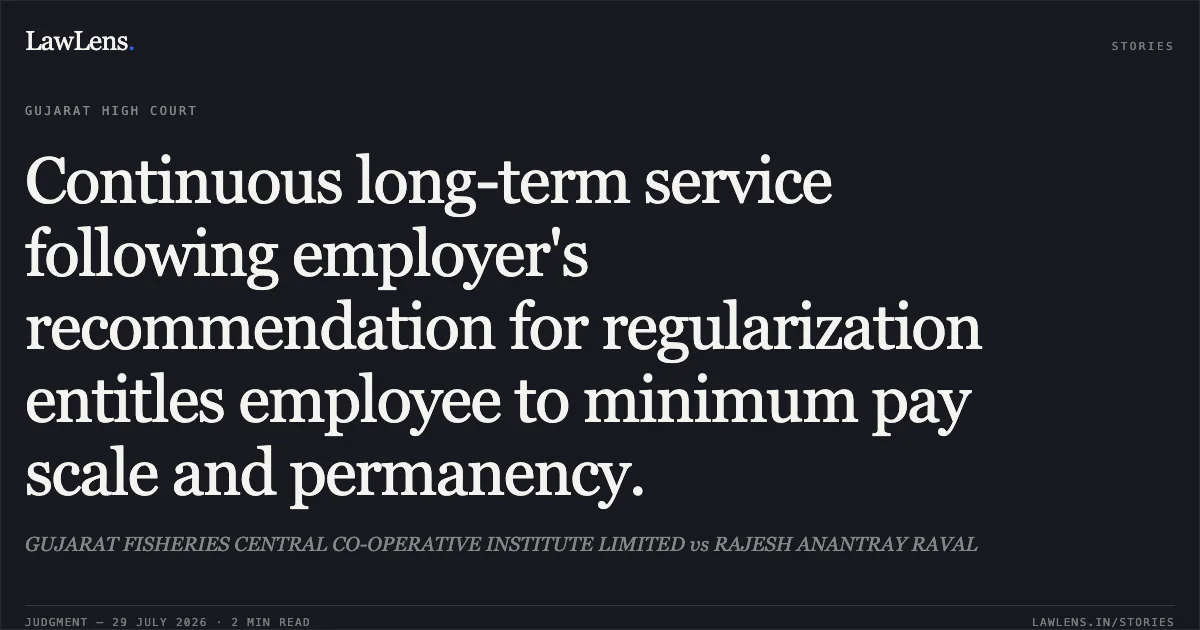
The Court dismissed the appeal, affirming the judgment of the learned Single Judge
It held that an employee who has rendered nearly 25 years of continuous service in a permanent role is entitled to regularization, especially when the employer has formally recognized the merit of such a claim through a resolution
Source reference: para. 9, 13The Appellant was directed to regularize the respondent’s service from June 1, 2016, and pay the minimum pay scale of a Class-III post, with arrears to be cleared by April 30, 2026
Source reference: para. 6, 7All pending civil applications were consigned to record
Source reference: para. 14Original Court PDF
GUJARAT FISHERIES CENTRAL CO-OPERATIVE INSTITUTE LIMITEDvsRAJESH ANANTRAY RAVAL
Click to open original judgment
Original judgment, available to read, download and summarize on LawLens.in


![Subsequent exoneration does not retrospectively invalidate a finalized promotion select list.. UNNIKRISHNAN M vs M/o Environment And Forests. CAT - ['Ernakulam']. LawLens](/stories/thumbnails/subsequent-exoneration-does-not-retrospectively-invalidate-a-finalized-promotion-select-li-ce80a0e84f2f4887857271e8b4341c42.webp)