Facts
On 27.01.2003, the Plaintiff entered into an Agreement to Sell (“ATS”) with Mrs. Joginder Malik (predecessor-in-interest of the Defendant) for the purchase of a residential property in Safdarjung Development Area for ₹2.35 Crores
Source reference: p.2The Plaintiff paid ₹40 Lakhs as part consideration
Source reference: p.3Under Clause 2(b), the balance of ₹1.95 Crores was due by 15.05.2003 or within 45 days of the property being converted to freehold, whichever was later
Source reference: p.3The property was converted to freehold on 09.08.2003
Source reference: p.19Disputes arose regarding the intimation of conversion and demands for 12% interest for delayed payment
Source reference: p.9Mrs. Malik died on 02.03.2004, leaving the Defendant as the sole heir
Source reference: p.2The Plaintiff filed for specific performance in May 2004, alleging readiness and willingness, while the Defendant contended the Plaintiff lacked funds and breached the timeline
Source reference: p.15, 26Issues
1. Whether the Plaintiff was ready and willing to perform his obligations under the contract?
Source reference: p.2, para 2(i)2. Whether the Defendant was justified in rescinding the contract and forfeiting the sum of ₹40 Lakhs?
Source reference: p.2, para 2(iii-iv)3. Whether the Plaintiff is entitled to a decree of specific performance?
Source reference: p.2, para 2(v)Law Applied
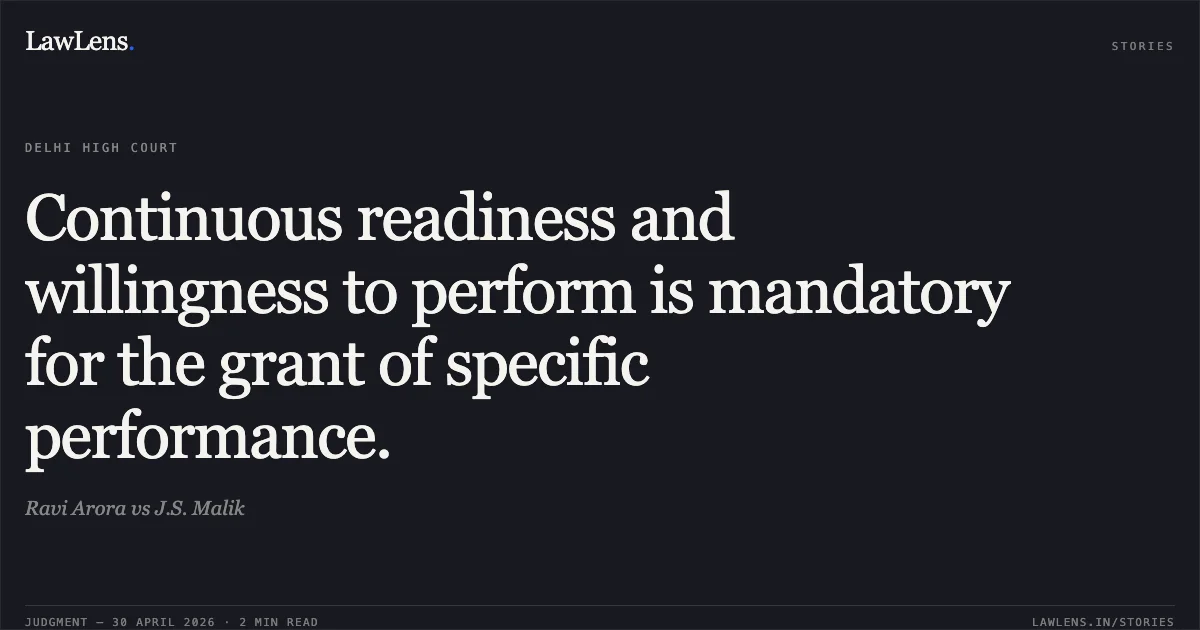
Section 16(c) of the Specific Relief Act, 1963, which requires the plaintiff to aver and prove continuous readiness (financial capacity) and willingness (conduct) from the date of contract until the decree
Source reference: p.33Saradamani Kandappan v. S. Rajalakshmi, which established that in urban properties with galloping inflation, time is increasingly treated as a material factor, and a purchaser cannot use the "time is not of the essence" doctrine to cover laches or lack of readiness
Source reference: p.40-42In the absence of an express forfeiture clause or proof of actual loss, advance money/part-payment cannot be forfeited
Source reference: p.46-47Reasoning
The Court found that the Plaintiff failed to establish "readiness" because he offered the balance consideration in fragmented installments through Pay Orders only starting in 2004, well beyond the 45-day window from the date he admittedly knew of the freehold conversion (07.10.2003)
Source reference: p.37-39Evidence from PW-2, PW-3, and PW-4 revealed the Plaintiff only began seeking loans/funds in early 2004, indicating he did not possess the funds at the contractually stipulated time
Source reference: p.39The Plaintiff’s refusal to pay the 12% interest stipulated in Clause 6(a) for delays evidenced a lack of "willingness"
Source reference: p.39-40While the Court held the ATS was validly rescinded due to the Plaintiff’s breach, it ruled against the Defendant on forfeiture. Since the ATS lacked a specific forfeiture clause and the Defendant admitted during cross-examination that no such clause existed, the ₹40 Lakhs was treated as part-payment rather than earnest money, necessitating its refund to prevent unjust enrichment
Source reference: p.47-48Holding
The Court dismissed the plea for specific performance, holding that the Plaintiff failed to satisfy the mandatory requirements of Section 16(c) of the Specific Relief Act
The Court partially decreed the suit by directing the Defendant to refund the part-sale consideration of ₹40,00,000/- to the Plaintiff. The refund is subject to 9% per annum simple interest, calculated from 22.11.2003 (the date the 45-day performance window expired) until the date of actual payment
Source reference: p.49-50Acts & Sections Cited
2 provisions across 2 statutes referred to in this judgment. Each provision opens on LawLens.
Specific Relief Act, 19631
Indian Contract Act, 18721
Original Court PDF
Ravi AroravsJ.S. Malik
Click to open original judgment
Original judgment, available to read, download and summarize on LawLens.in