Facts
The respondent workmen raised a dispute alleging threatened termination. During the proceedings, the High Court and the Labour Court granted interim orders for the maintenance of status quo.
Source reference: para. 1The Labour Court subsequently found that the workmen had been employed across various posts for over 20 years and directed their regularization.
Source reference: para. 2The State challenged this before a learned Single Judge, who upheld the award, noting that despite the availability of sanctioned posts, the State continued to pay minimum wages, which constituted an unfair labour practice and exploitation.
Source reference: para. 3-4The State preferred these Letters Patent Appeals, contending that the workmen had not completed 240 days of service in every year.
Source reference: para. 5Issues
1. Whether the State's contention regarding the failure to complete 240 days of service is sustainable in light of a 20-year continuous service record.
Source reference: para. 52. Whether the continued employment of workmen on minimum wages for over 20 years despite available sanctioned posts entitles them to regularization.
Source reference: para. 4, 6Law Applied
The court relied on the principles of regularization established by the Apex Court in Vinod Kumar and Ors. v. Union of India & Ors., which distinguished between legitimate regularization and illegal "backdoor entries".
Source reference: para. 3The court also applied relevant Government Resolutions (GR), specifically the GR dated 17.10.1988, which provides a framework for the regularization and benefit-extension for long-serving daily-wage workers.
Source reference: para. 8-9The court invoked the doctrine against "unfair labour practices" and "exploitation" where the State avoids granting benefits of regular employment despite the existence of sanctioned posts.
Source reference: para. 4Reasoning
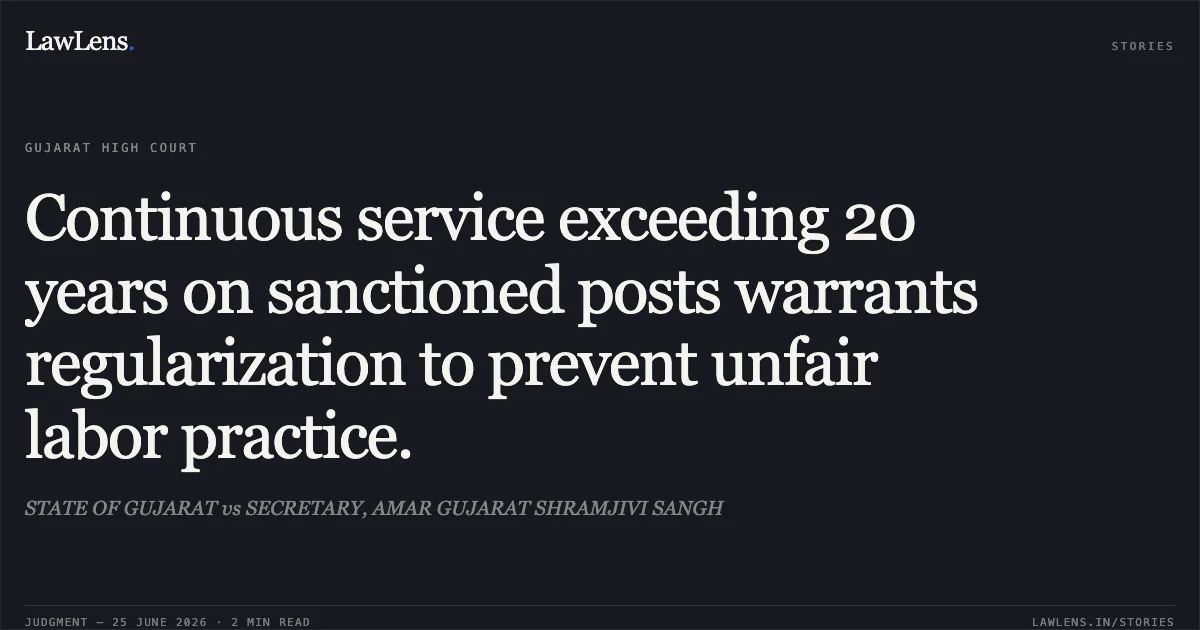
The Court rejected the State’s technical plea regarding the 240-day requirement, holding that the factual finding of 20 years of continuous service rendered such arguments inapplicable.
Source reference: para. 5The Bench observed that the State’s own conduct—specifically the department’s positive recommendation and proposal for regularization during the pendency of the appeal—contradicted its legal challenge.
Source reference: para. 6, 9The Court reasoned that keeping workmen on minimum wages for two decades while sanctioned posts remained unfilled amounted to exploitation.
Source reference: para. 4By proposing regularization under the GR dated 17.10.1988, the department effectively accepted the findings of the Labour Court and the learned Single Judge.
Source reference: para. 8Holding
The Court dismissed the appeals and connected civil applications, finding no merit in the State's challenge.
The Court held that the workmen are entitled to regularization in terms of the GR dated 17.10.1988.
Source reference: para. 8The State Government is directed to accept the department's recommendation and pass appropriate orders for regularization within a period of six weeks.
Source reference: para. 10Acts & Sections Cited
3 provisions across 2 statutes referred to in this judgment. Linked provisions open on LawLens.
Gujarat High Court Rules, 19931
Industrial Disputes Act, 19472
Original Court PDF
STATE OF GUJARATvsSECRETARY, AMAR GUJARAT SHRAMJIVI SANGH
Click to open original judgment
Original judgment, available to read, download and summarize on LawLens.in