Facts
The Applicant and Sinnar Municipal Council entered into a contract on 26 August 2014, with a 24-month completion period.
Source reference: paras. 2–3, pp. 2–3Following delays, the completion date was extended to 31 March 2021, and a completion certificate was issued on 8 March 2021.
Source reference: paras. 2–3, pp. 2–3The Applicant subsequently claimed compensation and other amounts; the Council denied the claims and raised a counterclaim.
Source reference: paras. 2–3, pp. 2–3After withdrawing a writ petition, the Applicant invoked Clause 8 of the contract on 18 December 2025. The Respondents did not appoint an arbitrator, prompting this Section 11 application.
Source reference: paras. 2–3, pp. 2–3Clause 8 provided for disputes to be referred to the Principal Secretary, Urban Development Department, whose decision would be final and binding; it also provided for an appeal and stated that the contractor could not initiate a dispute in court.
Source reference: para. 4, p. 4Issues
Whether Clause 8 constituted an arbitration agreement under Section 7 of the Arbitration and Conciliation Act, 1996, notwithstanding the absence of the word “arbitration” and the description of the named authority as an appellate authority.
Source reference: paras. 20–22, pp. 11–12Whether the named authority’s connection with the Government affected the existence of the arbitration agreement or required appointment of an independent arbitrator.
Source reference: paras. 33–40, pp. 17–20Whether Mumbai or Sinnar was the juridical seat of arbitration.
Source reference: paras. 20, 43–47, pp. 11, 20–25Law Applied
Section 7 of the Arbitration and Conciliation Act, 1996 does not require a particular form of words; the court must determine from the agreement as a whole whether the parties intended a private tribunal to decide disputes and intended to be bound by its decision (*Babanrao Rajaram Pund v. Samarth Builders & Developers*; *K.K. Modi v. K.N. Modi*; *Bihar State Mineral Development Corpn. v. Encon Builders*).
Source reference: paras. 22–25, pp. 12–13A clause providing for disputes to be referred to a named officer for a final decision may constitute an arbitration agreement even if it does not use the term “arbitrator” (*Chief Conservator of Forests v. Ratan Singh Hans*).
Source reference: paras. 26–27, pp. 13–14Finality alone is insufficient; the whole procedure and the parties’ intention must disclose adjudication rather than administrative fact-finding (*South Delhi Municipal Corporation v. SMS Ltd.*).
Source reference: paras. 27–30, pp. 14–16Ineligibility of a named arbitrator under Section 12(5) read with the Seventh Schedule is distinct from the existence of the agreement to arbitrate and may be addressed by appointing an eligible, independent arbitrator.
Source reference: paras. 33–37, pp. 17–19The seat is determined from the parties’ agreement and intention; the place where the contract was signed or work performed does not, by itself, determine the arbitral seat (*BGS SGS SOMA JV v. NHPC Ltd.*).
Source reference: paras. 43–46, pp. 20–24Reasoning
The Court read Clause 8 as a complete dispute-resolution mechanism: disputes were to be referred compulsorily to a named authority for a decision, an appeal was provided for, the decisions were stated to be final and binding, and recourse to court was restricted. Taken together, these features indicated an intention to provide binding adjudication, rather than mere administrative supervision or mediation; the absence of the word “arbitration” and the “appellate authority” label did not alter that conclusion.
Source reference: paras. 26–32, 38–42, pp. 13–20The Court treated any ineligibility of the named authority as a separate issue concerning the person who would perform the arbitral function, not the existence of the agreement.
Source reference: paras. 33–40, pp. 17–20For the seat, it found that Mumbai was expressly connected in Clause 8 with the authority to whom disputes were referred, whereas Sinnar was only the place of contract execution and work performance; those circumstances did not establish Sinnar as the seat.
Source reference: paras. 43–47, pp. 20–25Holding
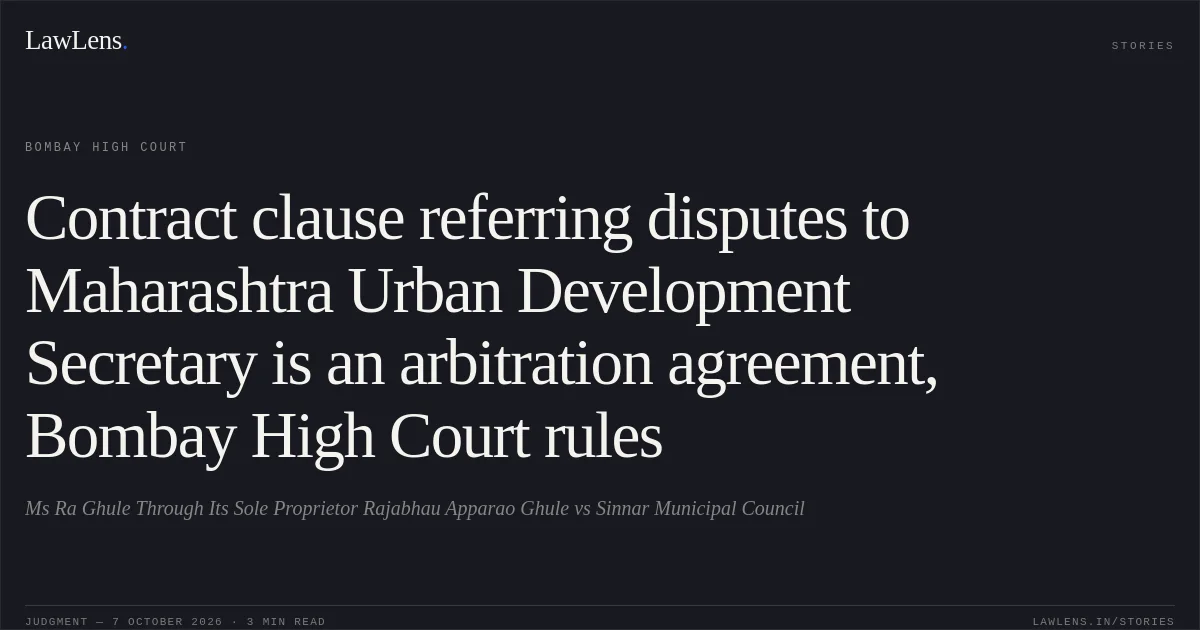
The Court held that Clause 8 contained a valid arbitration agreement and that Mumbai was the juridical seat of arbitration.
It allowed the Section 11 application and appointed Justice Avinash Gharote (former Judge) as sole arbitrator.
Source reference: paras. 48–50, pp. 25–27The parties were directed to bear the tribunal’s costs and fees equally in the first instance, subject to the final award; their merits contentions were kept open.
Source reference: paras. 48–50, pp. 25–27Acts & Sections Cited
3 provisions across 1 statute referred to in this judgment. Each provision opens on LawLens.
Arbitration and Conciliation Act, 19963
Original Court PDF
Ms Ra Ghule Through Its Sole Proprietor Rajabhau Apparao GhulevsSinnar Municipal Council
Click to open original judgment
Original judgment, available to read, download and summarize on LawLens.in